90
After the First Thanksgiving
In progressIn November 1622, the great diplomat Squanto died while leading a trade expedition with his English allies. Only a year had passed since he formed a treaty between the Pilgrims of Plymouth and the indigenous Wampanoag people. While the early years of English-Indian relations were marked by cooperation and accommodation, including the famous Thanksgiving feast, Squanto's passing marked a descent into a period of slowly ramping hostilities, culminating in the first war fought between English settlers and Native Americans.
This episode of Gladio Free Europe explores the continuing history of colonial New England, across the 1620s and '30s as the English population rapidly swelled, in large part due to the establish of the new Massachusetts Bay colony which would quickly overshadow Plymouth and the original Pilgrims. While the Pilgrims and Puritans maintained warm relations with some native peoples, such as the great Mohegan chief Uncas, competition over land and resources drew them into conflict with others.
Though little known today, the Pequot War would have particularly grave consequences on English-indigenous relations, as it set the precedent for mass slaughter of Indian women and children and ended with the enslavement of the entire Pequot nation. Massachusetts and Connecticut are not remembered as slave societies, but captive Native Americans formed an essential role in the colonial economy and helped normalize the institutions of slavery and racial segregation across the English colonies.
Listen to understand how the peace of the First Thanksgiving collapsed into the bloodshed and subjugation that defined the American colonial experience, and try to uncover how the consequences of this turn towards violence shaped our country for the worse for centuries to come.
Transcript
Back to New England
Hello and welcome to Gladio Free Europe. I am here with the incredible Russian Sam.
Hello, hello.
And we are back. I know we had a short delay and I'm very sorry about that, but we have been working on some really cool content. Particularly a few episodes about colonial New England, picking up where we left off last year when we talked about the broader context of the first Thanksgiving. Over the past couple months, I've been reading a fair amount about early American history, which has not really been my forte up to this point. And one thing that really struck me is the centrality in so many eras of American history of New England. So I thought that it could be really interesting to go back into this period, specifically looking at how the world of the Pilgrims transformed into the world of the Boston Tea Party 150 years later. I think that in a lot of ways, New England can be understood as kind of the most American part of America.
The Pilgrims might not have been the first colonial venture of the English in the Americas, but I think that theirs was the one that set the tone of American society and American culture in the most important ways. Looking forward, a lot of really important transformations in American society, like the spread of education, abolition, industrialization, would all happen out of New England. This was the home of John Adams, Samuel Adams, Horace Mann, all of these really intriguing figures. And I think that if we want to understand New England as this engine of American history, we gotta go back to the beginning, after the first Thanksgiving. In this episode, we're going to go over the middle of the 17th century in New England, looking at events like the Pequot War, leading toward the much more deadly King Philip's War. These would see great transformations happen to colonial New England society.
And I think that to begin, we should look at the first great transformation of the world of the pilgrims that we described in our previous episode.
The death of Squanto
So let's go to 1622, a year after the first Thanksgiving, when the great Tisquantum lay dying. He's better known to English speakers as Squanto, but just a very remarkable man. Can't get around that fact. He lived one of the most exceptional lives of the 17th century.
So just to refresh everyone's memories, he was a warrior from the Patuxet tribe of Massachusetts, possibly a pniese, who were sort of the knightly class. He was captured as a young man by English explorers around 1614, and he was brought across the Atlantic, first over to Spain, and then after being miraculously rescued from slavery by a bunch of Spanish priests, he ultimately made his way over to England, where he lived for some time in the home of a London merchant and informed prospective colonists about the life in the New World. Eventually, he was able to secure passage back to his home country in 1619, only to find that his entire community had been wiped out by disease. Across 1620 and early 1621, he became a captive of the powerful paramount sachem or chief called Ousamequin, also known by his title the Massasoit. This was the leader of the Wampanoag people, one of the many political confederations that were present in this region, which, again, to remind our listeners, had a bit of a structure not dissimilar to the heptarchy, where you had all of these different competing chiefdoms, sometimes allying with one another, sometimes warring with one another in an attempt to define these constantly shifting boundaries.
So the Massasoit, he was the leader of the Wampanoag people, and when Squanto returned, there was a whole hullabaloo with the circumstances of his return. But long story short, he became a captive of the Massasoit. There was another captive being held by the Massasoit at this point.
Samoset and the first treaty
This was a man named Samoset from the Abenaki people who lived up in Maine, who also had their encounters with the English. And Samoset, because of this, learned a bit of the English language. Less than a year after his return to New England, Squanto learned that a group of English people were attempting to permanently settle in New England in the exact same Patuxet territory where he grew up. And so, in one of the most incredible moments in early modern history, after deliberating about the proper course of action, the Massasoit decided that he would make contact with the newcomers. He sent out Samoset to visit the pilgrim's village and to assess their intentions. Famously, he wandered into the Plymouth colony and declared, Welcome, Englishmen, and asked them if they have any beer to share with him. We spoke in our previous episode about how the arrival of this man was a genuine miracle to the Puritan settlers.
Squanto was dispatched to Plymouth as well after Samoset made first contact, after which point the Massasoit saw fit to make an appearance. The incredible grace and generosity showed to the newcomers, particularly by Squanto, helped to ensure the survival of the Plymouth colony and had huge implications on the course of American history. Because initially, the English were very few in number compared to the Wampanoag and the neighboring tribes like the Pequot and the Narragansett, that they weren't considered an existential threat, unlike these other tribes, which in the context of these constantly shifting boundaries could pose a threat to the power of the paramount sachemship of the Wampanoag, the Massasoit. So Squanto helped to negotiate a trade and protection pact between the Massasoit and the Puritan leader Edward Winslow. As recorded in the Pilgrim sources, it stipulated that the natives would do nothing to harm the pilgrims, and that those who commit harm would be given over to pilgrims for legal proceedings.
That both sides would return stolen property, that there would be a mutual defense pact, and that Massasoit would send other sachems to make an agreement that natives visiting English settlements must disarm before entering, and that, quote, lastly, that doing thus, King James would esteem of him as his friend and ally.
A treaty lost in translation
Yeah, yeah, there are really a number of problems with this treaty because it survives to us only in the pilgrim's version, and the linguistic difficulties really shouldn't be overlooked. None of the pilgrims had time to learn the local languages, and very few of them ultimately would. And at this point, Samoset and Squanto's English was still rusty. It's probable that both sides went away from the encounter with different ideas of what they had agreed to. It seems unlikely, for instance, that the natives would agree to not harm the English without a stipulation giving them the same guarantee. The extradition clause was never successfully implemented, and in fact, attempts to do so would be one of the triggers for King Philip's war. And it was already the custom of the natives to disarm before entering another town, unlike the English, who continued to brandish arms during negotiations and would continue in this custom because, as they explained to the natives, it was a sign of honor in their culture.
This idea that you're being greeted by the armed warriors of another culture, which I mean, yeah, fair enough. It's, I guess, a matter of interpretation. But nevertheless, this did make the Wampanoag uncomfortable, as well as the other Algonquin tribes. But the last clause is particularly problematic and subject to interpretation, because what would it mean for the Massasoit to be considered a, quote, friend and ally by King James? Did the pilgrims even have the authority to make such a claim in the first place? This would become a thorn of contention when the balance of power shifted to favor the English in the region, and even contemporaneously, some settlers interpreted it to mean that the Massasoit had agreed to become an English vassal. But despite such questions, Massasoit walked away from the encounter pleased. But not everyone was convinced.
Right. So across the next several months, warm relations were maintained between Plymouth and the Wampanoag, eventually leading to the highly mythologized but only faintly attested first Thanksgiving. But the pact was very flimsy. Language barriers meant that neither side was ever really certain that the other understood them and that they were acceding to terms that they wanted. Perhaps more importantly, Massasoit quickly learned that Winslow actually had no authority over the other English people who may still be active in the Americas, including those avaricious kidnappers who had taken Squanto. Massasoit himself only had limited control over the entire Wampanoag people, because the Paramount Sachem had more influence than actual coercive power. At any moment, an upstart minor sachem could threaten to take his place.
Corbitant's challenge
And in 1621, this minor sachem was a man named Corbitant.
Yes, Corbitant was a sachem of the Pocasset sub-tribe and was uneasy with the Massasoit's alliance with the Puritans. He might have correctly recognized the existential threat that those Englishmen posed to the Wampanoag way of life, or it may have been that he was looking for a chance to seize power, or maybe it was a little bit of column A and a little bit of Column B. But in any case, he made the bold move of reaching out to the Wampanoag's enemy, the Narragansett, possibly to form a secret alliance to overthrow Massasoit. The pilgrim leader Edward Winslow described the situation in his pamphlet Mourt's Relation, thus. Corbitant, quote, sought to draw the hearts of the Massasoit subjects from him, speaking also disdainfully of us, storming at the peace between the Wampanoags and us, and at Squanto, the worker of it. Corbitant had personally led a band of warriors to the village of Namasket, where Squanto and some of his allies were staying, and took them hostage with the intent of killing them.
In Winslow's words, Corbitant recognized that, quote, if the Squantum were dead, the English had lost their tongue. One man named Hobbamock managed to evade capture, but he saw Squanto being held at knife point. Fearing for the worst, he ran to Plymouth and told them that Squanto had been killed by Corbitant. A party of ten Englishmen, led by Miles Standish, were dispatched, and they broke into Corbitant's village, discovering to their relief that Squanto was still alive. The pilgrims would spend the remainder of 1621 developing their settlement and cementing ties with the Wampanoag, especially because of common fears of their rivals, the powerful Narragansett. Hoping to intimidate the much more numerous natives, the pilgrims had to bluff prodigiously, and many would try to test boundaries. This was a really important element of local hostilities because the natives had a large repertoire of antagonistic actions they could take without resorting to warfare.
And the English wouldn't understand this for quite some time.
Yeah, they were basically psyoping each other all the time over there.
Yeah. Rumors played a really important role in negotiations and communication. And there are many points like the Corbitant episode where rumors of impending hostilities would be circulated in an attempt to have better terms in negotiation without having to actually take up arms.
Right. There are many points like the Corbitant episode where rumors of impending hostilities would be circulated in an attempt to acquire better terms and negotiations without having to actually take up arms. Some of our listeners might recognize this as a form of what Dennis Reynolds calls the implication. That is, nothing bad's going to happen. Things will go well. The other party will do what you want because of the implication of what happens if they don't comply.
The snakeskin and the arrows
Right. And so by early 1622, about four months after the first Thanksgiving, the Narragansett leader, Canonicus, approached Squanto and gave him a message to deliver to the English. It was a snakeskin wrapped around a bundle of arrows. Squanto was sure this was a threat, and his English allies responded in kind, filling the snake skin with gunpowder and sending it back. Canonicus was apparently either unnerved or impressed enough that he then sent this snake skin around to various other tribes like a game of hot potato before it eventually made its way back to Plymouth.
Yeah, yeah, one of the interpretations I saw of this was that the natives they made the association between gunpowder and plague, so in their minds it was kind of linked. They thought that this might be the way that plague is transmitted.
Yeah, it kind of makes sense. It also explains why they were so eager to get their hands on guns, even though at this point guns weren't a very good weapon in and of themselves. They had more of an intimidation value rather than as actual, you know, weapons of war. Speaking of intimidation, the English managed to keep their cool during this whole affair with Canonicus, and they proceeded with a trade expedition headed by Miles Standish, only to encounter one of Squanto's last remaining relatives with a bloodied face, who warned them that the Narragansett had suddenly joined hands with both Corbitant and the Massasoit and were preparing to strike Plymouth. Squanto's ally Hobbamock was asked about this and he assured the English there was no real plot. It was just a rumor. But even though the trade expedition was completed without any further hiccups, this would lead to some new tensions between the pilgrims of Plymouth and really all Native Americans, not just the Narragansett.
Squanto's death
Right, and so after this scare, it seemed that the peace would prevail, but any peaceful relations between the pilgrims and the Indians, including both the friendly Wampanoags and the more dangerous Narragansett, entirely rested on the skills and apparent beneficence of Squanto. And to the great tragedy of all, by November 1622, Squanto was aboard an English ship, dying of an unknown disease. William Bradford recalled in Of Plymouth Plantation, quote, Squanto fell ill with Indian fever, bleeding much from his nose, which the Indians take as a symptom of death, and within a few days died there, desiring the governor to pray for him, that he might go to the Englishman's god in heaven and bequeath sundry his things to his English friends as a remembrance of his love, of whom they had great loss. And this sudden death was a massive blow to the pilgrims who now found themselves in very uncertain waters.
Could this have been foul play? On the one hand, another wave of colonists that summer had introduced a new wave of disease into the region, which indeed killed many people. But on the other hand, to me personally, it seems unlikely that Squanto, who had been among Europeans for close to a decade at this point, would not have been exposed to these diseases earlier.
Yeah, no, it's true. It is. It's odd because remember, because remember, not only had he been living in Plymouth for a year, he had been in Spain for several years and then in England for probably another full year. So you would have thought that, yeah, he might have gotten something earlier. So this basically means that the timing was suspicious enough, because this came after the antics of Squanto and his relative nearly wrecked relations between Plymouth and the Wampanoags, that some people thought this could have been some deliberate poisoning by either the Massasoit or another native leader who distrusted him.
Was Squanto a schemer?
Because while Squanto appears basically saintly from an English perspective, even described by Governor William Bradford as an instrument of God, others, particularly many Native Americans, were more ambivalent. Edward Winslow penned a second pamphlet called Good News from New England, which picks up right about where Mourt's Relation ends, and that provides some really interesting insights into early colonial attitudes about Squanto and the Native Americans more broadly.
As a Puritan, Winslow believed that the religion of the native was a form of Satan worship, but he was not without great sympathy for them as a whole. At least, that's the way I took it. He took great care to describe their ways, and he would even mastered their language ultimately. But again, although he saw their religion as devil worship, it should be highlighted that this wasn't really a matter of dehumanizing them, as would be the case later. In fact, I bet he had much more fiery invective to give against the Catholics rather than these natives who are just unfamiliar with Christianity to court, and consequently they have an excuse, unlike the papists who are, you know, actively inverting the word of God.
Right, right. And I think also the idea is that even if the Native American religion was viewed as Satanism, a lot of Puritans saw the natives as victims of Satan, not agents, which is kind of interesting. And, you know, of course, we also should mention here that we're getting ahead of ourselves, but this obsession that Satan could be everywhere in New England would have very important implications for the witch trials of later, of the later 1600s.
Right, but getting back to Winslow, his pamphlet begins by condemning the earlier English explorers who had preyed on men like Squanto, and he complained that even many prospective settlers in the region were, quote, the image of men imbued with bestial diabolical afflictions, which hampered missionary efforts that some pilgrims actually saw as their primary goal. But speaking on Squanto directly, Winslow's assessment was much less flattering than Bradford's. To quote from him again, thus by degrees, we began to discover Squanto's ends were only to make himself great in the eyes of his countrymen by means of his nearness and favor with us, not caring who fell, so he stood. In the general, his course was to persuade them that he could lead us to the peace or war at his pleasure and would oft threaten the Indians, sending them word in a private matter that we were intended shortly to kill them, and thereby he might get gifts to himself to work their peace.
Right. The idea is that he was just in it for himself and that he was, you know, stirring up trouble between the pilgrims and the natives just so he could take credit for stopping a war. It's kind of a funny, very kind of modern, I think, perspective on him.
Yeah, and I mean, Winslow goes even longer than that. The passage is quite lengthy, so we had to truncate it a bit. But he's basically saying in this passage that he thinks that Squanto is actively trying to subvert the rule of the Massasoit so that he could take his place. So that just gives you an idea of the political environment of this region at the time. You have people like Corbitant, you have people like Squanto, and all of them are trying to do their little tricks and schemes to end up on top.
Right. And I think that unfortunately for Squanto, he might have been at a disadvantage as a schemer because he was essentially a foreigner in this society. He was not a Wampanoag, you know, he was from the Patuxet tribe that basically no longer existed. And so this meant that not only was he never fully trusted by many Englishmen like Winslow, he was never fully trusted by many native peoples either. I think that the fact that he was an orphan is really essential because this personal tragedy made him an unknown quantity in a society basically defined by kinship. Even the Massasoit regarded him with suspicion, and it's hard to know how voluntary his relationship with the Massasoit was because it began with captivity. And, you know, captivity leading to indefinite service, possibly slavery, is going to be the focus of the second half of this episode.
Right. And all of this is to say that even though Squanto was absolutely essential to maintaining good relations between the settlers and natives, there were those on both sides who are not particularly sad to see him go. Not long before his death, the Massasoit had demanded Squanto's head because of the perceived scheming in the Narragansett scare that we described earlier. The pilgrims refused to surrender him, so it's not impossible to believe that the Massasoit could have ordered his poisoning some months later, if that's indeed happening. But again, we just want to highlight that this is purely speculation because so much time has eclipsed. We have no way of knowing what exactly went down. What we do know is that the death of Squanto was this great symbolic turning point in the history of New England. Because while natives and settlers would live side by side in New England for hundreds more years and still do in a sense, the period after 1622 transformed the relationship between natives and white settlers, generally leading towards increased hostility and conflict.
And eventually, by the 1630s, the realization that the English were gaining the upper hand.
New Amsterdam and Massachusetts Bay
I think that the most important factor here was actually not anything that was done by the pilgrims of Plymouth, but instead the arrival of other whites, not just from other parts of England, but even from other European countries. Because in 1624, 30 Dutch families landed at what is today New York City, then of course New Amsterdam. Colonial director Peter Minuit famously purchased the island of Manhattan from a group of Lenape people for 50 guilders, which is about $1,000 today. This meant that peoples like the Wampanoag, Narragansett, and also the Pequot of Connecticut now had a new colonial entity to reckon with on the other side of their territory. Plymouth colony continued to grow due to its pretty fast rate of natural reproduction as well as the arrival of new settlers, but after 1628, the real game in town was Massachusetts Bay, because a new group of English Puritans founded their own colony of Massachusetts, which was legally separate from Plymouth and much larger.
And then things really took off in 1630 when a ship called the Arbella, led by Governor John Winthrop, headed an entire naval flotilla bringing 700 colonists, thus immediately tripling the English population of New England.
The Massachusetts Bay Puritans had some slight religious distinctions from the Pilgrims, who actually did not call themselves Puritans. The Pilgrims were identified as Puritans later by historians. And while Pilgrims were mostly from central England, especially this small town called Scrooby, the Puritans were mostly from East Anglia. And the great tome of modern colonial cultural history, Albion's Seed, goes in great length about the ways that the particular regional habits of East Anglia would go on to define the culture of New England. It's pretty interesting. It's a real doorstopper, but it's a good book to check out. But possibly because of ideology or simply their large numbers, Massachusetts Puritans were much more able to influence the politics and ways of life of Native Americans, slowly leading toward a relationship that was much less equal than what existed between the pilgrims of Plymouth and the Wampanoags. Of particular interest was spreading Christianity.
The official logo of the Massachusetts Bay Company that started all this was a drawing of a Native American with a speech bubble saying, Come over and help us.
Yeah, so the Massachusetts Bay Puritans had a much more utopian religious vision. The idea was to be a religious and moral model for other Christians, in particular fellow English Protestants who they believed had fallen for Catholic idolatry, like the Anglicans who dominated Virginia hundreds of miles away. So by the end of the 1630s, the original colony of Plymouth was completely surrounded and outnumbered by the thousands of Massachusetts settlers. Unlike the small wild villages of Plymouth, the Massachusetts Puritans built real towns like the ports of Boston and Salem. The first one was named after the East English town where many Puritans had departed from, and second one from Jerusalem in the Bible.
"We are the saints"
To quote from historian Alan Taylor, quote, Puritans insisted that the Christian God meant for them to enjoy the land in reward for their godly industry and to punish the Indians for their pagan indolence. John Winthrop explained, quote, As for the natives in New England, they enclosed no land, neither had they any settlers' habitation, nor any tame cattle to improve the land by, and so have no other but a natural right to these countries, so as so as if we leave them sufficient for their use, we may lawfully take the rest. The colonists appointed themselves to judge just how much land the Indians needed, which shrank with every passing year. The resolves of the town of Milford in Connecticut in 1640 were particularly blunt. Quote, voted that the earth is the Lord's and the fullness thereof, voted that the earth is given to the saints, voted that we are the saints.
Wow, that's very presumptuous.
No, very much so.
And you know, you know, the big point of Albion's Seed is that there's this through line from colonial Puritans to the 19th and 20th century of American history. And I do think that you kind of see the smallest grain of Mormonism in that line there.
Oh, yeah.
Toward the Pequot War
All right, so basically, Massachusetts Bay grew really, really fast, both due to immigration and an incredibly high rate of natural reproduction. This meant that suddenly Puritan and really English life in New England was no longer defined by the more conciliatory Puritans of Plymouth, but by the somewhat more bellicose and much more ambitious Puritans of Massachusetts. Across the 1630s, tensions between settlers and Native Americans led to the short but shockingly brutal Pequot War, probably the first open conflict between English settlers in New England and native peoples. It doesn't get as much attention as the later and much bigger King Philip's War of the 1670s, but this was a hugely transformative event in its own right. Not in the least because the end of this war caused hundreds of captives to essentially suffer a life of slavery in English towns, really altering the course of American labor history and the formation of racial hierarchies in the American colonies.
The lay of the land
So, before we talk about the Pequot War, though, and its consequences, I think let's do a little bit of a lay of the land here. We previously described the tribes that were around in the 1620s. Now that we're in the 1630s, we kind of want to take a step back a little bit and look at the broader region of New England and the Atlantic seaboard. So, the biggest tribes in coastal New England were the Wampanoag and the Narragansett, who we've mentioned before. The Narragansett actually surrounded the territory of Plymouth, which meant that there was no way to get from Plymouth to Massachusetts by land without crossing through Narragansett territory. That led to some tensions there. It also meant that, you know, because they were surrounded on all sides by Indians, the peoples of Plymouth, even into the 1640s and 1650s, had to be a little bit more conciliatory than the Puritans could be.
Going down to the west into Massachusetts and Connecticut, you've got the Wampanoags as well as the Pequot people, mostly in Connecticut. And the Pequot people in this time were involved in a violent conflict with a group known as the Mohegans, who seem to have started out as some kind of a sub-tribe of the Pequots, but were quickly separating away, largely due to the efforts of a very interesting figure named Uncas, we're going to talk about in this episode.
Yeah, and that's a really interesting phenomenon because, again, when, like, this is why people prefer to talk about sachem ships rather than tribes, because when you hear tribe, you think of this like primordial ethnicity type thing where yes, like these people just always exist. But here with the Pequot and Mohegan split, we see that this is a result of actual political machinations.
Totally. You know, we talked about this way back in the early episodes of Gladio Free Europe in one of our episodes about ancient Germanic-speaking tribes. But there's this assumption that a tribe must be some kind of, you know, clan-based ancient line of descent, when in fact, a tribe or a clan or whatever often can be a political unit, not an ethnic unit. And that's very important to keep in mind.
Yeah, and just in general for keeping track of this region, because again, when the English first landed in New England, there were six major tribes, but again, there's no way of telling what exactly was the way of the land before they came. So we don't even really know where these tribes would have existed or even if the same tribes existed at all, even like 20 years before the arrival of the Panama.
And so if we move even more south and west of the Pequot territories of Connecticut, we get into New York, which then of course was New Amsterdam. So it was a colony of the Dutch, although, however, Long Island was actually English at this time. And eastern Long Island had a few important Puritan English settlements. And then outside the boundaries of Dutch New York were the fearsome Mohawk people. The Mohawks were in fact the eastern flank of the Iroquois Confederacy that dominated the Great Lakes, stretching up into Canada. Traditionally understood as defenders of the Confederacy from eastern tribes like the Wampanoag and the Narragansett, the Mohawks had a very long history of warriors. They kind of remind me of the marcher lords you see in medieval Europe, who have such a long history of low-level conflict with their neighbors that they take on kind of a more martial lifestyle in general.
The Mohawks were known to extort other groups for tribute in slaves, in food, to the extent that apparently many Mohawks were full-time warriors who did no farming at all. They simply relied on other tribes to basically act as their serfs. It's very interesting and kind of unfortunate relationships.
Yeah, very Spartan dynamic almost.
It is, yeah, yeah, very much so.
John Stone
All right, so now that we know the players involved, let's talk about the Pequot War. I'm just going to say, before I read the book Brethren by Nature, I had never known anything about the Pequot War at all, but now I'm realizing it is really one of the most important conflicts in early American history. It is just so transformative, largely because, as we'll talk about, it provided English white settlers with slave labor for the first time in New England. But to explain how that slave labor was acquired, let's see how the war that justified it started. So it was a big war with very small beginnings. It began as retaliation against the Pequot people for the killing of white fur traders. Interestingly, these white fur traders were actually killed by the Pequots, not because of any conflict with the English, but because of the conflict with the Dutch.
Because a guy named John Stone was accused in 1634 by the city fathers of Boston of a litany of crimes, including drunkenness, adultery, and even piracy. We mentioned that the Puritans lived by an incredibly strict moral code, so personal behavior was very strictly prohibited. Any white colonists who violated these norms, including transgressions as small as simply being an unmarried man or being an unemployed man, would be given the choice to either accept indentured servitude or exile. This guy, John Stone, chose exile, so he initially left Boston for the West Indies. Massachusetts and the Caribbean might seem like worlds apart today, but in the 17th century, the small handful of English colonies scattered across the Atlantic were pretty interdependent. They really relied on each other for shipments of food, of money, and really any kind of goods and wealth. They were always trading with each other. Ships going from Old England to New England typically took a circular route that brought them down into the tropics, where they'd restock at English colonies like Barbados, as well as a short-lived Puritan settlement called Providence Island off the coast of Honduras.
This guy, John Stone, he was probably involved in the early rum trade, which used the sugar cultivated on the island. The first record we have of rum actually comes from a Massachusetts law banning the sales of quote Barbados spirits. He may have witnessed the beginning of African slavery in the colonies. Just like the Spanish a century earlier, the English colonists in the Caribbean forced the indigenous Arawak people to work the sugar fields. But the absolutely inhumane conditions of the early plantation economies, paired with European diseases, caused most of the indigenous peoples of the islands to rapidly die off. Many others, given their knowledge of the local landscape, fled into the hills and caves of the island, which were free of European control. The practical the practical concerns, as well as a misguided sense of humanitarianism, caused the Spanish to move from indigenous servitude to African slavery, and the English would themselves follow suit in this.
Right. John Stone probably learned that in the 17th century, the dealing of slaves and servants was a difficult business because of restrictions on trade between the English and Spanish colonies. The slavery present slavery presented a problem for the early modern merchants for the simple reasons that slaves are people, no matter how hard the enslavers would try to deny their humanity. Which means that while slaves generally had no rights as we would understand them today, all slaves were political agents and political subjects. There was a fear that the slaves purchased from Spanish colonies would be the rightful legal subjects of the king of Spain, especially because many slaves in the 17th century were not African but indigenous to the Americas. What this meant was that any merchant of low moral character, like John Stone, would be best off capturing and selling Native Americans from the land surrounding the English colonies.
It helped that, unlike the Spanish, the English crown offered no protections to the Native Americans at this point.
And so this means that in around 1635, John Stone returned to Massachusetts illegally, where he joined a group of Dutch traders who sought to go into the Pequot territory to raid for slaves. What he didn't know was that these Dutch traders he was joining with had had a long feud with the Pequots over the alleged killing of a Pequot Sachem several years earlier. So this meant that eventually they did manage to get into Pequot territory. They captured two Pequot men and told them to lead them to their village. They thought that they would have the element of surprise that they could capture a whole bunch of Pequots to take slaves. Instead, these two men led the Dutch and John Stone into an ambush where they were all immediately, and I would say, pretty rightfully killed.
Yeah. Yeah, so many Puritans in Boston actually cheered on the killing of this infamous apostate and all-around terrible person. But because Stone was a citizen of the colony, the government insisted that the Pequot nation pay reparations for his killing. The Pequot said that his killing was an accident because they thought he was Dutch and not English. And to make matters even worse, they refused to identify which men among the Pequot had caused the ambush. So again, this idea being originally that there would be extradition between the English and the various native nations in the case of crimes, which was always a very tricky subject because no one was particularly keen on giving up their own people to these foreigners to be tried under foreign laws.
Totally. And also, I do want to underscore here, though, that I completely agree that this is a really interesting sticking point, but it also shows that the English were still basically working in a largely indigenous-dominated legal system. You know what I mean? Like, New England was not theirs to dominate. Like, they had to work with the Native Americans' rules, even if they didn't agree with them. I'm at this point, at least.
Yeah, no, yes. Well, basically, as we're going to see, after this war, and particularly after King Philip's War, that would completely change. But the balance of power has not yet completely tipped into the English favor. Yeah, this war was also notable because it was the first time you saw a confederation of all these different English colonies coming together for the purpose of war. Up until this point, this was a massive sticking point because they all wanted to maintain their autonomy. But when this war broke out, they finally saw that they needed to have some kind of overarching organization to make sure that they're all fighting on the same side, which helped to clarify the strict boundaries between native and English.
Block Island
Right, and so very shortly after the killing of John Stone, another Puritan exile, a guy named John Oldham, was also killed by Indians from an unknown background. However, it was on an island, they knew what happened on a place called Block Island in Rhode Island, and whoever killed him then retreated to Pequot territory. And once more, Pequots refused to surrender whoever killed this guy. This is where the war really began. So a small army of Englishmen traveled to Block Islands to take revenge, but they discovered that the island's native inhabitants had mostly escaped. They destroyed whatever buildings they could find, killing at least one Native American in the process, and then learning that where the people who had killed John Oldham had gone, which was Pequot territory. An army of 100 Puritans was then assembled to attack Pequot villages, killing an unknown number of people. In response, the Pequots immediately besieged English forts in Connecticut, capturing any settler who strayed outside.
Initially, it seemed that the Pequots probably thought they had the upper hand because it seemed initially that, you know, it was just them versus this small number of English people. But then the Pequots realized that actually the white settlers would not be their only enemies in this war.
Uncas and the alliance
Right, because not unlike the start of World War I, this outbreak of war between the Puritans and the Pequots activated a very complex chain of alliances and reignited ethnic tensions that had existed since long before the colonial era. This meant that the English had unexpectedly two powerful allies. The first were the Narragansetts, who had previously been the enemies of the Pilgrims of Plymouth, but trusted the English more than they trusted the Pequots. And second were the Mohegans, who any listeners from the tri-state area might recognize as the present-day owners of the closest casino to New York City, the Mohegan Sun.
Yeah, and so, yeah, an ambitious Mohegan sachem named Uncas was really instrumental in bringing these alliances together and forming this coalition of Native American tribes and all of the Puritans, kind of working together to fight the Pequots. They all had various reasons for not liking the Pequot people of Connecticut, and they quickly realized that the Pequots were completely surrounded. Interestingly, Uncas also, during this war, allowed some English settlers to permanently live in Mohegan territory. And the town that these white settlers built is called Uncasville. It still exists today, and it is in fact the location of that casino you mentioned.
The Mystic Massacre
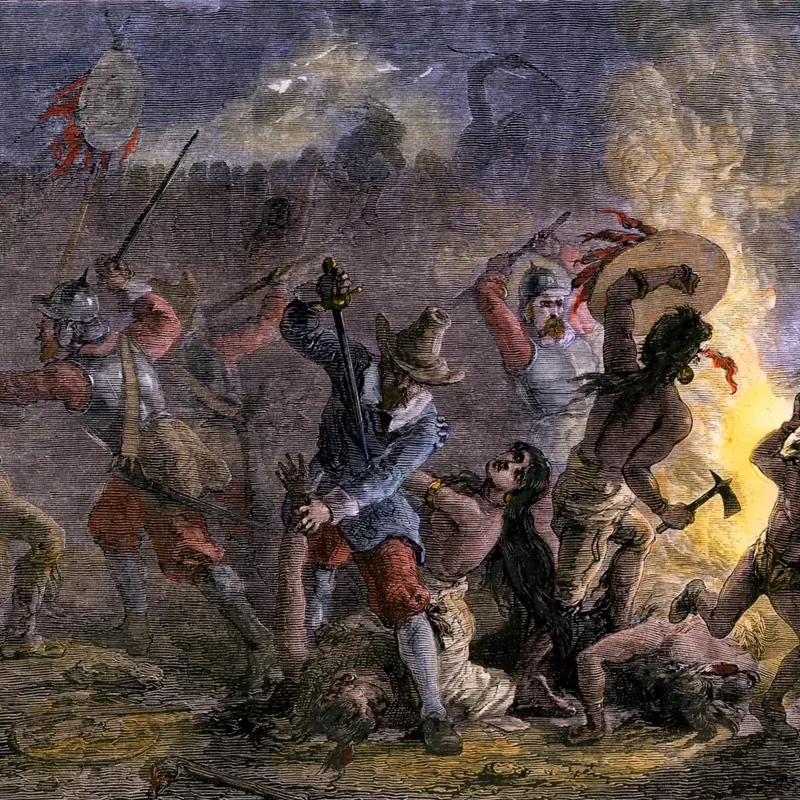
Right, so in the spring of 1637, a trinational force of English, Mohegans, and Narragansetts under Uncas and John Mason led an attack on a walled Pequot village known as Mystic, which was located in the Connecticut swamp. By early colonial standards, this was a huge battle with hundreds on both sides. When the Puritans and their allies were unable to break through a wall by the traditional means, John Mason came up with a brutally effective solution, which shocked both Englishmen and Indians under his command. Instead of trying to attack the town and claim it for their own, they would just burn it down with all of the inhabitants inside. According to one Puritan soldier, quote, many were burnt with the fort, both men, women, and children, and others forced out, 20, 30 at a time, which our soldiers received and entertained by the point of a sword. Down fell men, women, and children, and those that escaped us fell into the hands of our Indians.
Yeah. And then of the survivors of this burning, they were chased into the swamp, leading to a brutal fight in which hundreds more were shot, stabbed, or drowned across two entire days. It sounds just incredibly miserable. The Pequot Sachem managed to escape the fight, only to be captured by the nearby Mohawk people of New York. The Mohawks weren't actually a belligerent in this war, but they took this opportunity to show the burgeoning Englishmen where their loyalties lay. The Mohawks killed the Pequot sachem and then sent his head and hands as a gift to the governor of Massachusetts. Up to 700 Pequots would be killed in what became known as the Mystic Massacre. This was a fundamental turning point in English-Indian relations and arguably the start of a centuries-long campaign of slowly simmering genocide against all indigenous Americans. While some Puritans condemned the massacre for being unnecessary, unjust, and unchristian, others thought that it was a brief episode of mass slaughter which could prevent further violence in the future.
Some other Puritans would even justify the massacre on biblical grounds, citing the slaughter of the Philistines and the Amalekites by the ancient Israelites. Although some native warriors eagerly participated in the massacre, others saw it in an aberration of the traditional rules of war in Indigenous New England.
War in Indigenous New England
Because at this point, we really need to clarify what war looked like in New England.
I would note this point.
Yes, no, 100%.
Right, right. I completely agree.
Because so, while some native groups, like the Mohawks, did carry out pretty brutal massacres, that was something they were infamous for, in coastal New England, war seems to have been much more limited and ritualized. It really was more like small targeted assassinations in which small handfuls of men would go out to seek down and kill individual men from other tribes. Usually, an entire war would just be fought to kill one or two people. And then, in response to this killing, some kind of reparations would be paid, some kind of treaty would be agreed upon. Often, slaves would be captured, but as we're going to talk about in a minute, slavery in this context looked quite different from later slavery in the Americas. It is very possible that Squanto might have actually been a slave of Massasoit, given what we know of how they came together. Generally speaking, the main prize was capturing people as slaves.
It was not killing people. Killing children, as happened in the Mystic Massacre, was especially frowned upon, not just for sentimental or moral reasons, but because children, as you know, they're so young and malleable, they could be raised up in the customs of your own tribe and eventually become fully fledged members of your tribe. Even the Mohawks, who did have a habit of killing children, would often let the adoptees from other tribes rise to a very high rank. It seems that the famous Mohawk leader Joseph Brant from the subsequent century, his parents were actually adopted or kidnapped from the rival Huron tribe, but he was able to become chief of the Mohawks. So this kind of shows it's a very different attitude towards captivity, towards violence, and towards warfare.
Right. And I know we generally don't talk about current events on this podcast, but I was just reading an article earlier today as I was preparing for this episode that sort of gave me chills to think about the parallels. Namely, The Guardian just released an article talking about the kidnapping of children from Ukraine into Russia, which, according to some Russian sources themselves, they say that like 700,000 Ukrainian children have been taken back to Russia, and most of those are never repatriated back to Ukraine. So it just makes me think: is this also the future of warfare where because of the dwindling rate of reproduction, people just start kidnapping children again on a massive scale?
No, that's no, yeah, that's possible. And hey, even as you're looking closer to home, like, you know, there's such a long history of the kidnapping of Native American children by white settlers to acculture them into this culture. You know, like it's a very nasty practice. I do think that this kind of captivity is fundamentally not as bad as later Anglo-American slavery as defined by the South. But still, any kind of captivity, forced labor, forced acculturation is evil, you know, whether it's being done by, you know, English settlers or by the Narragansett. I think it would not have been pleasant to live through.
Yeah, no, absolutely not.
Right. But I think the big difference, though, is that that kind of slavery treats human civilians as a prize, which for economic reasons, must be preserved. So, the sudden and shocking English habit of killing civilians was not just a moral abomination, it was economically not very good sense.
Right. And at this point, we should just make clear that, of course, not all English were down with this. In fact, up until King Philip's War, there was a very strong sense in the English discourse that they were more civilized than the Papist Spanish. And so, this idea of the black legend, as it's called, which the Spanish love to complain about, this idea that the Spanish were particularly brutal in their dealings with the Native Americans, not necessarily true in practice, but it was a very strong motivating force for deciding the conduct of all of these people who, steeped in a very deep Puritan tradition, saw this kind of barbarity as an aberration of the moral order ordained by God. And so, consequently, this idea of like setting themselves up against the Spanish as the more moral people who don't do these kinds of things was just very central to their discourse.
Right, right. Yeah, and I think that one kind of general trend, I think, in human history more broadly that you start seeing here is just the fact that the reason why these people were killed is because, from, you know, from a Native American economic perspective, it was very important to keep these people alive. But I think that from the white settler perspective, the lives of Native American civilians were not of much interest to them, and that they made this brutal and horrific calculus that, you know, killing a huge amount of civilians right now to end the war would be worth potentially fewer English casualties later down the line. You know, it's, you know, again, not to bring up current events, it kind of makes you think of like the atomic bombings in Japan, in a sense.
Yeah.
And I think that it's kind of this calculus happening here where ideologies like, you know, the kind of human, almost humanitarian Christianity of the Puritans starts to fall away in light of these brutal practical considerations. And that's really what we're going to see going forward, the kind of dissolution of the Puritan utopian dream, especially with the, what we're going to see, the widespread adoption of slavery.
Pequot captives
Because after this war was clearly settled or was basically over, many Pequot people did survive. And several hundreds of Pequot slaves, or captives rather, were now being divvied up between the English, the Narragansett, and the Mohegans. So let's talk about what this kind of early captivity or slavery or servitude looked like. I use all of those words here because this kind of slavery in early New England did not really look like slavery in the later American South. It was not as industrialized. It was not as dehumanizing. It was still exceptionally brutal to anybody who experienced it, but it was fundamentally a different institution. And I think the most important difference was that on paper, it was supposed to be temporary and punitive. The Pequots were given sentences of 10 years of servitude or slavery, both words were used, as punishment for their involvement in the Pequot War.
Although this was a time when, in the earliest, you know, 1630s, 1640s era, the distinction between slavery and servitude was not really hammered out. So, our main source for this part of the episode is the book Brethren by Nature by Margaret Ellen Newell. And she points out that to the English at this time, the word slavery actually did not have implications of permanent servitude, like enslavement of Africans. In the Elizabethan era, even before the settlement of New England, the word slavery was actually used in England to refer to 10-year punishments given out to debtors and prisoners, which I found quite shocking. I didn't realize there was still any kind of practice of anything called slavery that late in Europe. That's kind of crazy to me.
Yeah, yeah, brings a whole new dimension to the idea of debt slavery.
That's true.
Yeah, yeah, it was quite literal, yeah.
And but suddenly, hundreds of Pequot captives are being given their own sentences of slavery that initially probably were understood in the context of this less dehumanizing English system of slavery. But across this 10-year span, across the sentences that these people were given, attitudes towards slavery and servitude began to change. And really, it seems like with every passing year, slavery became more intrinsic to the New England economy. It became more legally codified. And the idea that it was supposed to be something that was punitive and temporary, given as, you know, punishment for a crime, that became increasingly remote. One thing also that Newell makes a really big point about in her book is that many people today associate New England with yeoman farms, with abolitionism, with progressivism, but we are projecting later economic and social aspects of New England onto the past. Because by the middle of the 17th century, New England was a society with slaves just as much as Virginia was.
Its form of slavery may not have been as brutal, but in practice, I'm not sure how important the difference was, especially because, as we're going to talk about, even though sentences of slavery were intended to be temporary, many white slave owners found ways to get around that and keep Pequot people enslaved basically forever. We're also talking about not a huge percent of the population here. I think that roughly 10% of the New England population in the 1650s were indentured servants or slaves, and of that 10%, the vast majority were white. But many of them were, in fact, captive Pequots, who, as we're going to see, were treated significantly worse than white indentured servants, especially as time got on and the social distinction between whites and Indians became wider.
Right, so again, this is not something that looked like what we came to associate with American chattel slavery, the African model, because there was no total dehumanization. These sentences of slavery were supposed to be temporary, and serious efforts were made to assimilate the captives into white society. So, not unlike the native sachems adopting the children of their enemies, the Puritans would forcibly baptize and educate their slaves in the hopes that they could become allies in the broader New England colonial project. The Puritan slave owners would even make an effort to form political marriages between their Pequot slaves and free people of other tribes, hoping that this would bind the tribe to their own household.
Enslaved life
But on the other hand, any kind of forced unpaid labor is inhumane, of course. So while many white Englishmen were forced into some kind of bondage in New England, the Pequot captives experienced significantly more prejudice and received significantly less sympathy. Additionally, the religious and social differences between the Pequot and the English societies made slaves choose between violating their closely held taboos or being savagely beaten by their captors for not compliance.
Yeah. And that's also kind of a very important aspect of this: the English way of life was not just foreign to the Pequots, it was offensive. It was seen as vulgar and shocking to their sensibilities. For instance, farming was strictly gendered in Pequot society. It was something that women did. It was not something that men did. Many Puritan slave owners forced Pequot men to do farm work, which they saw as being forcibly put into a feminine position, which would have had humiliating implications about gender and sexuality. Pequot women were really unwilling to work when they were on their period because of another whole set of taboos. And then additionally, completely harmless Pequot practices like singing at night were banned by the Puritans as, you know, too satanic, essentially. And any Pequot person who resisted would typically be whipped.
Sold to Barbados
But we should mention, though, that actually whipping was not the worst punishment available to a Pequot slave. Instead, it was sale abroad. Because remember how this war began because of the Englishman John Stone intending to sell Pequots to Barbados? That threat was now brought back. And at any moment, a Pequot person could be sent on a ship and packed away to the Sugar Islands to experience a regime of much more brutal slavery and also much more deadly slavery from which they had really no hope of ever returning home.
Right. Generally, when people hear the phrase being sold downriver, they think about African slavery in the 19th century when suddenly the invention of the cotton gin and the expansion of white territories in the continental U.S. meant that there was a whole lot more territory for slaves in places like Virginia to be shipped to that were much more brutal to them. And yeah, it was just very interesting to find out that this idea of being sold down south into much more brutal conditions got its start right here rather than in this later period.
There was one other area in which seemed that this form of slavery was not as exceptionally brutal as later American slavery, which was that you don't want to give them too much credit for this, but thankfully, sexual abuse does not seem to have been anywhere near as widespread. And enslaved women had, at least on paper, the right to sue and bring justice to anyone who should abuse them. We have several court cases involving allegations of abuse by slaves against masters. So, on one hand, clearly this existed. So, there was an ability of horrific abuse in this system, but unlike later American slavery, it was illegal and people who committed it could face some repercussions. And I think that more broadly, this shows that in this early form of slavery, where it's based on this punitive model, slaves were still seen as human. Even if they were not citizens of New England, they were foreigners living within New England society, they still had some rights and protections under New England law that would have been alien to enslaved people in 19th century South Carolina.
And, you know, kind of on this topic, probably more common than outright sexual abuse would have been unequal relationships, coercive relationships between enslaved women and New England men. We have a few records of intermarriage between Pequot women and Puritan men that probably began through slavery. I think it might have happened basically that, you know, a woman saw that she would be given the choice, she'd be given this opportunity of freedom, but only if she chose to marry the man who enslaved her, which is really not really a great choice to have, I would say. And I think, you know, given the context, this could not be a truly consensual relationship. Any enslaved women who had children, whether inside or outside of marriage, would be punished for that. Some enslaved women would be married to other slaves or married to white indentured servants. And every child that they would bear while a servant, they would be given two extra years of servitude as punishment or reparations or whatever for the period in which they couldn't work because they were too heavily pregnant.
Yeah, this is all very interesting just from a racial perspective, just because these people didn't have the same kinds of taboos that would exist in southern society around the sexual abuse of black slaves because, because yeah, I'm like, I guess they just didn't have enough time to develop their own system of racial supremacy at this point that would have like actually well, I think that's it.
And I think they remember because in the early period when there's not such a power gap, you have to treat other people as human. You know what I mean? Like, I think that the Puritans, like in this time and place, this complete dehumanization we see under later racial regimes didn't really kind of make sense to exist yet. But as we're going to see across this period, that racial regime does begin to take place. Like we mentioned, there was outcry about mistreatment of white indentured servants, even Irish Catholics, the feared Catholics, that was not given to the treatment of slaves, I'm sorry, of Native American slaves, which was seen as kind of less objectionable.
Slavery becomes permanent
And additionally, this increased racialization corresponds with the increased entrenchment of slavery in New England. So, you know, like we said, Pequot captives were supposed to be set free after 10 years, but there were a lot of ways around that. The simplest way was that we mentioned that many slaves had children in slavery. Not only were their children born into slavery, but their condition of slavery would last for much longer. The idea would be that, you know, instead of being a period of 10 years, someone born into slavery would be under the care, supposedly, or really under the thumb of their master until adulthood. And what I found kind of surprising is that adulthood actually got to be defined by the master. Sometimes it was as early as 18, but it could have been as late as 30. So this could effectively be, you know, a 30-year sentence.
Additionally, if anybody born into slavery got married and had a children while still a slave, those children would also be slaves until up to age 30. So we start to see this intergenerational cycle of enslavement, which becomes a very important part of the later American history of slavery. And you also have cases of slave owners finding really cruel ways to get around freeing their slaves after 10 years. Some of them actually, this is horrific, but they would simply, when the time was about to run up, they would sell their slave to Barbados, where the Barbados slave masters didn't care at all about how much time these people had left. And other times, especially in the hinterlands where they were kind of more free from any kind of legal recourse, white slave owners would simply refuse to let their Pequot captives go and would force to keep them on in bondage for, you know, the rest of their life.
And there was nothing these people could do. And so in the decade after the Pequot War, as slavery became commonplace, in particular in the port towns, the new ideas about race and slavery began to shape up. Because of the prejudice against Native Americans, initially mostly on religious grounds, many New Englanders thought it was unreasonable for white people to be treated as badly as Indian captives. So white indentured servants outnumbered Indian slaves by at least two to one in this period, but generally their condition improved across the middle of the 17th century.
Irish servants, Pequot slaves
With the outbreak of the English Civil War, there would be huge implications for New England, and this brought the Puritans to the forefront of old English society. Many prominent settlers went back home to be part of Oliver Cromwell's new Commonwealth, while others went in the opposite direction. Cromwell's government deported many captive Irish and Scottish people to the Americas, most famously to Barbados, but also to New England. And so, although Irish Catholics were feared and reviled by the English Puritans, possibly second only to the pagan Indians, and maybe in some cases even more so, the Puritans were unwilling to, at this point, treat their Irish indentured servants with the same level of condescension and violence as the Pequots. I would guess that this was because the English were so outnumbered by the Pequots. They saw the Irish as a potential demographic ally. And despite the complete intolerance of Catholicism, the Irish were still Christian and could be more easily acculturated into evangelical Puritan values.
So they obviously looked more like the English than the Pequots did, but maybe even more importantly, they arrived speaking English.
Right, and so individual New England towns began passing laws protecting Irish and Scottish indentured servants, but conspicuously excluding Native Americans. Additionally, you know, although intermarriage seems to have been pretty common between servants of all races, it was increasingly discouraged across the 17th century and eventually would be banned outright in New England in the 18th century.
African slavery in New England
But really, another key element in the 1640s that did not define New England so much, but still deserves mention, is the enslavement of Africans. Because so, due to the expansion of the Native American slave trade, many New England Puritans, especially in Boston, became involved and invested in the broader Atlantic slave economy. We start to see small numbers of New England merchants take ships directly to Africa to purchase African slaves to bring to New England. African slaves were generally more vulnerable socially than Pequots because they had none of the meager protections given to citizens of Native American tribes. One fundamental problem with Pequot captivity was that many Pequots had political or marriage ties to other tribes that the English had treaties with. So there was some fear that if you treat a Native American slave too bad, some group could basically intervene on their behalf to protect them.
There was no such hope for African slaves. And additionally, the tradition was for African slaves to be enslaved for life. And I think, really, more than anything else, that is why African slavery was desired. New England never had a plantation economy, so there were never huge numbers of Native American or African slaves in New England. But low levels of slavery were very important to society, especially for the wealthiest New Englanders. And, you know, for this wealthy New England elite, it was like a drug for them. They got one little taste of slavery after the Pequot War, and then they were hooked. And so, really, for the next 70 years, slavery of both Native Americans and Africans would increase, despite the initial thought that this slavery would have been a temporary 10-year thing. Because 20 years after the Pequot War, slavery has become now more commonplace, not less.
Yeah, this was a brief period when Boston became a real center of the Atlantic slave trade, where human beings would be both imported and exported through its harbors. The arrival of so-called seasoned slaves from Barbados had a chilling psychological effect on Native Americans because their stories of utter depravity of Caribbean slavery intimidated the Native captives into not misbehaving or attempting escape. Any indiscretion could lead to sale in Barbados. And so in the 1640s, a war fought by Uncas and the Mohegans against the once-allied Narragansetts produced even more slaves for the Puritans. And now with the increasing entrenchment of permanent African slavery, the permanent enslavement of Native Americans became less objectionable. As a result of the increased rate of enslavement and increased white encroachment, many Native Americans in coastal New England began to retreat farther from the colonies towards the mountains of Vermont and New Hampshire or in the territory of the Mohawks.
This demographic shift both enabled further white settlement of inner New England and increased the ancient ethnic tensions between the Mohawks and the peoples of New England. There were also further waves of disease ripping through Native American communities, particularly hitting the captives and hundreds of free Indians living within white society.
A demographic reversal
Right. And this is really a fundamental change here: that you know, we talked about how for up until this point, the English were basically a small population, but now the English were rapidly growing. From 1620 to 1670, the white population of New England grew from just a few hundred, maybe about a thousand, to 54,000. Meanwhile, the Indian population of coastal New England shrank from 150,000 to less than 20,000. A lot of this was emigration. It was not just from death, not from disease or violence, but it still shows this complete demographic transformation with really serious political impacts. Now, instead of being outnumbered by the natives, the English outnumber local Native Americans two to one. Any child born either into a white family or a native family in the time of Squanto would have seen their world completely transform across this 50-year span. The English had gone from a tiny tribe enmeshed in the pre-Columbian political structure into a small but rapacious military hegemon capable of bullying neighboring tribes to feed their slave addiction.
But now, as their numbers grow and more and more Native Americans flee into Mohawk territory, the white English had become completely dominant over the coastal New England region. Native Americans appeared to have a choice before them: either accept servitude toward the English and, in the process, likely abandon their freedom and their religion and their way of life, or resist even if they no longer had any numerical advantage on their side. Because what the natives did have was a knowledge of the territory and by 1670, a deep understanding of English psychology and tactics. Which we're going to talk about in our next episode: a coalition of New England tribes under the young chief Metacomet, also known as King Philip, would attempt and come very close to destroying all English settlements in the American Northeast.
Toward King Philip's War
Yeah, yeah, that was heavy stuff, and we're not out of the woods yet. It's gonna get worse before it gets better.
No, no, and that's the thing. So, the Pequot War led to the creation of a racial hierarchy in America that had kind of been alluded to in the earlier decades of Puritan settlement, but was now really starting to come together and have legal implications. We are still living, obviously, with the ramifications of this kind of racial hierarchy today. And as we'll see in next week's episode, it was really King Philip's War that gave the English this idea that they could be living in essentially a whites-only society. They no longer needed to rely on any kind of Indian labor or Indian goods, so they could force out as many Native Americans as they could. It's a movement from a society that's not simply white supremacist, but white exclusionary. It's a movement from exploitation to genocide, I would argue. So, yeah, so we're gonna go, we have some more unpleasant discussions to go through, but I think it's really important to go over the ensuing history of English and Wampanoag relations.
You know, these people and the horrible things that happened to them do very much deserve to be discussed and documented, perhaps especially because New England in its later history was so remarkably progressive. And I think this is a really strange and fundamental distinction here, that the part of the country that prides itself on being the birthplace of abolitionism, that does deserve some credit for being a very important fight in the destruction of enslaved labor in the South, did have its own history of slavery in the colonial era, both through the mass enslavement of Pequot peoples and other tribespeople, and also the enslavement of Africans and the involvement and financing of the slave trade in the South. I think that, you know, that's kind of the thing with American history is that basically, you know, in this complicated system of hierarchies and exploitation, really almost nobody has their hands clean.
Even groups that you would not expect to be involved in slavery were enmeshed in an economy that slavery was a fundamental part. And I think that we see an example of this in colonial New England. This was not a slave society in the way that Barbados was a slave society, but it was very much a society with slaves in which many white people benefited in various ways from terrible enslavement. This form of enslavement might not have been as brutal as the enslavement we see later in the American South, but it was still really bad to live through. And I think that the fact that it's such an under-discussed aspect of New England history makes it particularly interesting. I don't think there's really any effort to sweep this under the rug, but I think that people's preconceived notions of New England as the home of the small yeoman farmer, of Harvard, of John Adams, I think that's so strong that it's easy to forget the kinds of exploitation that might have actually existed.
Yeah.
Wrapping up
Any further thoughts, Sam, as we wrap this one up?
Yeah, yeah. So thank you, Liam, for finally pushing me to get back into this topic after it sat derelict for over a year. It really is fascinating history. And again, we just don't really go over this stuff in schools at all, except in the most cursory manner. Once again, I'd like to underline just how historically contingent all of this was. Like, this was not a preordained outcome by any sense of the imagination. Like, again, like, the Plymouth people themselves were quite friendly to the Massasoit, and within his own lifetime, he was able to maintain pretty good relations with them. But just because of the circumstances, because of all of these different kinds of people with different ideas of what their religion meant or if their religion mattered to them at all, were suddenly competing in this space and entering into market relations rather than the earlier form that the Plymouth Colony would have had to adhere to.
It meant that suddenly just the window of possibility was slammed shut, but it wasn't like it didn't have to be that way.
I know, absolutely. And then we've got to mention here that always, both on the Native American and the English side, there were dissenting voices in all of this. And I think that the question of why those dissenting voices were not able to be heard, I think is really important. And I think it gets to some very kind of cold questions and calculations in American society, basically. I think it fundamentally comes down to the search of profit, of free labor, of short-term gains of any kind over any kind of moral clarity or any really any long-term vision of what kind of society you're trying to create here. Because again, I think the fact that these Puritans of all people who are doing this, these are the people who truly believe they were building the most virtuous society of all. They recognized correctly that Spanish exploitation of Native Americans was horrific, yet they seem to see absolutely nothing wrong with not only recreating Spanish systems of Native American exploitation, but even copying the most horrific aspects of Caribbean slavery. I don't know.
It's like it definitely makes you. Some people have a very negative view of Puritans. Some historians have kind of a more positive view of Puritan society as kind of proto-egalitarian, proto-liberal almost. But I think this episode is showing us Puritan society at its worst. And we'll have a lot of more of this next time as we get into King Philip's War. Which both of these, the Pequot War and King Philip's War, I think, are horrific events, but are really important into understanding why this country we live in is the way it is. All right. Well, thank you guys for joining us for this one. I promise we'll have some more fun episodes in the future. But this is a really interesting topic, and I'm glad we went through this one, man. Thank you, Russian Sam.
Yeah, this was important to get through.
Yep, yep. Goodbye.
The show is also on Apple Podcasts, Overcast, Pocket Casts, Podcast Addict, YouTube, RSS and Patreon.