67.5
Even More Bog Bodies
In progressMore and more people are talking about bog bodies! Due to great feedback on our most recent episode we're following up our bog talk with an overview of recent developments in wetland archaeology and an overview of some of the most interesting bog sites in Europe. We dive into our favorite finds that we didn't have time to cover in our last episode, like the morbid battlefield of Alken Enge and the beautiful bog dog of Saxony. We expand our scope to bog bodies outside the Iron Age, exploring corpses deposited in bogs from 9,000 BC up to a late medieval murder mystery. Linked below is the new meta-analysis of hundreds of bog remains we draw from in this episode.
Tune into Gladio Free Europe this week for one more dip into the murky mire.
Bogs, bones and bodies: the deposition of human remains in northern European mires (9000 BC–AD 1900)
Transcript
More bog bodies
And we are back with another episode of Gladio Free Europe. I am Russian Sam, joined always by The Incredible Liam.
Hey!
And wouldn't you know it? We really stepped in the peat last time. What can we say? As it turned out, just a month before we released this episode, a new meta-analysis of bog bodies across Europe, across an enormous time span, was published, and we somehow managed to miss all that.
Yeah, yeah, it's just this huge collection of analyses of bog bodies from as early as 9000 BC up to the early 20th century. And it's this great, yeah, like you said, a meta-analysis looking at conditions all across the bog body phenomenon.
Yeah, and since people liked our bog bodies episode so much, we figured we might as well just go over that study as well as some more case studies of specific bog bodies that we thought were very interesting or remarkable in some way.
Not all sacrifices
Right. As we mentioned previously, there was a noteworthy proliferation of bodies deposited in bogs during the Iron Age. That's from the 5th century before the Common Era to the 5th century of the Common Era. So around 1,000 years. But the practice, as it turns out, existed for far, far longer than that.
Right. Also, in the last episode, we were relying pretty heavily on scholars like Dr. P.V. Glob and Anne Ross, who mostly deal with bog bodies in Scandinavia and in Britain. However, there are a fair amount of bog bodies found elsewhere, especially when you expand your purview to look at much older and much more recent bog bodies. We want to reiterate that although we speak of the bog bodies as a single thing, it's not really something that could be collapsed into a single phenomenon, as we're about to get into. Even the sites from the Iron Age are very varied in terms of practice, and we don't really have a great idea of what the practitioners themselves would have believed they were doing or why. All we have to go on are scanty Roman writings about the customs of these peoples by authors like Caesar and Tacitus, who clearly had their own agendas.
We also need to focus on the bog bodies that are killed violently, and many times spectacularly so. We talked about the threefold death of the Lindow Man in Britain and also the Tollund Man, but it turns out that actually doesn't accurately reflect the broader phenomenon. Some of the data we were leaning on for last episode was a little bit out of date, and earlier generations of scholars like the famous P.V. Glob tended to privilege violent deaths over others, it turns out.
Yeah, it varies from era to era, but as far as the authors of the study could tell, approximately 80% of the bog bodies across eras have no evidence of having been killed violently. That isn't to say that it didn't happen. It could just be that this was damaged to soft tissues that didn't survive. But nevertheless, it's important to keep that context in mind.
Sometimes a guy just has a little too much to drink and wanders into the bog.
Yeah, yeah.
Bogs, Bones and Bodies
Well, hey, with that in mind, let's get into the paper in question. So, the paper is titled Bogs, Bones, and Bodies: The Deposition of Human Remains in Northern European Mires. And as we mentioned, it's a meta-analysis of 266 different sites, which covers over a thousand bodies or fragments of bodies.
And one thing we should add here is that not all of these are preserved bog bodies. We mentioned that only about like 120 preserved bog bodies with, you know, flesh you can study still remain. Most of them are skeletons deposited in bogs, but still have some kinds of unique preservation of their clothing or their personal effects, even if their flesh and their hair is no longer intact.
Right. So the authors of this paper make a distinction between so-called bog mummies, the bodies which preserved their flesh, and that's the 122.
Yes, and the bog skeletons, who are just skeletons in a bog, basically.
Yeah, yeah, yeah. They also made a six-phase chronology to separate the bodies from the earliest to the latest, because, you know, we mentioned that there are some that are like 9,000 years old.
It's crazy.
Yeah, so they divided into roughly six phases and they tried to classify it based on characteristics to basically sort of, you know, map out a basic lay of the land as to under what conditions were bodies deposited in bogs in different eras and why. The paper creates a more holistic study of the entire phenomenon, or like we said, set of phenomena writ large, instead of just focusing on the Iron Age bodies like we did in our last episode.
Something also that we didn't explicitly state last time is that the chemical reactions that preserve flesh are very destructive in other ways, most interestingly of bone. So many of the mummies and even, I assume, even the skeletons preserved in bogs have either very few or very weak bones, which is why they're so mushy and why some people who discover these bodies describe them as rubbery.
Mm-hmm. Yes, to quote from the paper, bog skeletons and disarticulated skeletal material dominate in eastern Denmark and southern Sweden, whereas bog mummies are far more common in other regions such as Northern Netherlands, Germany, and Ireland.
Yeah, and given this date range, it's obvious that most of these people involved weren't necessarily ritually murdered, but could have died from a number of reasons, like accidents, suicides, foul play, or, you know, and when we say foul play, we mean the non-sacrificial kind. Even during the Iron Age, when sacrificial activity seems to have peaked, it turns out that actually only 13% of individuals had violent deaths, which goes against what P.V. Glob said 60 years ago.
Well, that should be qualified, as far as we can tell. In fact, let me quote from the paper again: Violent deaths are probably underrepresented in our database due to preservation issues and a general lack of high-resolution paleoanthropological investigation. In general, distinguishing between so-called ritualistic and other forms of violent acts, such as armed conflicts, raids, or robberies, is often impossible based on archaeological evidence.
I also wonder if this study errs on the side of caution when calling someone a murder victim, whereas Dr. Glob was such a romantic. He wanted every death to be some kind of dramatic violent crime.
Right. Yes, this paper is definitely very cautious, but.
Yes, much more sober.
Yeah, yeah, yeah.
We also used Anne Ross in our last episode, who was also much more cavalier about a lot of making a lot of assumptions about ancient cultures than people might be today.
One-time and repeated sites
Right, so let's get into the nitty-gritty of the paper itself. The overwhelming majority of sites were only used once, as far as we can tell.
Yeah, they were not designated, you know, like body depositing zones.
Of the 266 sites which were examined, 196 were used to deposit a single individual, and 14 were used to deposit multiple individuals, roughly contemporaneously. The remainder, that is, 56 sites, were used repeatedly over a longer period of time. Like we mentioned, most of them are found in Ireland, the UK, parts of Germany and Denmark, as well as parts of Norway and Sweden. But interestingly, this study also mentioned some bog bodies from Finland, the Baltics, and Poland. And there are even two pretty well-preserved bog mummies from later medieval southern Germany in the Alps by the border with Austria.
Right, right, yeah, all the way down there.
And if you look at this paper, it's open access, by the way, so you don't need to have a library subscription to open it. We can link it in the show notes.
Yeah, there's a great map which shows the locations of all of these places. And when you look at it, you can tell that clearly this isn't a very well-filled out map because you have a very high concentration in like northern Germany and Denmark and southern Sweden and all those places. And then a few in Poland and in Estonia and places like that. So most likely there were far more sites. There's more continuity between these zones. This is just what we've been able to find so far. And again, and again, discoveries continue to happen as we'll get into.
Totally, totally. And one thing to keep in mind here is that, you know, bodies are preserved in bogs. That doesn't mean that bogs are the most likely place to contain bodies. People might have been dumping bodies in every body of water they could find. It's just that these are the ones where there's still a tale to tell today.
Yes. And also another thing to keep in mind: they acknowledge that we may have a very skewed view of such practices because of changing environmental conditions, shifting where bogs would be. This happens all the time. Time climes just start to drift in one direction or another based on various data that's too complex to map.
And yeah, I think in particular, the climate in Scandinavia is particularly fragile, I'd say. And whenever something like the Little Ice Age or the early medieval warm period or the late antique ice age hits, Scandinavia tends to be hit the hardest. That's where the fluctuations are particularly extreme.
Nine thousand years of bog bodies
So, like we said, this study organized every known bog body by date. And they did find that the Iron Age was in fact the peak of the bog body phenomenon, but they were a lot later. A lot of them were found between 1100 and 1900. So these are much more recent bog bodies.
I have to wonder if that's partially just recency, you know, if like bog bodies within the last 900 years are more likely to be preserved than you know, bog bodies from 5,000 years before.
It also might be population density. A lot more people were able, were living in Europe and therefore able to fall in bogs for whatever reason after the 12th century.
Yeah, and also the more modern ones wouldn't be as deep, so it wouldn't be as difficult to uncover them.
A Copper Age peak
And something really cool that you noticed, Sam, in the data, was that one of the peaks of the bog body phenomenon was around like 3000 BC, end of the Neolithic, beginning of the Bronze Age in Europe, or more accurately, the Copper Age, the Chalcolithic. This is interesting because this happens to correspond with the presumed introduction of Indo-European languages into northern and central Europe for the first time. In particular, the famous corded ware culture.
Yeah, and in this period, the proportion of violent deaths is also higher than it was at any point before phase six, that being from 1100 to 1900 of the Common Era. So again, this is just pure speculation, but it had me wondering, could the Indo-European migrations have caused this? Was this perhaps local communities freaking out to the fact that a bunch of new guys just showed up and they're frantically trying to appease their gods to make them go away?
Yeah.
Or perhaps did the Indo-European invaders bring something analogous to this practice with them?
Yeah, no, I think all of those are, both of those are very kind of probable ideas. Either it was being done by the local peoples, the local Neolithic farmers, or by the newcomers. And this is a kind of rare case where it seems like genetic data wouldn't be much help because it's very hard to get DNA out of bog bodies.
Yes.
Violence in Neolithic Denmark
And just one final point, one actual final point. All of the confirmed violent deaths from phase two. Phase two being the early Bronze Age. Right, from 5200 to 2800, before the Common Era. All of these were entirely clustered in Denmark. What do you think this suggests?
I guess I would think that Denmark was in a specially dynamic place at this time. I know that probably I would expect probably a lot of conflict was occurring, I would guess, you know. What do you think?
Yeah, I don't really know what to make of it, honestly, because you're kind of the prehistory guy, and I'm just pouring over today.
Yeah, no, no, sure. Sure. Well, one thing I'll say is that there are kind of three kind of groups that we should mention here at this time: archaeological cultures that we know of around 2800 BC. And so, or I guess four really, take a broader view. I guess you'd say the native inhabitants, essentially, of Denmark at this time were known as the Funnel Beaker culture. They were Neolithic farmers with an ultimate origin in Anatolia. They were very widespread across Northern Europe. And the corded wear, which was the newcoming culture, would basically completely swallow them up. And it's believed that a lot of aspects of the later culture of that region, known as the Battle Axe culture, was sort of a mix of both of their traditions. It would have spoken an Indo-European language, but they would have practiced agriculture in the way that their funnel beaker predecessors had done.
So, this could be, like you said, in Denmark, a result of violent conflicts between Indo-European corded ware newcomers and these earlier funnel beaker farmers. But they would eventually coalesce into the battle axe culture. But there's one other very interesting group that I've talked about a little bit before that I think are very interesting. They're called the Pittedware culture. These guys were the last hunter-gatherers in ancient Europe. They survived right up until the beginning of the Bronze Age. And even though they lived right next door to the Funnel Beaker culture for thousands of years, they had basically no genetic contact. They didn't intermix at all. And so maybe, you know, that has something that the existence of that culture, I think they were mostly in Sweden, but just across the straits from Denmark, might somehow have something to do with these sacrifices. They could have been captives, they could have been, you know, sacrifices to ward off their hunter-gatherer enemies. I don't know.
And one final thing that we should mention is that one last Indo-European culture that would most likely be involved in some kind of migration into this region were known as the Bell Beakers. They were a group from Western Europe, probably Germany, maybe as far southwest as Spain, who would very quickly come to spread their culture, their archaeological culture, especially associated with these weird little jars, these actual beakers shaped like bells, all across Western Europe. So maybe, and we know that in Britain, the introduction of the bell beaker culture was very violent. So it's possible that if there were a lot of deaths in Denmark around 2800 BC, might be something to do with the Bell Beakers, which was the newest stage of Indo-European migration in that part of the world.
Yeah, well, here were some educated guesses. Take whichever one you want to believe, whichever one you find most preferable. Just have fun with it.
Okay.
The phases
Yeah, so let's dig further into the paper. It starts with phase one, which is from 9,000 to 7,000 before the Common Era.
Yeah.
And this is the only period without violent deaths. But from 5,200 onwards, from phase two, roughly 10 to 20% of dated people died violent deaths. And of the bodies that could be sexed, which is actually a lot harder than it sounds as we're about to find out, there is rough parity between the sexes of the deceased in all but two periods. Period one is all male. And again, these were all likely accidents, no signs of foul play. Perhaps these were hunters who got lost in the bogs while they were tracking prey.
I think, if anything, it indicates that men might have been more mobile than women at this time, which I feel like might be kind of a. This is an enormous leap of logic here, but might imply that there was already some kind of unfortunate, you know, systems of patriarchal domination in hunter-gatherer cultures that might have kept women away from being able to walk around as much.
All right, that wouldn't surprise me at all. Then when we get to phase two, which is again the one that coincides with the migration of the Corded Ware people, the first introduction of Indo-European languages, yeah.
Yeah, and phase six from 1100 to 1900 of the Common Era.
So the most recent bodies, yeah, yeah. The Bronze Age, that, yes, or late Stone Age, early Bronze Age, and then the most recent bodies.
Yes, in those periods, roughly two-thirds of victims are male. And this is also when we have peaks in the percentage of violent deaths. But the overall peak in terms of bodies deposited would be, of course, phase four, the Iron Age, from 1000 BC to 1100 CE in this paper. That had a roughly 60-40 male-female split. We find no bog mummies before 2000, before the Common Era, roughly. And the proportion of mummies to skeletons gradually increases over time until the final period, phase six, up until 1900, when 90% of remains are mummies, which is to be expected. Instead of skeletons. Yeah, they're more recent remains, so they haven't had as much time to decompose.
You mentioned the gender distribution, the age distribution is also kind of interesting. I believe among the earliest bodies, 25% of them are children, which is very high.
And then among sample size, just five individuals.
Okay, yeah. Oh, you're right. So, okay. So, I guess, so I guess we really can't draw too much about that. But it is going to show that even among the most ancient bog bodies, some of them are children, which is interesting.
Right, okay. And again, we highly recommend that you guys check this paper out. We can't really condense all that information. There's a lot of visual content that you have to look at to really get a sense of.
Yeah, but yeah, yeah, it's a really good compliment to kind of the stories we shared earlier.
Case studies
Yeah, so that being said, let's get into more case studies, more specifics.
All right, yes. And so, yeah, for the second part of the satellite here, we're just going to go deeper into some individual bog bodies that we find especially interesting, like we did last episode.
The Koelbjerg Man
There was, just to start off, there's one that we mentioned just in passing last time, which is the oldest bog body that we know. This is the Koelbjerg Man, previously misidentified as the Koelbjerg Woman.
Well, the woke left is turning the bog bodies transgender.
Yes, they are. Yes. And interestingly, even though this is so old, they were able to do DNA testing on this body, and that was how they determined that they were biologically male.
Yeah, again, it's difficult to really gender these things just because there's been so much facial and bone decomposition over this time. So, not always the easiest thing in the world. So, it's likely that the Koelbjerg Man belonged to the Maglemosian culture, which existed around 8,000 years before the Common Era. Yeah.
Liam, do you know anything about these guys?
Only a tiny, tiny bit. They are typical Western hunter-gatherers that have been found, you know, that their skeletons have been found all across Europe. Due to subsequent waves of migration by farmers and pastoralists, there's not much of a remaining genetic impact among modern European people of these guys, but for many thousands of years, theirs was the only game in town. The most famous Western hunter-gatherer is this guy called the Cheddar Man that we've talked about in multiple episodes found in Britain. And interestingly, when they did this genetic study on the Koelbjerg Man, they found out that he was from the same haplogroup, haplogroup I, as the Cheddar Man. So it suggests there was some kind of genetic continuity going centuries or millennia back between Denmark and Britain. And that shouldn't be too surprising because, you know, even today, the regions are quite close geographically. But back then, Denmark and Britain were in fact connected by a land bridge.
Oh, yeah. Oh, yeah.
Yes, this was the era of Doggerland.
Exactly. Yeah, yeah. Much of the North Sea would have been connected by land at that point. And just a fun little kind of tip here: the reverse is that, you know, the North Sea was much smaller. The Baltic actually was a lot bigger. Because when the glaciers melted, two things happened. First, sea levels in the Atlantic got a lot higher. But then, but then second, as Scandinavian glaciers melted away, as crazy as it sounds, the lack of glacial pressure on the modern-day territories of Sweden and Finland caused the lands to actually rise up out of the sea. So, in that case, in a weird way, the earth rose, and so sea levels effectively sank in the Baltic, causing the Baltic today to be much smaller than it is, even if the North Sea is now much larger.
All right, so getting back to the Koelbjerg Man, he was discovered in 1941 on the island of Funen, which I believe is the biggest island in Denmark, although I could be wrong. It's not an entire body, only the skull and some bones discovered at various depths in the peat remain, and only the bones remain as it's believed that the body was incorporated into the peat after it had already decomposed.
That's gonna happen in a few of these cases. It's like they're not in great condition when they get into the bog.
Yeah, and there are no signs of violence on this guy's bones, so it could be that he just drowned in some kind of accident. We know that he was somewhere between 5'1 and 5'3, which I gotta say, that's very short.
Short king, let's go.
And finally, based on strontium isotope analysis, we know that the Koelbjerg Man was local to the region where he was discovered.
The Luttra Woman
And if you thought that was short, check out the Luttra Woman, better known as the Raspberry Girl. This was a woman who was about 20 years old, certainly an adult, who was probably only around 4'8, which is, you know, even I think in her time, what if I would have think that that would be quite short? She's called the Raspberry Girl because her stomach contents appear to have entirely been raspberries at the time of her death. She was discovered in the town of Milnarp in Sweden in 1943. And once again, this is not a proper bog mummy, but instead a simple bog skeleton. Her remains are also very, very old, somewhere in the kind of earlier stages of phase two, so in like the late Neolithic. She had probably grown up in Scania, kind of near the border of Denmark and Sweden, which would have been the northern edge of the funnel beaker culture, which was the Neolithic farmers that we mentioned earlier.
And she was likely the first, one of the first sacrifice victims that we found so far. And so I would say this then would basically prove that human sacrifice in Scandinavia predates the arrival of Indo-European languages.
Yeah, but unlike the later Iron Age iteration of the practice, she wasn't murdered through physical force. Judging from the position that her bones were found in, from what I understand, her toe bones were right near her hips, which would suggest that her legs were tied behind her back and she was placed on the water on her stomach. She likely would have drowned to death.
That honestly might be worse than the whole like threefold murder kind of thing.
Yes. And although the flesh doesn't survive, we do have some idea of what she may have looked like based on the bust that today stands next to her remains at the Falbygdens Museum. I hope I pronounced that correctly.
Rebuilding a face
But yeah, I was actually interested how these reconstructions are made when I saw this bust.
Yeah, you see them all the time now, and I feel like digital reconstructions are especially common. You're always going to wonder, like, yeah, how accurate are they? What are they actually basing this on? So what are you doing?
Well, thankfully, the museum's website has a nice passage which explains this process. Quote: A few years ago, the idea was born to complement the exhibition with the reconstruction of the Raspberry Girl's face. The commission went to model maker Oscar Nilsson in Stockholm. He is an archaeologist and artist specializing in sculpture. Many of the projects have been commissions from museums. Among his works are the Bäckaskog Woman, the man from Granhammar, the Viking Estrid, the Bocksten Man, and Birger Jarl. We're going to talk about the Bocksten Man a bit later in this episode, by the way. The Raspberry Girl's skull was first imaged in a CT scanner. From this data, they 3D printed an exact replica in vinyl plastic. Attached to the plastic skull are some 30 pins that mark the thickness of the facial soft tissue from bone out to skin level. The facial muscles are then modeled in clay.
Some parts of the face cannot be molded from the skull, such as the nose and lips, but here too, there are techniques based on forensic science. Finally, everything is covered with a thin layer of clay to sculpt wrinkles, pores, and aging features. The final step is a plaster cast. A silicone cast is then made in the plaster mold, which becomes skin seen in the finished reconstruction. The silicone is given a skin color, and the hairs of the head and the upper lip are fitted strand by strand. What cannot be recreated from the characteristics of the skull are the ears and the color of the eyes and hair. For these parts of reconstruction, plausibility, technique, and artistic interpretation have been combined. So there you have it.
Yeah, so again, a lot of speculation all the way down. That's a very common theme. But it does seem plausible, like, yeah, sure. Maybe if she had blonde hair, she would have got like that, I guess. So, so next time you see a viral tweet of a reconstruction of an ancient man that says, he looks like a guy you'd see in line at Arby's, you know what they're doing here.
The Porsmose Man
Next up on our list of morbid curiosities, we have the Porsmose Man.
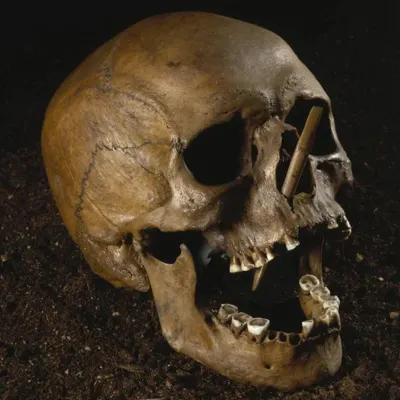
Yes, so this guy comes in at 2600 BC. So again, this was right near the end of the Copper Age, beginning of the Bronze Age. This was right, and it was also right around the time that the Bell Beaker culture would have been introduced to Denmark and Scandinavia. So possibly, this is around the era that the ancestors of the Germanic languages come in. We don't really know. It's plausible. He was a guy who had died violently with an arrow entombed right in his nasal cavity, which I think is what a way to go, right? Arrow in the nose.
Yeah, and that's likely not even what killed him. There's also an arrow lodged in his breastbone, and it's likely that he died because his aorta was severed by one of the arrows.
Yeah. He was shot from above and from a short range. So yeah, this was literally this was like execution style. Someone had been tracking this guy. They find him and they just, you know, put a couple, put two in the head, just like, you know, like a modern killer.
Yeah, and finally, he was found in Zeeland. That's the Denmark Zeeland, not the Dutch Zeeland.
Man, there's too many Zeelands.
There certainly are. And he probably was in his later 30s when he died. Pretty interesting, and I gotta say, if the Bell Beaker culture was in fact introduced violently into Denmark around this time, he might be a direct casualty, which is kind of cool.
The Cashel Man
Now, let's get into the first bog mummy that we have proper. And this one.
Yes, with real good old flesh, bog flesh.
Yeah, and this is the so-called Cashel Man who was discovered in 2011 in County Laois in Central Ireland. So, again, these discoveries are ongoing. They're finding new stuff all the time. It's just a matter of actually, you know, getting out into the field and digging these guys up. Yeah.
He was initially thought to be from the Iron Age, because that's when most Irish bog bodies date from. But he was in fact much older. Radiocarbon dating places him around 2000 BC. That is still within phase three. And unlike the Koelbjerg Man, we know for a fact that the Cashel Man died a violent death. He was a man of around 20 to 25 years old. And in a previous episode, we made it sound like peat harvesting is a thing of the past, just something that Danish and Irish peasants would do back when they still had to fire stoves. But as it turns out, it's still practiced today. That's how they found the Cashel Man himself. The body was uncovered because it got stuck in a peat harvesting machine, which did a fair amount of damage to the body. It's hard to because of that, it's hard to tell which wounds are from the death blows he received and which ones are from the fact that this guy went through a peat harvester and broke several bones in the process.
And again, we're back in speculation mode, but he was perhaps a scapegoat king. As we mentioned last time, in Ireland, the king was held responsible for all sorts of things from military defeat to crop failure. And so in these kinds of circumstances, the people would resort to ritual killing of the king and the crowning of a new one as a way to, you know, say goodbye to misfortune and to apologize to the gods for having chosen a king who clearly wasn't to their liking. But again, this is all very speculative. However, here is what we do know for a fact. The body was marked by wooden stakes, which would suggest some kind of ritual connotation. And the place where he was killed is believed to be near an inauguration site, which is a site quite common in Ireland. It's a place where Irish kings would have been crowned.
They would hold a feast, have a nice party, have a bunch of guys suck their nipples, because that's just what they did back then. Yeah. Yeah.
Yeah, I gotta say, 2000 BC is so early that I'd be skeptical if there really is like, you know, continuity of coronation for one single hill going back that far, but there certainly could be. I'm just a little skeptical.
Yeah, so again, just we're in the realm of speculation. But nevertheless, Cashel Man, he's an outstanding specimen, really makes you wonder what else is out in those bogs. Maybe we'll find an even older one of these days.
Maybe so. Yep.
The Huldremose Woman
And of course, so this is kind of this one is the middle of the Bronze Age. Next up, we have, of course, the Iron Age, which is the time period most associated with bog burials and the preservation of bog mummies. In the context of this paper, they describe these centuries from like 500 BC to 500 AD as phase five. And a great example of an Iron Age bog mummy is the Huldremose Woman.
Yeah, she lived sometime in the Iron Age, likely between 160 before the Common Era and 340 of the Common Era. So quite a bit of range, but we're thoroughly into the Iron Age. Her body itself isn't that well preserved. It looks very dry. It kind of reminds me of Egyptian mummies, actually.
Yeah, it does. Yeah, not very squishy.
Mm-hmm. Yeah, not at all.
Although, I have, while doing research, I've discovered that some bodies were in fact smoked after they were dug up, so maybe this is what happened to her.
I've heard we had some Native American burial girls doing that too. That's interesting. Well, what's most, you mentioned that her body's not very well preserved, and that's true. But what's most well-preserved about her are her clothing. You know, we talked about the Egtved Girl was buried in a very kind of unusual outfit. This woman is buried in an outfit that might be less unusual, but it's almost, I think what's interesting about it is how almost how modern it looks, or at least how much it resembles later clothing found in Northern Europe. So it shows a real kind of cultural continuity of fashion. So this woman who died around like, you know, she died about 2,000 years ago, she was buried in a plaid dress, which is not the oldest plaid we found, but it shows how it was a very ancient practice. You know, we associate plaid with Scotland and Ireland today, but in this time, the Iron Age, people all over parts of Europe were wearing plaid clothing, it looks like.
Interestingly, the wool that she was buried in came from three different sheep, or I'm sorry, came from three different breeds of sheep found in different regions of Scandinavia. And so, yeah, which is kind of interesting. One of them was found locally in Denmark where she was buried, but the other two were from Norway and Sweden. So this could indicate that there was some kind of an early, you know, regional economy where if you wanted a certain type of wool, you were able to easily access it even if it came from hundreds of miles away, which is interesting. One last thing, she was also found with a bone brooch fastening her clothes, her dress together. And that's interesting because brooches are a really big part of the later medieval fashion. Once you get into like the Viking Age in Northern Europe, especially Scandinavia and Ireland. And this was a very simple brooch made out of bird bone, but later on you get these famously intricate jeweled box brooches, they've called them.
That's like these very, some of the most beautiful pieces of jewelry we have from the early Middle Ages.
The Elling Woman
And then next up we have the Elling Woman. So this is interesting because the main bog body we talked about last episode was the Tollund Man, the famous discovery by Dr. P.V. Glob in the 50s. This woman was found actually before the Tollund Man, but isn't as well known because she's not as well preserved. She was about 25 years old at death and was buried just 200 feet away in the same peat bog. The bodies were roughly contemporary, which is interesting. So that kind of suggests that this was a deliberate bog burial site in this time. And so the same people who killed the Tollund Man would have killed this woman. And just like the Tollund Man, she had been hanged. When her body was first discovered, farmers actually thought that she was a drowned sheep because all they saw were bones wrapped in sheepskin. It turned out she was wearing a sheepskin shawl.
She also, interestingly, had a very complicated hairbraid, which was about three feet long, and that's with being, you know, all tied up. And so just as many people have tried to recreate the clothes of the Egtved Girl, a lot of people have tried to recreate the really complicated hairbraid of the Elling woman.
Yeah, yeah, we're gonna steal her look. Her bones are very heavily demineralized. So initially, they thought that she would have been an elderly woman who had osteoporosis. But given her age, it's far more likely that this was just the bog leaching the calcium out of the bones as bogs are wont to do.
Yeah, again, this is why the bones are kind of like rubbery. You can bend them, I think, which is crazy.
Alken Enge
And now, here is my favorite that we're going to do. This is the big one. This is one that I didn't, had not known about until this episode, which is the Alken Enge bog site in Denmark. Probably the creepiest of all of them. So, the Alken Enge site, it's unusual because it contains over 380 individuals who died violently during the Roman Iron Age, roughly 2,000 years ago.
Yeah, it's a massacre, it looks like, or at the very least, a battlefield. Yes, there are other battlefields from the end of this period. And this was a period when there was probably increased migration across the Baltics. But this is an unusually early and unusually bloody site.
Right, right, yeah. So, most of the, yeah, so that most of the battlefield sites that we have from the Iron Age are from the end of the Roman Iron Age, which was like around the year 500-ish. This would have been from the beginning of the Roman Iron Age, which is really interesting. So, this slaughter would have happened pretty soon after the peoples of northernmost Europe would have first come into contact directly or indirectly with the Roman Empire. And even though these areas were never part of Rome or even that close to the Roman border, their economic relations would be completely transformed with the arrival of so many high-quality Roman artifacts.
Yes. So, what else is strange about the site?
Well, it's the fact that they're super decomposed, even though they're preserved, which means, creepily enough, they had been left to rot in shallow water or open air for weeks or even months before somebody eventually shoved them into a bog. They had decomposed so heavily that their bodies had basically opened up in many cases. Some of them have been, yeah, they've been found with sticks and stones in their rib cages, which is pretty creepy, you know. And then eventually, after somebody got tired of the smell, somebody would have dragged these bodies individually, you know, hundreds of them into a lake to dispose of them. And I certainly do not envy whatever poor Iron Age farmer would have done that.
It's a living. And in addition to that, it seems that all of the clothing and personal belongings of the deceased were looted, either by the people who killed them or by scavengers who passed by later. What was left were broken weapons, which were probably ignored by scavengers because they had already rusted beyond usefulness.
In the era before, you know, stainless steel, if you kill somebody and leave their body in shallow water, that sword is not going to be a sword much longer.
Yeah, absolutely not. And we know that this was a battle site, not a massacre site, because it seems that almost everyone who died here was a young man in his 20s or 30s. Some of them had marks of old wounds across their body, which had already healed, which suggests that many of these men would have had long and very violent careers. And when it comes to their wounds, they all had died from axes, from lances, from the occasional sword. But interestingly, there are some post-mortem wounds too. There are bone marks where passing wolves would have gnawed on their bones in the weeks after they died, but before they were dragged into the bog. And most interestingly, a few of them have spinal fractures, which were probably made by a bear.
What we should mention also is that, like we said, this is from the start of the Roman Iron Age, when contact, usually indirect with Romans, had led to significant changes in Denmark, which would go on to influence the culture of the later Viking Age in a very interesting way. The Viking sword is basically a Roman sword, for instance. Romans never had any direct military expeditions into Denmark, as far as we know. At one point, there might have been some Roman settlements sort of close to the Danish border, but generally speaking, individual Romans would not often be found in the area. However, the presence of Romans in southern Germany and the Netherlands, a few hundred miles away, meant that intermediary cultures between Denmark and the Roman border would have had really important roles in distributing Roman goods to the northernmost parts of Europe, which eventually led to new social hierarchies and presumably new violence.
We can imagine conflicts starting over access to Roman markets, and that might be the kind of thing that led to these people killing each other. Although, on the other hand, we should underline that these ancient peoples weren't the nicest guys around. They really didn't need any kind of outside agitation to fight against each other.
Oh, yes.
Yeah, yeah, because there's the famous Tollense Valley battlefield, which is like a thousand years before this during the Bronze Age, in like not too far away in northern Germany, where something like a thousand people were killed and just left to rot. So, yeah, you know, you're right. There's certainly a pretty violent time.
The Osterby Head
Yeah, next up, we have the Osterby head, which, as name suggests, we only have the head, but what a head it is. So, so before we get into it, let's just talk about the basic details. It's likely dated from sometime between 75 to 140 of the common era. This was a man of around 50 to 60 years old, so no spring chicken by any means of imagination. His body was not found, but his head has a very, very distinctive look. The man's hair and scalp survive. His hair is tied in what is called the Swabian knot. What's crazy about this is that Tacitus actually wrote about this in chapter 38 of Germania. The special characteristic of this people is that they comb their hair back over the side of their head and tie it in a knot behind. This marks off the Suebi from other Germans and the freeborn Suebi from their slaves.
The practice does exist among other peoples, either because of some kinship with the Suebi or through imitation, but it is rare and confined to the period of youth. Among the Suebi, the hair is twisted back so that it bristles, even when it is turned gray, and is often knotted behind on the very crown of the head. It is not for lovemaking or to inspire passion that they adorn themselves, but for the eyes of their enemies, dressing their hair when about to go to war adds considerably to their height and makes them appear more terrifying.
Yeah, yeah, that makes sense. So, if you have like a bunch of hair sticking up from the top, from the back of your head, you're suddenly, you know, this big tough guy. Obviously, that's how it works.
Yeah, but it's very funny. And not only does Tacitus mention it, but we have evidence of art of the Swabian knot too. So, archaeologists were incredibly excited to find a real one. We've actually found more than one there.
Oh, really?
Yeah, yeah. There's also the Dätgen Man of Holstein, who is from around the same period. Although, whereas the Osterby Man, he has his knot on the side of his head towards the front by the temple, the Dätgen braid is in the back of the head, as Tacitus describes it. And like many of the bog bodies, this guy's hair was bright red, which probably wasn't actually the color it was in life.
What's funny about the whole bog preservation phenomenon is that the different chemicals in the peat leach into hair and cause it to take on different colors depending on the specific chemical composition of the bog. So sometimes someone with lighter hair, such as potentially the Elling woman, would get darker and become brown. And then in this case, a guy who probably might have had darker hair turns red. It's very funny. There's a lot of cases of this.
The Grauballe Man
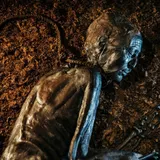
We should mention one other very famous red-haired bog body is one also one of the most famous is the Grauballe Man, which was another big Iron Age discovery by our friend Dr. P.V. Glob. This one is especially well preserved, particularly the hands, but the face has been a lot more distorted. It's kind of creepy looking. You know, if you look up the Grauballe...
Oh yeah, it's all twisted.
If you look at the Grauballe Man, it looks like a mummy. It's kind of horrifying, honestly, in ways that not all bog bodies are. We know from his musculature that just like the Tollund Man, he had a life free from hard labor. He wasn't a peasant, he wasn't a slave, probably wasn't a warrior. He also, though, had teeth, which and even jaws, which were somewhat underdeveloped. Particularly, they seem to have had a childhood calcium deficiency, which means he might have had a harder life as a young child, but then, you know, times got easier as he got older. I don't know if it was, you know, environmental conditions led to nicer harvests, or if he had been, you know, poor that he became rich, but it indicates that he had a kind of a pretty dynamic life. And then, yeah, that is right until the moment when he died around the age of 30.
Yes, he had his throat cut. This is a much less elaborate murder than some of them, but it's still, you know, it's pretty bad.
Thanks to his round face, his snub nose, and of course, his famous wavy red hair, when he was first dug up, some locals in the town of Grauballe were convinced they recognized him. They said, No, no, no, Dr. Glob, that is not an ancient sacrifice. That is a guy named Red Christian who disappeared in the 30s and everyone assumed must have fallen into a bog. Glob wasn't convinced, especially because something like this guy's snub nose might not actually be a reflection of how he actually looked, but simply a result of conditions in the bog. Slowly, you know, the pressure distorting his face after thousands of years, right? But it led to some big hub at the time. Last episode, we mentioned how Irish Nobel laureate Seamus Heaney wrote a lovely poem about the Tollund Man. He also wrote a poem about the Grauballe Man. We're not going to read that.
Instead, we're going to read another poem, which I think is a lot more fun about the Grauballe Man. This is a poem published in a local Danish newspaper mocking Dr. Glob for finding the body, declaring it to be ancient, when everybody knew it was so obviously just this local farmer. They still remember him well in the parish, but how famous he's now become. Yet we have to admit his age has been considerably overdone. Yes, Glob must have made a big mistake when he made his diagnosis, and now the folk who know what's next want to speak out and tell what they know. There's monkey business somewhere. Glob must admit it, so.
I'm sure it sounds better in the original Danish.
I also gotta say, you know, I think that if newspapers started putting like comic poetry in their paper in their pages again, I think subscriptions would go way up. But lo and behold, later chemical analysis proved that this body was not, in fact, the poor farmer Red Christian, but was an ancient man from the Iron Age. Dr. Glob was correct. The hair, it turns out, was actually, as we said, not necessarily reflective how he actually looked. So he probably didn't really look like that farmer in life. This bog body is interesting because by the time this one was discovered, people knew that once you take a bog body out of the bog, it's going to very rapidly decompose. So Dr. Glob and his colleagues worked really fast to preserve it for a later study. And they made a pretty radical decision using the best means they had in the 50s.
And that was to tan the entire corpse with chemicals, which means that you can see the Grauballe Man today, but he is now technically a piece of leather.
Hmm. Well, it sucks to be him, I guess.
Yeah.
Yes.
Medieval and modern bog bodies
So those are all of the main bog bodies we're talking about from the Iron Age, from ancient times, from the Iron Age and beyond. However, bog bodies continued to be deposited into marshes and mires for long after their ritual uses would have faded away. There were even some bog bodies from the World Wars that have been discovered. And these ones, we should note, are usually not included in any kind of scientific study at all because they really aren't analyzed. They're simply identified and buried. They're treated like modern corpses, which they are. But people would be dying in bogs all the time throughout ancient times up to World War II, either unintentionally, you know, after getting lost, through suicide, or sometimes even in murder.
The Bocksten Man
And there's one great example of a later murder victim discovered in Sweden in the 30s that's known as the Bocksten Man.
Mm-hmm. Yes, the Bocksten Man, whose facial reconstruction is also available and was done by the same artist as the Raspberry Girl. But this guy, he was discovered in Sweden in 1936, and it seems that he suffered several heavy blows to the head before being impaled on spikes. He is known for his curly head of red hair. Again, this was likely bleached. It probably wasn't his original hair color. And his body is also the source of one of the best preserved medieval tunics. Clothing, it surprisingly doesn't survive very well, so we have very few examples of actually existing clothing from before late medieval times. He had a full set of clothing, which included a tunic, a cloak, a belt, and a sheath with two knives. He also had a small shield-shaped pendant, which may have been engraved with his initials. He most likely lived sometime in the 14th or 15th century.
He was somewhere between 25 and 35, and he was relatively tall, standing at somewhere between 170, 180 centimeters. And he clearly was not poor. He was decked out. Like, you gotta look at this reconstruction of him. He basically looks like a hobbit.
Yeah, yeah, no, yeah, yeah, I agree. Yeah, he's dressed like Frodo. Yeah, like a nice cloak, you know, a warm tunic, some pretty good boots. And that's why it's somewhat unusual that whoever kills him didn't loot his nice clothes.
I have a theory about this, though, but I think there's a good reason why you might not want to do that.
Well, I would guess that if there's someone that you don't like and then you kill them, and the next day everyone in town sees you wearing their clothes, they're probably gonna put two and two together.
Well, yeah, but you can just go into town on a market day and sell it to some foreigner from far away who will never be in your parts. But yeah, that's a possibility. But there's another very intriguing possibilities. Based on the initials inscribed on the pendant, some believe that this may be the body of a man named Simon Goodmundi, who was the dean of Linköping, who died in 1491. The fact that the body wasn't looted may suggest that this was a targeted assassination, perhaps done by a rival who wished to take his post. An alternate explanation based on local legends proposes that this was an army recruiter who got killed by the local peasants who obviously didn't want to get conscripted all that much.
Yeah, that's very intriguing, both of those, yeah. Yeah, so we have a great modern-day murder mystery. Maybe one of you guys can solve the mystery of the Bocksten Man.
Yes.
The Burlage bog dog
But finally, not to end on too grim a note, we're going to talk about the goodest boy found in any bog, which would be the Burlage bog dog.
Burlage?
The Burlage bog dog.
Try saying that three times quickly. Yeah, yes.
From Germany, from Lower Saxony, yeah.
It's really remarkable because this is a dog whose fur has just been perfectly and I'd say really quite beautifully preserved. And just like a lot of the human hair that we've seen, the fur has taken on this bright golden color after, you know, many centuries in the bog. Although, maybe not as many centuries as some of them.
Right, because when the body was initially unearthed, it was thought to be from the iron, from the Bronze Age, because there are other examples of bog dogs that are very old from the Bronze and Iron Age. But more modern analysis has dated the dog to the mid-16th century, give or take, 60 years.
Yeah.
Yeah, so this guy, he was likely some peasant's dog who got lost on his journeys and sunk in the bog. But we will remember him forever, thanks to his beautiful fur.
Absolutely. Yeah. Yeah.
Bog bodies in Poland and Estonia
And we've talked about the most common places where bog bodies are found in the British Isles and Scandinavia. But as we mentioned, the range of these bodies was in fact much larger. In fact, there have even been bog bodies found in Poland and Estonia too, both on the other side of the Baltic.
Yeah, but in Poland in particular, two out of three bog bodies that were uncovered were found during Nazi occupation. As we mentioned last time, the Nazis had a very strong interest, albeit a negative interest, in bog bodies. Although we might have spoken too hastily, this was by no means a universal reaction. Some people hated the bog body stuff.
Hitler on bog bodies
And here's what the big guy himself had to say about it, Adolf Hitler. Why do we call the whole world's attention to the fact that we have no past? It's bad enough that the Romans were erecting great buildings when our forefathers were still living in mud huts. Now Himmler is starting to dig up these villages and mud huts and enthusing over every potsherd and stone axe we find. All we prove by this is that we were still throwing stone hatchets and crouching around open fires when Greece and Rome had already reached the highest stages of culture. We should really do our best to keep quiet about the past. Instead, Himmler makes a great fuss about it. The present-day Romans must be having a great laugh at these revelations.
Yeah, and this is quoted in Hitler's Table Talks, supposedly from a conversation between Hitler and Speer. But just a caveat here, there's been some more recent scholarship which suggests that the Hitler's Table Talk book might not be entirely genuine, that possibly some additional anecdotes.
Well, I wouldn't believe it because I like believing it because that means that if you like bog bodies, you are fighting Hitler.
Why bog bodies matter
Because I think it's good to keep in mind that, you know, like in that nationalist framework, you know, the nationalist is horrified to see that the culture he sees as his own, this ancient culture which he sees as his own forebearers, was not as, you know, supposedly great as other cultures of other people's forebears. But I think that if you put any kind of nationalist baggage aside, then you recognize that all cultures, no matter what level of development they might have had, can be incredibly interesting and are worthy of so much study. And why I find the bog bodies so interesting is because they are from cultures who didn't leave behind any kind of written evidence. Because they didn't give us their words to speak by, we have to go off their faces. And I think that's a really unique situation in archaeology.
Yeah, and although we don't have any writings from these people, we nevertheless have some idea of who they were and how they lived. At the very least, we know where they grew up. We know that they were, many of them were deeply tied into these very intricate trade networks.
Yeah. Yeah, no, one thing that I forgot to mention was that one thing that you see with the Roman Iron Age that Dr. Glob uncovered is that there were Roman-style mosaics being built in Scandinavia, which is interesting.
Oh, really?
Maybe, yeah, yeah. And again, Scandinavia was not close at all to the Roman border, but this technology was able to spread quite far, you know, far beyond the borders, the Roman frontier. It's possible that, you know, some Scandinavian people might have learned how to make these mosaics in Rome as slaves or as soldiers and then went back home. Or maybe, you know, there were like wandering Roman craftsmen who, you know, went far beyond the borders of the empire to sell these, you know, like luxury Roman goods and Roman artistic techniques to local elites.
Yeah, absolutely. So when you look at the bog bodies, don't think about how, you know, these were just guys in mud huts. Because, because I mean, they were, but they were so much more than that. They were, at the end of the day, people. They were like us in many ways, unlike us in many other ways, but nevertheless, still people and a part of our global heritage.
No, you're right. And no matter what continent you're studying, it's ridiculous to judge human worth based on the material circumstances of how a culture happens to live. Cultures that are more complex or hierarchical are not deserving of more study or are not more valuable than cultures which are less so. This is true when you're talking about native cultures of the Americas, and it's true when you're talking about Europe, I think. Generally speaking, Greece and Rome get the bulk of the scholarly attention due to the enormous level of evidence that they left behind, due to their written record especially and their great archaeological record. But that doesn't mean that these were better or more valuable people. It just means that they left a lot more for us to work with. A very specific stratum of those people left much more for us to work with.
I'd be willing to bet that many of the people living in the Roman Empire around this time would have been living in very similar conditions to absolutely correct. Yes, many of them were slaves, and even those who were free would have lived very meagre lives in the empire.
Yeah, absolutely.
So once again, study bog bodies, piss Hitler off. Simple as. That's all we have to say.
All right, yes. And so this has been a great little part two, you know, addendum to our bog bodies talk. And I hope to see all you guys soon. All right. Bye-bye. All right.
The show is also on Apple Podcasts, Overcast, Pocket Casts, Podcast Addict, YouTube, RSS and Patreon.