In the 12th century BCE, the Ancient Near East represented the apex of human achievement. Mesopotamia and the Eastern Mediterranean boasted hitherto unknown developments in urbanism, written literature, agricultural technique, and commercial exchange. Yet by the end of that century, nearly all of that had vanished. Cities were debased or abandoned, entire writing systems were forgotten, and the great trade networks ceased to circulate across the Middle Sea. But despite the magnitude of that collapse, until the turn of the 20th century CE, historians and archaeologists had no idea that it happened.
We are rejoined by Alexander Thatcher @ThatchEffendi for a look at the twilight of the first great civilizations of the Mediterranean. Traditionally only of interest to specialized academics, recent works of popular media as well as breakthroughs in archaeogenetic research have made the Bronze Age hot for the first time in thousands of years. We discuss Alexander's recent Substack article on the earliest Near Eastern civilizations and their Proto-Indo-European contemporaries, with a particular focus on contemporary uses and abuses of this history. Then, we move onto a more general discussion on the tumultuous collapse of the Bronze Age world and the aftershocks that radiated across the Mediterranean.
Though highly visible in archaeology, the Bronze Age Collapse left only faint traces in the literary tradition, and was completely unknown to western academics who drew their understanding of the ancient Mediterranean entirely from the works of Greek and Roman historians and the Hebrew Bible. This invisibility in ancient literature does not indicate that the collapse of the Bronze Age was not strongly-felt, but rather the opposite: urban literate societies declined so quickly in the late 12th century that nobody was able to write down what had happened. Further to our previous discussions, we examine potential links between the poetry of Homer and the cultures of the Ancient Near East, as Homer's Iliad and Odyssey represent our clearest memory of this antediluvian society. Though compiled in the Iron Age, partially contemporary to Homer, the Hebrew Bible also presents some interesting hints toward Near Eastern cultural memory of a lost Bronze Age glory.
Of great importance to academic and amateur discussions of this topic are the mysterious Sea Peoples. Though their identity, activities, and even existence are debated by scholars, it is evident that maritime marauders were present to witness the end of the Bronze Age. Though extremely little is known about these people for certain, generations of shoddy discourse has turned these people from the sea into rhetorical puppets for contemporary politics. As Alexander Thatcher explains, this too is true of the Proto-Indo-European from the start of the Bronze Age, whose relationship to these later Sea Peoples continues to elude and intrigue scholars.
Transcript
Back with Alexander Thatcher
Welcome back to Gladio Free Europe. I am Liam, joined here by Russian Sam and our man in Anatolia, Alexander Thatcher, returning for yet another discussion of the late Bronze Age and the archaeological context of Homeric literature. If you have not heard our previous two episodes, which really focused on the Hittite context of the Iliad, we'd strongly recommend it. This episode is going to continue further on that thread, looking a little bit more at the very end of the Bronze Age, the notorious Bronze Age collapse, and what both the Iliad and the Odyssey might tell us about that process. But we also want to talk about something else here.
Dechudding the Aryan
This is the forthcoming article by Alex about various uses and abuses of the Homeric past and its Bronze Age context by different political groups, especially on the contemporary right. At the time of recording this, your working title here, Alex, is Dechudding the Aryan. This, of course, refers to the Aryans as in specific real cultures related to the Indo-European speaking migratory tribes who settled in India, Pakistan, and Iran through the help of wheeled chariots. This term in our contemporary culture has been notoriously associated with its misappropriation, of course, by the German Nazis in the 20th century. The whole use of that term here points to the ways this Bronze Age backdrop has been used to frame and justify the most horrific abuses of the modern era. Alex, tell us about this piece and what brought you to it and what you're interested in here.
So I've been interested in pseudo-history since I was a kid. This piece actually originally started with my interest in how people use pseudo-history. My family background is Mormon.
Yeah.
And I have this very specific memory from when I'm about 14 years old of reading a Book of Mormon archaeology book, which concluded that when the Book of Mormon talks about horses, they actually mean tapirs, and that when they mean like other animals, they actually mean what are called brocket deer. So.
Yeah, there's a long history of saying that the Book of Mormon actually happened, like, or I'm sorry, everything in the Bible happened in Mesoamerica and is thus, you know, somehow corroborated by the Book of Mormon.
Well, no, no. I mean, what it actually is, is it's like it's a pseudo-archaeological defense of the Book of Mormon, like the literal truth of events in the Book of Mormon as like actual events that happened in Mesoamerica to a people of Levantine extraction, right? Because from a Mormon perspective, the last like 25 years of aDNA data has been really damning because there's just no evidence of any kind of Levantine or Jewish influence anywhere in the New World. So like they have to invent like these narratives so they can like keep believing in things. And even when I was like 14 years old, I remember reading like, what are they doing here? Do they actually believe this? Is this like a serious claim? So I've previously written on Azerbaijani pseudo-history, which is probably like the where I actually got my start as a writer a long time ago.
Yeah, no, and any of our listeners who are familiar with your work, Alex, will know that you've written quite a lot on Turkish and Azerbaijani pseudo-history and the way that this continues to influence right-wing politics in those countries.
Right.
The right's Bronze Age fantasy
And so what I kind of became interested in in a lot of this is so the right-wing kind of Bronze Age fantasy is very similar in a lot of ways. It's this romantic idea of like Central Asian, nomadic, hyper-masculine males coming in and conquering like a settled agriculturalist people. So in the in Turkish nationalism, this is often given an Islamic or a racist, but like Central Asian like kind of racialist perspective. But for you know, modern-day Chuds, for right-wing people, they're essentially going back to the 19th century racial concepts. And they're bringing up Maria Gimbutas, but like inverting Gimbutas' like feminist archaeology into something that is ideologically masculinist. And combining it with Nietzsche, combining it with Nietzsche and stuff like that.
Yeah, no, a lot of this goes back, of course, to like the most notorious racialists of the era, like you know, the French scholar Arthur de Gobineau or the somewhat more legitimate German scholar Kossinna.
Scholar is being very generous when you're describing Gobineau. I've already read a little bit of it.
Yeah, yeah, no, no, yeah. He was more of a fabulist and propagandist.
So the piece will come out between now and the time this is released. And I ended up reading quite a bit of Thus Spoke Zarathustra. And the thing about Nietzsche is that Nietzsche is a genuine genius. And when you read Thus Spoke Zarathustra, he's pretty clearly working off of like an actual informed idea of a certain type of Indo-Iranian, I think you could comfortably say Iranian religious ideology, right? He's smart, so he gets this. And there's a big difference between Nietzsche kind of like playing around with the idea of Zarathustra and, you know, Arthur de Gobineau inventing shit out of nothing, which is basically what he's doing.
Gobineau, Aryans and Tolkien
Yeah, and so de Gobineau, for those who are unfamiliar, he is more to blame than anyone else in turning the genuine Indian and Iranian concept of the Aryan, which was a genuine ancient ethnonym for those peoples, transforming it and twisting it into a contemporary racist term to describe Europeans.
Yes.
Because these cultures were founded in part by migrants whose origin does appear to have been, in a sense, in Eastern Europe. These proto-Indo-European speakers who arrived and wheeled chariots. This was used to justify European superiority and contemporary 19th century European control over places like India and Pakistan and less successfully in Iran. I know, Sam, you were thinking, you brought up that a good example of this juxtaposition here is a famous letter from the 1930s when a Tolkien, J.R.R Tolkien of Lord of the Rings fame, was asked by a Nazi publisher if he himself was an Aryan. Tolkien, being a clever philologist, very familiar with the original meaning of that term, gave a famous, pithy reply.
Dear sirs, thank you for your letter. I regret that I am not clear as to what you intend by arisch. I am not of Aryan extraction, that is, Indo-Iranian. As far as I'm aware, none of my ancestors spoke Hindustani, Persian, Gypsy, or any related dialect. But if I'm to understand what you're inquiring whether I am of Jewish origin, I can only reply that I regret that I appear to have no ancestors of that gifted people.
Right, and this really points to the way that the term Aryan specifically was misappropriated by 19th and 20th century German nationalists and other racialists more broadly to contrast European peoples whom they saw as superior with other groups they saw as inferior. In the German context, this would, of course, be German Jews. In many other contexts, the great other here were other supposedly swarthy and languid peoples of the Near East. In your article, Alex, you present the traditional and very much incorrect model of Indo-European expansion as these hale and hardy, very butch Aryans overrunning and replacing who you describe as the dusty Anatolian peoples, these non-Indo-European speaking peoples who dominated both the Near East and also introduced agriculture to Europe. You present this traditional narrative in which a pale-skinned, superior group supplants a darker-skinned, physically weaker group. This has essentially nothing to do with how Indo-European languages spread across Europe and were introduced into places like India and Iran, where the actual ethnonym Aryan was used.
However, this kind of rhetorical usage is one of the main contexts in which Bronze Age culture and Bronze Age history is discussed.
The right and Nolan's Odyssey
And this even affects discussions of Homer and right-wing reactions against the recent Christopher Nolan adaptation of the Odyssey.
Right. So, like, I think a part of the reason the one of the reasons the response to The Odyssey was so funny for me is that there really is this like vitalist right-wing kind of like fetishization of Homer and of the Bronze Age. And everyone kind of knew that the Odyssey was a cultural turning point, where like the fact that the movie made a billion dollars and that the right-wing histrionics, like the wailing and gnashing of teeth, the like screaming at the top of their lungs on YouTube just didn't really work, right? Like it was this real moment where like I think it became kind of clear that the kind of the vibe shift, like the cruel kids people moment had kind of like passed already. So I kind of wanted to like take like a part of this is just like, I think a lot of people are tired of all of human knowledge and culture being put into left or right categories.
I think there's a renewed interest in the classics for a bunch of reasons. Like I know actual leftists who are reading Leo Strauss now, which is like a shift, right? Or even the kind of like occasional receptivity to like aDNA research and stuff like that. So I kind of wanted to like find a way to approach the Bronze Age and the European studies in a way that isn't that isn't like a shirtless, kind of like not very bright guy on YouTube talking about the beauty of the European race.
Yes. And much like the Turkish and Azerbaijani nationalists that you've written about at length, modern American and European white nationalists, they have a basically a dishonest influence in the Bronze Age past in that they're only interested in these cultures and this history insofar as they can use and abuse it to support their contemporary right-wing political grievances.
Is Homer Western?
A lot of this is a very vulgar interpretation of traditional understandings of the classics, which understand Homer as the beginning of a Western civilization that is wholly dissimilar from Oriental civilizations. I don't think this is accurate. I don't think you can understand Homer outside of the Iron Age context of his literary world, as well as the Bronze Age context that he is writing about, as Homer's poems are set about 500 years before they were written. Very little, if anything, in the Iliad or the Odyssey can really be considered Western. I think in many ways, Homer doesn't even appear very Greek, as so many of the elements we associate with Greek culture and Greek philosophy had not yet been developed. The last two episodes recorded with you, Alex, went very deep into the cultural, religious, and political influences of the Bronze Age Hittites onto their ancient Mycenaean Greek neighbors.
Some of this influence can clearly be seen in the works of Homer. You also put Homer in kind of this broader Anatolian context that I found quite cool. Your article as well mentions how figures in the Homeric texts, as well as the mysterious historical figure, Piyamaradu, this rebel in Western Anatolia who appears to have fought the Hittites and might have influenced the depiction of certain Homeric characters. All of these figures, whether Achilles or Piyamaradu or Paris or Menelaus or Agamemnon, they have these trans-historical Balkan and Anatolian and Caucasian influences as well. Would you mind expanding on this a little bit?
Many-turning men
Right. So if you spend time in Turkey or in the Balkans, like the stories that kind of come up often, like when men are a bit drunk, are stories of like kind of irregular warfighting in the collapse of the Ottoman Empire, the formation of the Turkish Republic, kind of that period, right? So let's say 1810 to like 1923, 1925. In Greece and the Balkans, it's a bit different because they have World War II for like myth-making and stuff like that, right? But there are these like really outsized characters that kind of show up everywhere that everyone talks about, that everyone kind of knows, that everyone has anecdotes about. And, you know, these many turning men, as you call them in your article, you know, a little nod to the Odyssey. You give that 400 years, and I think you could end up with like Achilles. Like, I just think that's the way this works. Like, just objectively.
Homer's Age of Bronze
You know, we spent so long introducing kind of the right-wing misappropriation of Homer and these various what we would see as misinterpretations of Bronze Age history. We should actually discuss what Homer is in his historical context. Again, this is what we discussed in our previous episodes, but Homer was a writer during the Greek archaic period, reminiscing about what we would today have called the Bronze Age. Funnily enough, Homer's contemporary Hesiod would have also referred to that same period as the Bronze Age, not because bronze was the prevailing metal used by warriors and craftsmen in that time, but because it was seen as inferior to the preceding gold and silver ages that were more godlike. The contemporary terms bronze and Iron Age actually do, in a sense, come from the writings of Hesiod and reflect the archaic Greek understanding of the Bronze Age world as superior to their own.
We might have mentioned this in our previous episode, I can't remember, but the funniest example of this kind of complex is how on multiple occasions, somebody in the Iliad will lift a heavy rock, and Homer pauses the story to let us know that in those days, 500 years ago, people could more easily lift rocks than they can today.
Yeah. It does kind of remind me of the Simpsons gag, like when Grandpa Simpson says, like, when I had an onion in my garter, as was the style of the time. Like, maybe, like, the memory of the boar's tusk helmet or like Ajax's shield. You could have like Grandpa Simpson saying, when I had an onion in my garter, this was the style of the time.
Or before we recorded this, Sam, you pointed out that chariots are, of course, a very prominent aspect of both the Iliad and the Odyssey, but don't seem to have been in use by Homer's time. This was a deliberate archaism in this right.
But it's misunderstood because they're only used as battle wagons. Like, they're not used as instruments of blood.
Yeah, yeah.
Instruments of transport and instruments of humiliation.
Although I'm not sure that they would have been completely out of use in Anatolia at that time. The Pontic king attempts to use them during the war with Mithridates. And that's like 700 years in the future. I think there is some evidence that maybe the Phrygians used them. I looked this up at one point.
We're going to talk about the Phrygians at the end of this episode. So I think that what I want to do with this one, we've already established in our previous episodes, the way that archaeology of the late Bronze Age world, especially the Hittites, can corroborate some of what we see in the Homeric epic, especially in the Iliad. For this episode, I would rather look at the ways that the very end of the Bronze Age appears to be attested in Homeric scholarship, particularly involving the collapse of the Mycenaean palace economy, the collapse of the Hittite Empire, and of course, the notorious and mysterious Sea Peoples.
What was the Bronze Age collapse?
The Bronze Age collapse is interesting because it was not something that was known or at least remembered by anybody in Europe or the Mediterranean after it happened. What we get in Homer, maybe a little hints here and there in the Old Testament, you know, of the Hebrew scriptures, we might have some distant memories of this collapse, but we have no great histories attesting to the kind of transformation that we know happened through archaeology. In the late 12th century, historian Eric Cline decisively dates this to 1177 BC. You see a broad systems collapse across the eastern Mediterranean, in which the great Hittite Empire collapses altogether, as we discussed in our previous episode, in which the great Mycenaean palaces, like that at Mycenae itself, are wholly abandoned, and in which the Egyptian Empire, which had previously stretched up into the modern-day lands of Lebanon, Israel, Palestine, suddenly recedes back to the Egyptian heartland.
This Bronze Age collapse was also associated with a decrease in trade, a decrease in the standard of living, probably had some connection with natural crises such as earthquakes and drought, but broadly speaking, led to a less interconnected, less literate, and less prosperous society. Over the ensuing period, the early Iron Age, which historians of Greece describe as the Greek Dark Age, we slowly see many of these international connections and institutions being reconfigured and recreated in different ways. By the middle of the Iron Age, coming out of this Greek Dark Age, we see Greek individuals living somewhat more far afield, the emergence of Greek colonies in Sicily and southern Italy, the birth of a new Greek alphabet introduced by another very expansive people, the Phoenicians. So we begin to see this recovery. And this recovery happened exactly as the Homeric narratives would have been developed as these oral histories recounting the glories of this period that again would have been known to these peoples themselves as an Age of Bronze.
There are many problems with ongoing scholarship over the Bronze Age collapse, its causes, its effects, and its cultural memory. But there is no question that it certainly happened and had profound effects on the lives of all of the peoples across the Mediterranean and even to an extent beyond. It appears that the Bronze Age collapse led to significantly fewer Mediterranean trade goods going north into the region of the Nordic Bronze Age, for instance.
Nolan's Sea Peoples
The greatest question, however, is what exactly was the relationship between the Bronze Age collapse and that of human migration, specifically that identified with the Sea Peoples of Egyptian record. The Sea Peoples have been discussed pretty intensely over the past several months, entirely due to the release of Christopher Nolan's film. In this movie, the destruction of Troy is used as a metonymy for the Bronze Age collapse. We see the symbolic slaughter of the goddess Athena, which seems to usher in the destruction of all literate civilization. Near the end of the film, Odysseus, played by Matt Damon, tells his son Telemachus, played by Tom Holland, that our stories must be sung, not spoken, as writing is rapidly disappearing. Indeed, the Bronze Age Linear B writing system of Mycenaean Greece did disappear after the Bronze Age collapse, being replaced by the phonetic alphabet introduced, of course, by the Phoenicians.
Nolan's interpretation of the Greeks as the Sea Peoples squares the circle of how Greek-speaking peoples appear to have been involved not only in destructive acts across the Mediterranean, but also in the destruction of their own civilization. As per Nolan, Greek avarice abroad, their piratical destruction of the city of Troy, dooms them to lose their own civilization as kind of a divine punishment. This is clearly meant as a contemporary political allegory. You know, Nolan too has his modern-day grievances that he's presenting here. In Nolan's interpretation, it seems to be that American imperialism abroad is to blame for contemporary barbarism at home. Kind of a Bronze Age example of the imperial boomerang. I'm not sure if this specific interpretation can be rooted in Homer.
Emily Wilson's Odyssey
And Nolan's choice here to present the Bronze Age and the Sea Peoples this way has been greatly disputed by translator Emily Wilson, whose version of the Odyssey was the primary basis for his film. Alex, what can you say about Emily Wilson's Odyssey and its interpretation of Homer and how it differs from Christopher Nolan?
I'm actually reading her Iliad now. So I've read a couple translations of the Iliad and I just enjoyed her translation of the Odyssey, so I'm going back.
Yeah, well, and actually, you know, in between recording the previous episode and this one, I read Emily Wilson's Odyssey.
Just so I think it's fine. I don't love everything about it, but it's quite good. No, the way I phrase it in the article is that I kind of think that I don't want to sound mean, and Emily Wilson is an actual poet, but I think a virtue of both Nolan's film and Emily Wilson's translations is that they are legible to a modern audience without getting into like squee or stupid contemporary cultural comparisons.
Yes, well, and that her text is quite colloquial, I would say. And what she argues, I think, convincingly in her foreword, is that in his own context, Homer would have been colloquial. He would not have presented his narrative with the grave solemnity that we get from Alexander Pope and other 18th and 19th century translators. And that she makes the epic much more lively and in many ways more relatable through the usage of contemporary language. The downside there is that there are certain turns of phrase that do kind of bump against the narrative there. The two that are most infamous are her very first line. She translates the Greek term polytropos, which you mentioned in your article to describe 20th century, 19th century figures, these many turning men. She simply translates that as complicated, which is not an illegitimate choice, but does seem extremely, exceedingly colloquial. And then I think the worst bit of language there is in the climax of the Iliad, excuse me, the climax of the Odyssey, when Odysseus reveals himself, which I think is actually quite a good scene, a really excellent climax in her translation, is kind of weakened when he says the line, playtime is over.
Yeah, I'm not going to argue that one. I think an issue with Emily Wilson is that she's a classicist who's trying to, you know, make something that's middlebrow. And occasionally she goes, like, I'm not saying that as an insult. I'm saying that as like she's trying to make something that will sell and that is like understandable to modern audiences. And maybe occasionally she overshoots that.
But you know, I'll say this: given that her translation was the basis of Nolan's film, I think we can say without reservation that her translation of the Odyssey did indeed bring the works of Homer to a vastly wider audience. Although, of course, as we're going to get into now, she has a lot of issues with Nolan's interpretation and was very uncomfortable with what she saw as his abuse of her work.
I think a writer's negative response to an adaptation of her work is legitimate, but I just think that the flaws of Wilson's translation are very similar to the flaws of Nolan's adaptation. And, you know, I just kind of like, I can, I appreciate that she's upset, but I think that it's a pretty clear adaptation that has the same strengths and the same weaknesses.
Yeah, no, I mean, just my issue in general is that, like, we should be thinking about these people as aliens to us, for all intents and purposes. They just had a totally different way of seeing the world. And I don't, like, I understand the impulse to colloquialize stuff given the abysmal reading rates of the American people at this point. But at the same time, like, it should feel alienating. It should feel like you're at a distance. You should be kind of squinting and wondering, like, what's going on there? Because if you just plopped someone from our world back then, it would, you know, it would be completely baffling. There would just be no point of reference.
Well, I, yeah, I would kind of push against that a little bit because I think that, to her credit, she does go out of the way to highlight the differences, the social differences in Greek society and contemporary society. I think that she really makes an effort not to sanitize the violence as well as the ubiquity of slavery. And one of the things she did was that there were many cases. Rape is a big thing in the Iliad for her, and she's very clearly uncomfortable with it, and she doesn't sugarcoat it. Like, I think that Nolan is probably guilty of that. I think it's really hard to accuse Emily Wilson of that.
Yeah, no, and yet there is no hint of sexual violence in his film, which is completely understandable. You're making a Hollywood movie, you don't want to present that on screen. The closest thing you get is the metaphorical decapitation of that. What were you thinking?
There's the violence against Helen.
That's true. Where she's, yeah, yeah, where she's scarred from being.
I mean, yeah, I mean, it's like you do have some kind of scene of Trojan women wailing, which probably would have been interesting, but I think some of that is abstracted into the Athena thing and then the violence against Helen.
Bronze Age Pervert
Because Bronze Age Pervert specifically made this point, and it's a clear thing in the film where the king of Sparta, Helen's husband, is like he's like Andrew Tate. He's like literally the chud standard. Like that's how he stylized. That's who he is.
Yeah. And for anybody who is blissfully unfamiliar, Bronze Age Pervert is perhaps the best example of somebody who's made a career out of misusing the Bronze Age legacy to argue contemporary political points. He is an eccentric reactionary who's been around for at least a decade now in the right-wing manosphere. It was one of the loudest voices objecting to what he saw as wokeness in both Wilson's translation and Nolan's film.
Were there Sea Peoples?
You know, Wilson has one other objection to Nolan's film that I think we really should get into. And that is that she took great issue with his argument that the Greeks of the Odyssey were indeed the Sea Peoples of Egyptian record, and that the Odyssey and the Iliad should be understood as documents of the Bronze Age collapse, the context in which these poems are essentially set. In a recent piece in the London Review of Books, Emily Wilson went so far as to argue that there were actually no such thing as the Sea Peoples. The Greek-speaking world's shift away from the more centralized, literate palace culture of the Mycenaeans in the 11th century BC toward the fragmented social formations of the early Greek Iron Age was caused by a range of factors, including climate change, earthquakes, and internal unrest. I think that these factors Emily Wilson describes did indeed contribute to the Bronze Age collapse.
They may have been the primary causes there. However, the existence of these factors doesn't necessarily come at the expense of the existence and historic involvement of the Sea Peoples. In our previous episode, we listed several groups identified with the Sea Peoples in Egyptian and Semitic language records, as well as the limited archaeological and onomastic evidence linking certain late Bronze Age rulers of Cilicia with the Aegean. Even Wilusa, the city of Troy itself, appears to have had significant influence from Greek speakers around the time of its destruction. These Greek speakers may indeed have been categorized by outsiders as the Sea Peoples. Cyprus most prominently was settled by Greeks during this period, although we're going to see later in the episode how Greek settlement of Cyprus, which may have been a launchpad for later Greek activities in the Near East, actually defies the narrative of the Sea Peoples as barbarian despoilers.
Lessons from the fall of Rome
If we can compare with our previous discussions on the collapse of Roman Britain in our episodes on King Arthur, we can see that barbarians were very active in Roman Britain before, during, and after the collapse of the Roman government. While earlier historians of the collapse of Rome took a simplistic and sometimes racialized view of these hale and hardy barbarian peoples overturning a decadent Rome, very similar to the view of supposedly superior Aryans overthrowing what you call the dusty Anatolians in ancient southern Europe. Instead, it becomes increasingly clear that barbarians in the late Bronze Age world became politically dominant only after much of the collapse was well underway. The rise of the Anglo-Saxon and the Frankish kingdoms in early medieval Europe can thus be understood not as a cause of Roman decline, but as a result of that decline. Our episodes on the groundbreaking Belgian historian Henri Pirenne emphasized how, for centuries after the Roman state ceased to exist, barbarian successor kings made every attempt to maintain and preserve Roman culture and institutions.
They saw themselves as the defenders, not the destroyers, of that Roman legacy. So, why would I spend all this time describing the fall of Rome here? That is because we lack any comparable detailed chronology for the Bronze Age collapse. We must go off the analog of the collapse of the Roman state over a thousand years later. We don't know for certain whether violent activities by seaborne traders were a cause or an effect of broader Bronze Age decline. But looking at this early medieval example, as well as everything we know with the written record and the archaeological record of the late Bronze Age, it seems increasingly likely that long-term structural factors in the Mediterranean, including drought and earthquake and political overextension, weakened central authorities, thus giving marginal peoples like the Mycenaean Greeks an opportunity to use violence to secure foreign goods formerly accessible through peaceful trade. As these peaceful trade links were disrupted, violence often became the only means of acquiring such foreign goods.
Mycenaean trade
Due to this lack of chronology, we have no idea if the Bronze Age world of Greece collapsed before or after the Bronze Age world of Egypt and the Hittites. Although Greece would have been geographically marginal to this world, the palace economies that would have been ruled by the real-life equivalents to Agamemnon or Odysseus would have been quite prosperous. We have a lot of economic records of the state of Pylos, for instance, which, according to the Iliad, was ruled by the hero Nestor. Clearly, the peoples of Pylos had enormous wealth in foreign trade goods as well as in foreign slaves, which suggested very close connections with Egypt and the Near East, and to a lesser extent, the rival Hittites. What are your thoughts, Alex, on what the works of Homer and certain adaptations of Homer can tell us about the role of trade links and even ideological links across the Bronze Age world from east to west?
So Mycenaean elites, to some extent, are basically people who live off of the importation and trade of like elite goods with the Middle East. I mean, from everything we know, the core, in some sense, the core of the high-functioning Mycenaean economy is it develops through taking over Minoan trade links, and then they develop their own trade links with deeper trade links with Anatolia and then probably to Italy and northward as well, which the Minoans wouldn't have any interest in, but with Egypt and Egypt. So the Mycenaeans are kind of, they're more of a warrior people than the classical Greeks are, but we know that they're engaged in pretty long distance trade from an early day. Although it is worth pointing out that the trade here is quite different. This is before the development of currency, so I think a lot of actual trade.
It's basically beyond doubt now that Greek-speaking individuals were active as merchants and possibly as mercenaries in Egypt and the Levant well before the arrival of the Sea Peoples. Some interpretations of the Bronze Age collapse basically present the Sea Peoples as the debut of Europeans on a Near Eastern stage. This often has uncomfortable racialist or supremacist implications. Some more odious figures online are very overt with their intentions here with this particular model of the Bronze Age collapse. But this just simply is not accurate. You know, trade goods from the Levant and especially from Egypt are well attested in Mycenaean sites. A royal Egyptian scarab at the Palace of Mycenae itself was very possibly a diplomatic gift handed to an Achaean king by an Egyptian envoy. We've spent a lot of time in these last several episodes talking about the regional collapse of the Mediterranean on a macro level, but comparatively little time considering what exactly was lost in the process.
Civilization isn't only about the physical presence of large settlements, but also the complexity that emerges when you have such a vast agglomeration of people, as well as sufficient surplus to allow for the development of social classes who don't need to engage in agricultural drudgery. These people would have been the artisans who made the material world of this epoch possible. Go to any world-class museum and you're going to see the handiwork of these craftsmen whose names are largely forgotten to history, but who will provide a direct testimony to a bygone world.
Uluburun and Cape Gelidonya
Sam, what can you tell us about what the material record shows of the late Bronze Age and the much meaner period that came after?
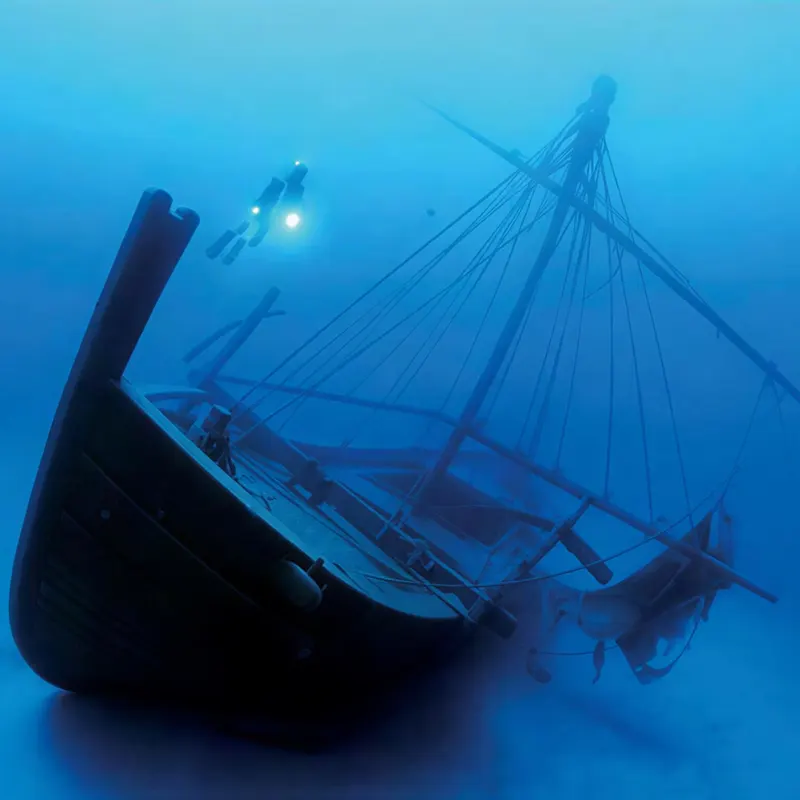
Yeah, so we've talked a bit about Schliemann and his contributions to archaeology in that archaeology as a field has evolved well past the explosive methods that he himself had employed. To a large extent, it grew out of people looking at what he did and saying, okay, don't do this. But it's really not enough to just retrieve the impressive artifacts. That's really the bulk of archaeology. The bulk of archaeology isn't just about retrieving impressive artifacts. It's also about finding a detailed view of the context that they came out of. And sometimes you're going to find that not in the rocky foothills of the eastern Mediterranean, but in its depths. So in 1982, almost exactly a century after Schliemann's excavations, a sponge diver was practicing his craft off the coast of Uluburun on the southern coast of Turkey. And on one of his dives, he found what he called, quote, metal biscuits with ears.
Archaeologists realized from his description that he was talking about oxhide ingots. This was copper or tin in slabs, which resembled a dried leather skin. Shortly thereafter, a submerged ship, which would be excavated by diving archaeologists over the course of a decade, was unearthed. This 14th century before the Common Era shipwreck was a literal poster child of the Age of Bronze before it collapsed. The ship carried roughly 10 tons of copper and one ton of tin, the proportions needed for bronze work. This is the largest collection of Bronze Age ingots found together. The ship was transporting a load roughly similar to those described in the Amarna letters, and some archaeologists have speculated that it was a diplomatic.
Yeah, and just to pause here, the Amarna letters, there are an amazing case of correspondences between Egyptian pharaohs and the Hittite king, and even at least one Hittite queen.
Yes, exactly. And so, rooted in these letters, some archaeologists have speculated that this was a diplomatic gift ship, a way for kings of the region to cement their symbolic brotherhood. This is discussed in great length in the Amarna letters. And the provenance of all these things is quite interesting. It really speaks to how far afield all these trade networks went. The copper was overwhelmingly from Cyprus, but the tin was likely from Anatolian, Central Asian, and possibly British origin. There were also many luxury goods on board that were the antediluvian world in microcosm. To give just a small selection, the sailors aboard the ship were transporting glass, ostrich eggs, ivory, rings, pottery, spices, nuts, precious jewels, and even a gold scarab, which was inscribed with the name of Nefertiti, the famous female pharaoh. The sailors also transported a set of balance weights and writing tablets, believed to be erasable cargo manifests, which would be updated when the cargo was updated at port.
Material richness was paired with an administrative technology that allowed for the management of goods beyond the ability of a single person. Archaeologists have deduced that the vessel was probably of Syro-Canaanite origin and it was probably sailing westward after making stops in the Levant and Cyprus. Its crew was probably multinational if sets of equipment aboard was for personal use. The ship and its sailors went down into their watery grave, undisturbed by the perturbances that would rock this world a century later. Another shipwreck recovered a few decades earlier speaks to the decline of material culture just one century later. Aboard the Cape Gelidonya shipwreck, which was excavated in 1960, we find a very different picture. This would be the first shipwreck excavation carried to completion on the seabed and the first to be directed by a diving archaeologist. This Canaanite or Cypriot ship's hull reflected a marked decline in quality of goods.
There were some copper and tin ingots, of course, but the bulk of the hull was packed with broken bronze tools and weapons that were probably being transported as scrap metal. The cargo was austere, practical, and lacking the finery of the Uluburun hull. And it might just be that this can't be pinned cleanly on the dynamics behind the collapse. Maybe it was just two ships representing very different types of maritime trade, but the contrast is very suggestive. One carried enormous quantities of exotic and precious goods gathered from half the known world, and the other carried the broken implements of a Bronze Age world at dusk, gracelessly thrown into a big heap of junk to be recycled.
Yeah, no, and just for some specific kind of numbers here, it seems like the Uluburun shipwreck was from around 1325 BCE. This one, the Cape Gelidonya shipwreck, was around 1200 BCE, coming perilously close to Eric Cline's 1177 BC date for the end of the Bronze Age system. So even before the Great Collapse happened, we are already seeing a material decline as trade links and possibly even domestic economic production begins to slow down.
I just wanted to add, there's a great quote in one of the books I read, which is, so he's discussing the different types of pottery of Bronze Age Greece, and there's this period of pottery that's clearly Mycenaean, but things have declined called post-Mycenaean. And I think his exact wording is something like: the chief characteristic of post-Mycenaean pottery is that it is bad.
Well, no, you know, we talked about this in post-Roman Britain, how, like, you just suddenly see both lower quantity and lower quality in what products remain. You see broken tools being used because there's no way or no knowledge left to repair them.
Archaeology in the Odyssey
While we were planning this, Sam, you pointed out that this kind of economic data, which is so useful in understanding what the Bronze Age collapse was and how it happened, this would have not really been of much interest to the first generation of archaeologists in the ancient Mediterranean. Heinrich Schliemann, in his frenzied search for precious goods he could associate with Homer, would have thrown all of these non-luxury products onto a trash heap, as he would have missed evidence that spoke to the palatial society of the Mycenaeans. The Gelidonya shipwreck contained brushwood packed between the cargo as cushioning, protecting the hull and its contents. This seems quite mundane. However, this kind of mundane data often does explain not only the archaeological context of the late Bronze Age, but even gives some color to the, or at least some clarity, to more puzzling passages in the Iliad and the Odyssey.
For instance, the Gelidonya shipwreck was filled with brushwood used as cushioning to protect the hull and its contents. This totally corroborates a puzzling line in the Odyssey in which Odysseus spreads brushwood inside the ship he builds. One man's trash is therefore another man's archaeological treasure. Another famous example of material finds explaining the Odyssey is that earlier scholars were very confused by the test at the climax of the work, in which Odysseus shoots an arrow through a row of axes. It is now quite well understood that in the late Bronze Age, Mycenaean craftsmen typically made axes with a hole in the middle that an arrow could indeed be shot through.
Yeah, I was at the Museum of Anatolian Civilizations last month, and there was a bunch of depictions of war gods, like Hittite and post-Hittite war gods, but these big axes that applied.
Yeah, no, I know it's great. Okay, all right. So now, so bringing, so to continue this synthesis of archaeology and, you know, and the works of Homer, let's look at what we can see about the rest of the Mediterranean world during the late Bronze Age and early Iron Age, and what, if anything, this kind of archaeology can tell us about the works of Homer.
Crete and the Minoans
So let's start with Crete. So Crete is not visited physically in either of the Homeric poems, but features very prominently in reference. I think, you know, the best example, as we mentioned in our previous episode, at one point in the Odyssey, Odysseus pretends to be from Crete when he's traveling undercover in his own kingdom of Ithaca. Interestingly, at one point, he describes how he spent a long period in Egypt, in which he both plundered the Egyptians and also served the Egyptian king. This story, as well as an earlier story about Menelaus fighting in Egypt, could possibly point to some folk memory of the activities of the Greeks as Sea Peoples. I know, Sam, you pointed out that the Sherdesh, in particular, who are, excuse me, the Sherden, who are typically associated with the peoples of Sardinia, also have some interesting parallels to these stories by Odysseus and Menelaus.
But bringing this specifically back to Crete, Crete, settled by the Minoans, would have been the first real civilization in what we can consider Europe. The Minoans had their own writing system, Linear A, still untranslated, but this would become the basis of the Linear B writing system of the Mycenaeans. Many elements of Mycenaean Greek palatial culture appear to have been borrowed from the Minoans. Additionally, Greek mythology has various references that seem to be, again, this folk memory of the Minoan Bronze Age. The best example of this is the name Minoan itself. This comes from the mythological king Minos, a figure mentioned by Homer, who was the legendary tyrant of Crete, the relative of the infamous Minotaur, who, of course, imprisoned young Athenian youths in his infamous labyrinth, and also was said to have built the first navy. Minos, who is also remembered as a lawgiver akin to Moses, is said to have become one of the judges in the underworld after his death.
All of these examples could suggest that the Mycenaean Greeks and their later archaic era descendants had some memory of a period of Minoan cultural hegemony over the Aegean. However, it seems that by the time of Homer, Minoan speakers had been reduced to a minority on the island of Crete.
Isn't there a reference in the Odyssey where Odysseus speaks in, there's a reference to Cretans speaking in mixed speech?
Yes, yes. The phrase Eteocretan, which means speakers of the original Cretan language, this is used by archaeologists and historians today. That comes straight from Homer, because Odysseus, when he's pretending to be a Greek from Crete, he says, oh yeah, I come from Crete, where Greeks live among the Eteocretans, speakers of a different language. If we had unlimited time, we could go forever about the Minoans. They were a fascinating civilization that has so many correspondences to the Greeks of the classical period. For instance, their emphasis on athleticism and on youthful beauty, but they are in many other ways extremely alien. They appear to have been much more egalitarian in gender. They were probably less martial than the Mycenaeans and the classical Greeks. However, in the interest of time, I think we should really just focus on what we can say about how Minoan archaeology informs our understanding of the late Bronze Age.
Minoan art and Arthur Evans
Yeah, so I spent about a month and a half on Crete. Crete's kind of like the earthly paradise. It's close to my favorite place on earth. It actually kind of brought back my interest in the Caucasus. Like I was just there fresh out, relatively fresh out of college, didn't really want to know what to do with my life. I'd kind of given up my interest in the Caucasus. And then I kind of reached this land of like mountains and weird traditions. And I was like, oh, yeah, this is how I imagine Georgia. So I went over to Georgia after that. But Minoan art and architecture, it's really astonishing when you see it. Like, I feel like everyone who kind of gets involved, interested in Minoan art or culture, kind of becomes almost like an otaku where they can't stop saying positive things about it. And of course, this goes all the way back to Arthur Evans, the early 20th century archaeologist, who was kind of like the Schliemann of the Minoans.
No, but there are some interesting differences here. So like Minoan art, it often has famously attractive people with very exaggerated characteristics.
Yes.
But what's interesting is that it's often flipped of Greek art styles. So the men are often very svelte. They're kind of like more twink-adjacent. Even the depictions of fighters in Mycenaean art are clearly based on Minoan dancers a lot of the time. So you have like Mycenaean battle scenes where everyone looks like they're in a yaoi or something. It's this very weird, very thin kind of like masculine ideal if you're used to Greek art. And then of course there's the Minoan female ideal of beauty, which is kind of funnier because it's very, very exaggerated in terms of sexual characteristics.
Famously, yeah, yeah. Minoan women's clothing would have been extremely revealing compared to basically any other society from that time, even from that time or place.
Yeah, yeah. And they all look like they all look kind of like anime porn or something like that. They all have really exaggerated forms. Like, for whatever reason, they all kind of look like Lady Dimitrescu from Resident Evil. Like, they're all like tall and a bit scary and very feminine.
Well, no, even back, you know, even in Arthur Evans' own time in the early 20th century, that was identified. I think the most kind of infamous example is that there's one image of a Minoan woman. It's only all that survives is her face. But she has very big eyes and bright red lips and one very kind of cute little hair curl. And a French guy shortly after Evans' time looked at her and said, Oh my god, she's a Parisian.
She's like, They all look like Gibson girls, and I don't think that's a coincidence, right? They all have this like turn-of-the-century kind of like maybe Jewish Mediterranean kind of like aesthetic. And I don't think that's a good idea.
Yeah, no, we know, of course, here we should mention that, much like the case with Schliemann, Arthur Evans' credibility as an archaeologist has come under fire in the ensuing century. It has been alleged with some significant basis here that he reconstructed or manipulated the art that he uncovered to present a specific exotic, often erotic image of Minoan life that might have to do more with his own interpretation and even his own handiwork than the actual art that was left to us. Many of the most famous Minoan artworks are largely reconstructed. This is true of many historical artifacts, but I think it's especially true with the famous frescoes of the Palace of Knossos.
But just to get into this, like Mycenaean palace culture, like the Mycenaean kind of warrior government style, it comes out of contact with the Minoans. Like, it's a militarized form of that at a certain price. Like, I did want to make that clear.
Minoan warfare
Even though the Minoans appear to have been much less martial than the Mycenaeans, we do have some evidence of Minoan warfare. I know that, again, bringing this back to Eric Cline, he argues that the Minoans probably did have a real thalassocracy. Because they were the greatest sea power in the Aegean world, they didn't have much need for hand-to-hand combat. So, you know, that kind of warfare wasn't really prioritized by their society or glorified the way it was by Greek speakers. And the iconic Bronze Age rapier was probably developed by the Minoans.
Like, if you ever see a very thin Mycos Age.
I didn't know that.
Yeah, if you've like, there's this famous, I posted about it today. There's the famous Pylos combat kind of combat agate, yeah.
Which is beautiful. One of the, like, I saw that in person at the Getty Villa in Los Angeles. It's incredible when it was on display there. It's for anyone who's not familiar. This is a piece of artwork. It's a single carved jewel from the late Bronze Age that has a shocking level of anatomical fidelity. It looks like something from like the Hellenistic period a thousand years later. It's it's almost without analog. And I know that historians and archaeologists worked very hard to make sure it was not a forgery because it's so unlike other Bronze Age artworks, but it's beautiful. Google Pylos Combat Agate right now, it'll blow your mind.
But also, it is interesting because it's distinct in a few ways. Like, the helmet on the warrior who's being stabbed looks almost more Celtic. Like, it has this kind of intricate bronze design on it that's really cool looking. And the sword that's being used is this very thin Mycenaean rapier, and they're all twinks. Like, the bodybuild of every male figure in it is very distinct and different from Greece.
And again, this is the perfect example of how we see these, we see many correspondences with like both Mycenaean Greece and later classical Greece, but also very many differences in art, possibly in attitudes toward gender, and of course, attitudes toward warfare.
Greeks on Crete and Cyprus
We should also mention that, so you know, the Minoans would be essentially taken over by Greek speakers at some point in the late Bronze Age prior to the Bronze Age collapse. We don't know exactly how or when this happened. It probably would have been a somewhat gradual process, not associated with major violent destruction. Instead, it's likely that, you know, Minoan, that Mycenaean Greeks coming either as conquerors or as invited mercenaries became a new upper class. Possibly after this seizure or ascension to power in Crete, we begin seeing increased cultural connections with other Greek islands and of the Peloponnese heartland of Mycenaean Greece. And then, and it's very possible that Crete may have been the beginning of a process of Mycenaean Greek expansion all across the Eastern Mediterranean toward places like Cyprus, which we'll discuss in a moment. I have a little bit that I can say about Cyprus and its role in the Bronze Age collapse, Alex.
But curious, what do you know about Cyprus? Of course, it's a very hot topic in modern Eastern Mediterranean politics, but I'm just curious, like, did you have much familiarity there with the history and the culture?
Not as much. It's kind of less interesting to me because it's not as mountainous. Like, it's famously quite a bit more arid than Crete is.
No mountains, and yeah, you don't care.
Yeah, pretty. Not exactly, but that is, there's some truth there. It's funny. Like, Crete, like, when you talk to Greek, they will, they all kind of consider Crete like a pearl. Like, it's actually quite wealthy, partially because of agricultural exports, just because it's like a big garden. Cyprus is more arid. It's historically more connected to the Levant for various reasons.
Yes.
But it is interesting for the narrative of the Bronze Age collapse. It is true that Linear B doesn't have a descendant, but Linear A does, because the Cypriot syllabary is used up until the Hellenistic period.
That's right. So, yes, so that's basically what we're about to say here: is that so Cyprus is a really fascinating case study in the Bronze Age collapse because it's one of those places where there was significant transformation, but not the same kind of collapse or destruction that we see elsewhere in the Mediterranean world. Instead, during this Bronze Age collapse, we see the ascension of a Greek-speaking elite that look somewhat different to other Greeks in the Iron Age, but preserved much more of the Bronze Age culture of Mycenaean Greece than any other Greek speakers did. So, it seems that in the late Bronze Age prior to the Bronze Age collapse, Cyprus would have been this kingdom of Alashiya, which was under significant foreign influence, first from the Hittites, then from the Sea Peoples, who would have included many Greek speakers. It's difficult to know if the Mycenaeans conquered Cyprus out of pure avarice, or if instead they ascended to power, filling a vacuum left by the Hittites in retreat.
It's probably something of a mix of the two. One of our only references to seaborne attacks outside of Egyptian sources comes from a Hittite governor of Cyprus, who isn't sure what to do about attacking peoples from across the sea. What we do see on Cyprus after the Bronze Age collapse is the emergence of a vibrant Mycenaean Bronze Age style society, much more sophisticated than anything left in the Greek heartland. It appears, therefore, that Cyprus was basically immune to the kind of destruction we see elsewhere in the early 12th century during the Bronze Age collapse. And it is very possible that Cyprus might have been a place of refuge for Mycenaean aristocrats fleeing this kind of destruction in mainland Greece and other islands.
So it's a bit like Brittany.
Yes, exactly. It's much like Brittany we see in their relationship to Celtic Romano-Britons fleeing the Anglo-Saxons. What's also fascinating, like you said, is that these Greeks would develop their own writing system, the Cypriot syllabary, which was apparently derived from the Linear A of the Minoans, just like the other Mycenaean writing system, Linear B. This Cypriot syllabary would remain in use all throughout the Greek Dark Age and even into the Greek classical period, like you said, basically up until Hellenistic times. This would be much, much longer than the usage of either Linear A or Linear B. Also, now that this Cypriot syllabary has been translated, we can understand that the language of classical era Cyprus was a Greek dialect extremely similar to that of the Bronze Age Mycenae, whose dialect would have been replaced in mainland Greece by the Doric and Attic dialects. In this sense, we really may be able to see Cyprus as this last holdout of Mycenaean society.
This really fascinating counterexample to the kind of decline and destruction that we would expect to see in this period.
The end of the Bronze Age beginning, huh? Sam, do you know what this is? This is Belarus. If the collapse of the Soviet Union is the Bronze Age collapse, then I mean, it's a continuation of a command political economy of authoritarianism, of the actual party structure.
Okay, I see what you're cooking.
That's what this is, right? It's like the one weird little part of the Soviet Union that continues.
The Phrygians
All right, we know. Well, it brings us back to another interest of yours, Alex. Let's talk now about what happened in Anatolia after the Bronze Age collapse. I know you know you mentioned previously the Phrygians. What can you tell us about those guys?
So, the Phrygians looked like they were at one point a Balkan culture. I'm going to try and speak in generalities because a lot of these are not very well known.
Yes.
I remember right, there's some kind of confusion on their physical geography.
Actually, and just to pause there, knot, comma, very well known. That describes the Phrygians quite well.
Yeah, fair enough.
As they're most famously associated with the Gordian knot of the city Gordion.
No, no, no, no, no. But they speak a language that's quite closely related to Greek. Like famously, there's the Greek still story of the Egyptians trying to figure out like the first man.
Oh, yeah.
The speech of the first man, so they lock a child away to not speak. And his first word is the bekos, the word for bread in Phrygian. And the idea there is the Phrygians are like closely related to us, connected somehow. But anyway, as the kind of late Bronze Age system collapses in Anatolia, the Phrygians appear to have moved in to kind of the central plateau. Not necessarily.
The same central plateau that the Hittite, that had been basically the headquarters of the Hittite Empire.
A bit west of that. So a lot of the central land of Hatti is east of a river that's now called the Kızılırmak. Like a lot of this area would have been quite central to the Hittite domain, but not quite the core. But anyway, they end up probably replacing a lot of the actual Anatolian languages, which I think actually helps explain why Greek kind of peacefully, relatively peacefully, ends up becoming the dominant language in much of Anatolia. It's because it's already been replaced by Phrygian, which is very similar.
It's quite similar.
Yeah.
Like I said, in addition to the story of the Gordian knot, the Phrygians also enter, I guess you'd say, you know, broader Western tradition through the story of King Midas, who supposedly could turn anything to gold. He is specifically a Phrygian king. I'm curious if that might say anything about.
You know who his wife is in Greek mythology?
No, no, I don't actually.
The direct descendant of Agamemnon.
Oh, that's really funny. That's interesting. And I wonder if there's any chance that this could attest to a period in which there may have been influential, very wealthy Phrygian rulers whom descendants of the Greek palatial rulers might have wanted to, you know, make marriage alliances with.
I mean, it's, I think a lot of these Western Anatolian cultures and Greeks would have been very closely connected. Like, Herodotus often says kind of like nice things about these people, about how similar they are to Greeks.
But Herodotus is, I think, from Smyrna. So he would probably say that in Herodotus.
Yeah, I think he, modern Izmir. I think just in general, there would have been a lot of cultural similarities, especially after the end of the Hittite Empire, the kind of Sea Peoples mixing everyone up, and the increased Greek dominance of the coasts.
Neo-Hittites, Urartu and the Mushki
We discussed this in our previous episode, and one thing we should add here, just describing the collapse of the Hittite state, we see in western and central Anatolia this new group of people, the Phrygians, move in. In Eastern Anatolia, we see a complete collapse of power. However, Hittite territories in Syria, which would have been ruled traditionally by a son or grandson of the Hittite king, these territories, these neo-Hittite states, would remain basically Hittite all throughout the Iron Age and appear to be the Hittites mentioned in the Hebrew Old Testament.
Isn't Uriah the Hittite like a lieutenant of the army of King David or something like that?
Yeah, yes. Yeah, no, he's the husband of the first husband of Bathsheba.
Yeah. Like, it's quite interesting how connected those are, but the actual situation in central and central Eastern Anatolia gets quite complicated. Now, Eastern Turkey looks like there's some kind of replacement there. I think there's something called the Mukhi, the people called the Mushki in Assyrian kind of early Iron Age literature, and there's a lot of arguments over whether they were Hurro-Urartian-speaking or Proto-Armenian.
For anyone who's unaware, Urartu is an Iron Age kingdom, which is very important to the modern Armenian political identity, although they appear not to have spoken the Armenian language at that point.
Well, I listen, like, people are not going to be surprised to hear me talking like a 90-year-old, like, Armenian, a retired cab driver when it comes to a ship like this. But, like, archaeogenetic and linguistic information now puts the formation of the Armenian people in the South Caucasus in the Middle Bronze Age, late Bronze Age period.
Which would have been before Urartu was founded.
So, yeah, so there definitely, there certainly is continuity between this ancient kingdom of Urartu and the modern Armenian culture. I'm not trying to say there's no link there.
If anything, what we saw in our last episode, this part of the world was extremely multilingual. So, even if we have linguistic records of one language being spoken in a city, this does not mean that was the only language spoken day to day by its inhabitants. It might have only been in usage as a ritual or a legal language. Yes, I've also heard arguments that the Mushki were proto-Georgians.
Yeah, I so the Mushki, that ethnonym is used later on in like an area of like southern Georgia, like the area near the Georgian-Turkish border. And by that point, it looks like that that ethnonym applies to Kartvelian speakers, I think. But I think at that early date, it might have been used by people who spoke an Indo-European language. But the issue here is that like... These might have been like multilingual tribal confederations or like maybe the Assyrians just use this one general term or something like that. It's hard to know. And something I find funny is that people have a hard time understanding this. But this is just the linguistic situation that regioned the Ottoman Empire. Like the pastoralists would speak Kurdish. Some of the town dwellers and farmers would speak Armenian. And if you wanted to go into the city and talk to a bureaucrat, you'd probably have to know some basic Turkish.
Well, you know, that's why I think that you have this specifically Anatolian perspective, Alex, because that I think is such a cool way to understand ancient Anatolian society, because there's just so many fascinating correspondences. I mean, like, it's quite funny. Like, I was reading about the Kura-Araxes civilization. This would be an early Bronze Age civilization in the Caucasus that had some interesting links with the formation of the Proto-Indo-European language.
Right. So there's this period of collapse that is linked to what looks like possibly intrusion of an Indo-European people, possibly a people ancestral to the Armenians or people who spoke like a language that could have looked like that could have eventually formed off into something that at some point becomes the ancestral to Armenian. But it looks like there's a shift towards like pastoral societies, Kurgan burials. But there's also some suggestion in the archaeology that those people were already there. It's just that some kind of social shift happened and the pastoralists had more power after that.
Greeks in western Anatolia
Well, all this is super interesting. You know, I would love to learn more in the future about ancient Georgia and Armenia, but let's bring this back to western Anatolia because that is what's most germane here to our discussion of Homer and the Odyssey. One thing I find very interesting is how, after the Bronze Age collapse, after the events described in the works of Homer, you begin to see permanent Greek settlement on a much more significant level in western Anatolia. Three regions in particular: Aeolia, Ionia, and the Troad. That being the vicinity of ancient Troy itself. We discussed in our last episode, there appears to have been some presence of Greek speakers in the city of Troy prior to the destruction of that city during the Bronze Age collapse. After the Bronze Age collapse, the area, the Troas, appears to have been significantly Greek-speaking. Ionia, another one of those Western Anatolian Greek-speaking regions, would of course become the legendary birthplace of Homer, and presumably where the Iliad and the Odyssey were both composed.
Centuries after Homer, Greek writers acknowledged that the Greek speakers in these western Anatolian regions derived some of their identity from local Anatolian peoples, such as the Carians and the Lycians. It should be noted that both the Carians and the Lycians appear to be mentioned in one of the Egyptian lists of vanquished Sea Peoples. This could suggest that the relationship between Greek speakers and Carian and Lycian speakers was quite complex. Prior to Greek settlement in these regions of Western Anatolia, you may have seen Greeks and Carians and Lycians fighting side by side as mercenaries or as raiders all across the eastern Mediterranean. One third Western Anatolian group also deserves mention. These are the Lydians, who would form the most significant Iron Age kingdom in Western Anatolia, and also are quite notable for their apparent invention of metal currency. You mentioned, Alex, that some scholars have suggested that Homer's apparent origin in Western Anatolia may have given him a unique sensitivity to the culture and history of that region, including that of, you know, including the Trojans.
What can you share about that?
Homer's Trojans
So I've thought quite a bit about this, and I think there's a bunch of these kind of like epic stories that are about kind of like ethnically pure heroic past. So like, I think it's interesting that the Anglo-Saxons have the story of Beowulf, because it's of like the Danes and like Scandinavia before like when people were real men when they lived in the old country, right? But what I think one of the reasons the Iliad and to some extent even the Odyssey are kind of stick with the culture and are so incredibly compelling is that they're the Trojans are allowed to have like interiority, right? They have their actual people, like Troy specifically. Zeus says that Troy is his favorite city on earth and King Priam's favorite king, right? I mean, like, and then Hector is probably the most fully realized character in the Iliad, and he's certainly, I think, from a modern perspective, the most relatable.
And I think he probably would have been to a contemporary audience as well. I think you run into problems when you think of Achilles as right when you're still as kind of like unironic hero because like he gets a bunch of soldiers killed. And especially for like an archaic Greek group where like everyone where a bunch of people would have had like actual functional knowledge of fighting. The idea of this like wunderkind sulking off, spending time with this slave girl and like his like best friend during actual fighting when the actual war is at stake, I think that would have been quite clearly a real thing from Homer's perspective. Well, Hector is like occasionally, Hector occasionally fucks up. You can say that he's stuck in this honor system where he's not able to flee Troy with his family, which is maybe what you would do from a modern perspective.
But Hector, like he fights, he dies, he's loved by his father, he's devout, he's devout, right? And I think that is what makes it so compelling, is that it's from this like mixed Greek Anatolian cultural background that is able to give functional respect to a people who are different. And I think that is distinct. I think that's interesting.
Achilles and the collapse
Absolutely. Right. And I think that Achilles is such a fascinating figure because he's very different from our association of a classical hero in that he is in no sense dutiful. He's extremely selfish to the point of self-destruction. You know, his death is extremely clearly foreshadowed time and time again in the text of the Iliad. And he brings to mind these kinds of Anatolian bandit figures who might be celebrated as a Greek national hero or a Turkish national hero due to their activities in various wars, but really were only out for themselves, just trying to increase their own glory and defend their own honor. I think we can probably assume that real-life figures like Achilles would have been extremely prominent during the real Bronze Age collapse. Men and women like this, these self-interested fighters, probably would have been the ones leading raids to destroy existing urban settlements, both in Greece itself and far afield through seaborne raids.
We know very little about how and why mainland Bronze Age society collapsed in Mycenaean Greece. There are many old, various conflicting models. Was it an invasion by their hinterland cousins, the Dorians? Could this been evolved because of drought and disease? But I think it's clear that on the human level, there would have been selfish individuals, people like Achilles, who, possibly without realizing it, were indeed contributing to the downfall of their own civilization. Bringing this back to Christopher Nolan, his kind of imperial boomerang argument, I think, is, it's of course entirely conjecture, but I don't think it's necessarily a wholly illegitimate way to understand how the Bronze Age worlds collapsed. I think it's very possible that violence abroad could have been turned inward against Mycenaean society itself. And that, just to kind of wrap this up here, Alex, we've been going on for quite a bit now.
What are your thoughts personally, on what Homer can tell us about the end of the Bronze Age world in Greece itself?
Mad Max and Homer
The comparison I think actually works best for Homer and the world that we're dealing with is the Mad Max films. Like I mentioned this in the article, George Miller, the director of this series, is, I think he's half actually Anatolian Greek and the other half is Cycladic Greek. So he's kind of really deeply in this. And I think in some sense, what we're dealing with is there's a hint at the end of Fury Road that these are kind of like epic stories being retold like decades, maybe even centuries afterwards. Like there's a storyteller at certain points in the movie. There's kind of a suggestion that we're dealing with like conflated events, a timeline that doesn't make sense, but they're all kind of like trying to make sense of a past that has these exaggerated heroic figures, right? And the image that I love of this is one of the opening shots from Fury Road is of the back of Immortan Joe, and you see it's diseased and everything, but he puts this armor on of all these medals of wars that were fought decades previous.
That no one has any social context, any understanding of any of these wars, of these wars that Immortan Joe fought. But he still goes up there every single day wearing these medals because he was the great hero of these wars that destroyed all of civilization.
I think it's, I think, that's exactly. He is the Bronze Age wanax becoming the Iron Age basileus right there.
Yeah, exactly, right? And that's what's so cool. Like, he's this figure of transition. And that is what makes him compelling. And that is why, like, I think this is such an exact comparison that I do kind of wonder if having Charlize Theron in The Odyssey is a specific nod to that.
I don't think I would go that far about that, but I like where you're thinking.
Did the collapse make democracy?
And, you know, I think we should wrap this up here now, but I want to ask one more question here. This is something that I've been thinking about a bit. This is quite a major topic of scholarship, but so little can be said about this conclusively. This is still one of those subjects where rampant speculation is allowed. So I want to hear your rampant speculation here, Alex. I want to ask you, what do you think the end of the Bronze Age palace economy has to do with the ensuing rise of city-states and democracy in the Greek world? This is to say, do you think it's possible that the fall of the Bronze Age monarchies and the predations of the Sea Peoples are the reason why democracy exists today? Yes or no?
Direct line, no. But they made the world possible. And in the various, like in the Circassian principalities, like the north of the Caucasus, north of Georgia, there were a bunch of these semi-Islamic kind of semi-feudal principalities. And we have these records of the Western principalities moving towards oligarchic kind of non-princely rulership at some time during the sometime around the French Revolution. And so occasionally you'll see like Circassian historians, especially like Marxist ones, trying to connect this to like, oh, some like Jacobin walked up on the shore of like Lake Maeotis and like spoke to the Circassians about the beauty of Republican government. But, like, I maybe that was true somewhere, but like, I think these like shifts from oligarchy, I mean, even the Greeks talk, the ancient Greeks themselves talked about this, right? The nature of like tyrannical, oligarchic, democratic government, how they go in between each other.
Like, I think that is true. I think what is kind of more interesting is the formation of not just trade links, but like personal links, like the formation of a kind of coherent Greek world that would eventually make the kind of level of commerce that the poleis developed kind of possible, right? Because it might be.
One strange change that you see after the Bronze Age collapse is the expansion of Dorian Greek dialects all across nearly all of mainland Greece, except for the vicinity of Athens. And it was once believed that there was some kind of violent migration by Dorian speakers from the northern hinterlands into the rest of the Greek peninsula. This, something like this, may have happened on a limited scale. I think it's also just as possible that as international trade connections declined, you began to see more overland trade leading to a flattening of dialects across most of the Greek mainland, interestingly, but not with outward-looking Athens, who instead maintained their own dialect, which was more similar to the dialect of the islands.
Something, and kind of, I think, I do think there is like folk memory of the Bronze Age collapse in some ways, because we actually have a story of, I think it's of the Heracleidae or the House of Sparta after the exile of the line of Agamemnon. They fight over their bones. They fight over the bones of like, the these like ancient heroes because they want to claim legitimacy from them. But, like, we do, I don't know. I do think the Greeks for a long time had an idea that there was a more sophisticated time that they only had to. And I think, and yes, again, and I think Nolan is right about that with Homer there.
And, you know, like the betrayal of Agamemnon, as depicted, you know, both in the Iliad and the Oresteia, that also seems like it could be a metaphor for the collapse of the internal destruction of this palatial society. And in the Odyssey, the great threat there is that the avaricious suitors are going to destroy Ithaca from within because they have no respect for tradition and for law. This might have been kind of what the collapse of any given palatial society might have looked like.
I think the vibe there is kind of correct in a lot of regards. Like, I think he really did kind of nail this kind of like Mad Max or The Road kind of feel of an actual sense of apocalypse of the ending of all political order and kind of like the death of norms. I just think a lot of the criticism of it there was genuinely quite silly sometimes.
Yeah, yeah, no, absolutely. And again, like one of the very few things we can say for certain about the Bronze Age collapse is that it happened. There was a Bronze Age world and then it was gone. We know extremely little about, conclusively at least, about why and how this transition happened. But I think it's clear that had this transition not happened, Greek society as we understand it could not have come into being. There have been other theories here and there really weren't hypotheses that what if the destruction, the internal destruction that you see in Bronze Age Greece could have been from internal social revolutions? What if the Dorian dialect was the dialect of the peasants and the slaves, which then became prominent after they overthrew the kings? What if the suitors in the Odyssey were actually a metaphor for the lower gentry who overthrew the more powerful kings and established their own little petty chiefdoms?
We will probably never know for sure unless there are sudden new translations of late Bronze Age texts or amazing archaeological discoveries. But it is very interesting to think about the ways that this kind of collapse does allow for this new order to be born. I think in the simplest directional sense, it is true that the Bronze Age collapse led to the rise of democracy only because, as you said, this power vacuum allowed new systems to be able to develop. But the difference in the difference in time from the end of the Bronze Age to beginnings of Athenian democracy is so vast, it really isn't a direct link at all. Well, yeah, this is a great one. This is much like the Odyssey itself. This is kind of a fun little ramble across space and time, but it's always so fun to talk about the Bronze Age with you and Anatolia.
Final thoughts
Sam, any questions for Alex to close this one out?
I mean, not really. I'm just very happy that Alex has stayed with us over all of these episodes. Thank you again. We're really looking forward to your article actually coming out because it's a banger.
All right. Well, thank you so much, Alex. And thank you, Sam. This has been a fun one. Yes, Alex, anything else you'd like to add to close this out?
Yeah, just I've made a version of this point before, but between Dune, which you know, actually does Paul Atreides is like literally the descendant of Agamemnon in the book. And there's like influence of the Iliad and is quite present in all of the series. I just think that if, I mean, if you've written, if you've gone these far into these episodes, and you probably have already reread Homer, but this is just such like a rich world to dive into at a time of like real feeling of cultural impoverishment and questioning of what like Western, quote-unquote, Western culture even is. And just like pick these books up, read about them, like try and learn from them. There's so much, it's incredibly rewarding once you get into it.
Yeah, no, at the very least, you'll have so many amazing similes in your back pocket every time you describe something.
Yes.
Yes, everybody. You know, so everyone listening, please check out Alex's new article. We will make sure to share it in the show notes. Thank you and goodbye.
Bye-bye.
Bye.
The show is also on Apple Podcasts, Overcast, Pocket Casts, Podcast Addict, YouTube, RSS and Patreon.