107
Neo-Druidism and The Wicker Man
In progress2000 years ago, Roman began a campaign of suppression against the defiant sages of barbarian Gaul. Yet millennia later, these druids survive. Their memory would inspire generations of alchemists, aristocrats, alternative-spiritualists, and eventually the creators of Britain's most iconic horror film.
On this week's episode of Gladio Free Europe, Liam and Russian Sam continues their survey over the druids, moving from the practices and beliefs of the ancient holy men to the generations of occultists and eccentrics who have sought to recapture their arcane knowledge. The strange road of neo-druidism winded its way to inspire The Wicker Man, the immortal 1973 picture set on an island of new-age recluses who revive their ancestral beliefs with murderous results.
For over 500 years, scholars and hobbyists have pored over the scant surviving references to the pagan priests of the ancient Celts, convinced that Western Europe's first recorded wise men were key to understanding the history of modern peoples in Britain and Ireland. These scholars, looking through a kaleidoscope of ideology, all believed they could use the secrets of the druids to advance their own spiritual and political agendas. Figures like Conrad Celtis, Iolo Morganwg, William Stukely, and Margaret Murray wore the robes of the druids to advance the cause of Christianity, anti-Christianity, Jacobinism, Jacobitism, freemasonry and deism. Neo-druidic belief and ritual has been used to promote a unified British imperial identity, and to defend regional Celtic cultures against English domination.
Listen to this week's episode of Gladio Free Europe to see how a half millennium of European history has shaped and been shaped by memories of the druids, the world's most enduring counterculture.
Transcript
The Druids, continued
We are back with Gladio Free Europe. I am here with Archdruid Russian Sam.
Hello, hello.
And we are continuing our story of the enigmatic pagan priests of the Celtic peoples. Those, of course, being the Druids. In our last episode, we went over basically every extant source of what is known of ancient Druidic practice. It's the handful of sources that we have mostly come from the Greeks and the Romans, as well as the much later Irish mythological tradition that seems to record a parallel tradition of Druidry much later on. What's interesting and so tantalizing about the Druids is that although they've captivated the imaginations of writers at the same time that they existed and for so many thousands of years later, we really know very, very little about them. There's some that we do know for certain. For instance, their practice involved some degree of nature worship. They appear to have believed in a system of reincarnation, and most infamously, they often carried out brutal human sacrifices.
All of those points I just said have at one time or another been contested by some scholars, but contemporary scholars generally agree that all of those points do represent what Druidism actually looks like. The funny thing with this topic, though, is that if you're looking at druidism, to understand the cultural appraisal of the druid, I think it's not enough to just look at the true druids in their own time. Instead, you have to look at the broader view of later appraisals of druidry, especially by early modern 18th and 19th century scholars, eventually leading directly to modern-day neo-paganism and Wiccan folk religions. I think that the Druid story, looking at the continuing history of the Druids, the Druids' resurrection and afterlife, you could say, is a really fun skeleton key for understanding so much about contemporary intellectual developments and even a lot about contemporary pop culture. So this is going to be a big one.
We're going really far across the centuries looking at the various ways later peoples have interpreted ancient Druidism and appropriated a legacy of the druids for themselves, often trying to imitate these supposed ancient practices. But we're also going to talk about the most famous and the most fun modern example of druidism, that being the 1973 folk horror film, The Wicker Man.
Oh, yes. But before we continue, Liam just mentioned the imitators. I just want to remind you guys that I am an arch Druid and we have the real deal here. So we are currently raising money on our Patreon to build stone circles so that we can, you know, appease the gods out there.
Yes, yes.
Give us a few bucks on Patreon and that'll go to our stone circle fund.
Yeah, yeah. So America deserves its own Stonehenge.
The Wicker Man
All right, but you know, so to get started here, we figured the best way to open up this whole discussion about neo-druidism with the only movie to really deal with this topic in a very fun way. And it's such a great movie. It's one of my favorite horror films, and it's really one of the most important films in the development of horror. It helped establish an entire genre, folk horror, with many imitators, few of them that come close to holding candle to the original. And it's a really fun, interesting movie. So, Russian Sam, you can lead us off. Tell us just kind of your before we get into the plot or anything, what are your general thoughts on The Wicker Man? I know you've seen it before, right?
Yeah, yeah, I saw it last year for the first time, and then I rewatched it again this year to stay fresh for this episode. And I mean, I generally wasn't super into horror when I was coming up, so you know, this is sort of like baby's first folk horror movie, as I understand it. But for me, I just came to it as like a fully-fledged adult with my own tastes. And I mean, I have to say, it's really, really masterfully done. It's like, you know, it's very spooky, it's very foreboding. It's got all these great elements where, like, you know, you can sort of tell where it's going to go, but at the same time, it manages to leave a very stark impression on you and keeps you, you know, thinking about it for a long time to come.
Definitely. And for both, foreboding is a great word here because it's so different from most other horror films in that, to be honest, it's really not very scary, but that doesn't mean it's not incredibly creepy and nerving because there's this constant sense of suspense and terror as you're never exactly sure what is going on on this island.
Inspector Howie on Summerisle
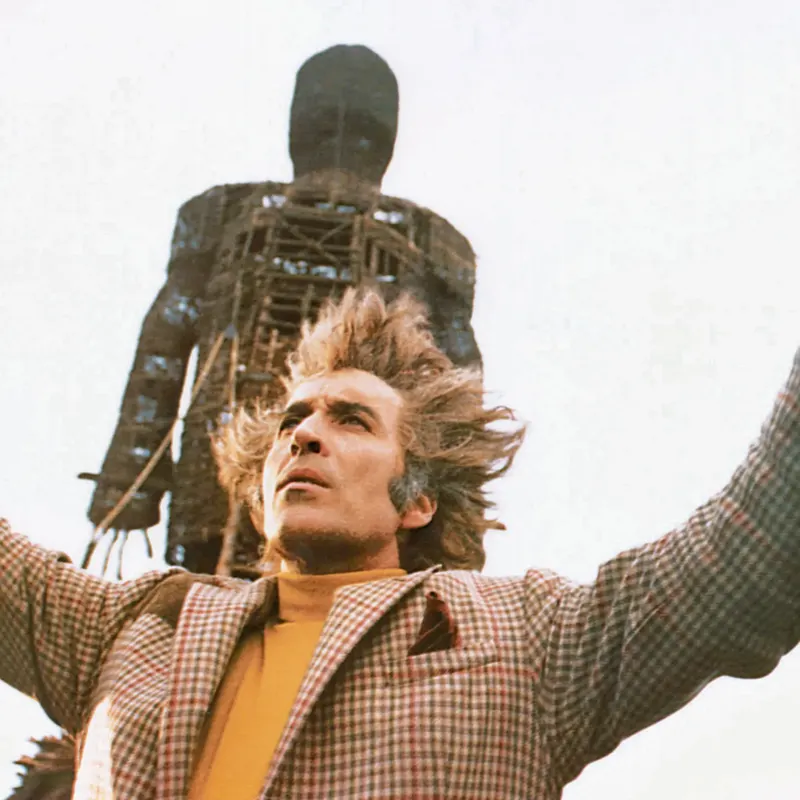
And so, just to dive into the plot here, it's basically a film noir. It follows a detective, Inspector Howie, played by the future TV star of the Equalizer, Edward Woodward, who comes to the remote Summerisle in the Scottish Hebrides. Even though this is up in the frigid North Atlantic on this island, vegetables and fruits grow bountifully, and there are even palm trees everywhere. This is actually, in fact, true. There are some palm trees across the British Isles, including on the Real Island where they shot this movie. Like in so many film noirs, Inspector Howie is on the hunt for a missing young girl, 14-year-old Rowan Morrison.
Like right off the bat, the movie just dives you right into what you're expecting. Like, because, you know, like the credits roll and it's all these stunning landscapes from like up above.
As Inspector Howie is.
There's this strange Robert Burns, yeah, with this strange Robert Burns song playing in the background. Corn rigs and barley rigs.
Yeah, yeah, there are some real bangers in this one. And once again, very, very foreboding and very unpleasant to listen to as you progress through the movie. But yeah, so like you see the shot of like the landscapes from above as he's flying on his sea plane and he finally lands on the island and nobody is cooperating with him at all. It's just incredibly suspicious. It's like he senses that like everyone is in on some big secret that he's not privy to and he's just driving himself crazy trying to uncover just what it is.
Definitely. And I think also it's one thing that's also a really interesting choice is that these kinds of movies about you know someone going into a spooky town, usually the people in these kinds of stories, the people there are very have a very flat affect. They're not willing to disclose much. But Summerisle and its people aren't like that. Instead, everyone seems to be jolly and having a good time. They might refuse to answer any of his questions.
Maybe too good a time.
Exactly. That's it. And we see that actually the people here are so happy and sanguine. They're actually the complete opposite of our Inspector Howie because this, our protagonist, is an incredibly devout Christian. And as we soon discover, this is a very non-Christian, strange locale. Like, you know, for instance, when he goes into the town tavern, and this has one of the all-time best scenes of everybody, everybody stops talking, the music stops playing when the stranger walks in. And a lot of fun tropes from all over the place coming in here. And as soon as he meets the daughter of the town's innkeeper, who I have to mention is played by a professional mime named Lindsay Kemp, who went on to be David Bowie's chief choreographer. This young, beautiful woman comes in to greet Inspector Howie. And then the whole bar starts singing this body song about the landlord's daughter.
Yeah, and calling her a hoe basically about how you want to find that. You're like slut-shaming that this young woman who, you know, who works in the tavern.
And this young woman, Willow, she is played by Britt Ekland, who'd be a future Bond girl. I think she, this is kind of a controversial character because she's almost entirely in the movie, basically for sex appeal. So this young woman, Willow, leads Inspector Howie up to his room in the tavern. And then that night, she attempts to seduce him in the funniest way possible.
Oh, yeah.
Yeah.
She's just like singing this song, like banging on the wall, like basically telling him to come smash.
Yeah, and we just look at him sweating bullets and like agonizing because he's a virgin.
Yes. That's the thing. Is that you know, unusually for male protagonists in a film, but maybe quite similar to, you know, an Arthurian night, Inspector Howie is himself a virgin. And that, you know, he, the next morning, after this strange song, she asks why he didn't come into her room, and he says, Oh, you know, I believe in waiting for marriage. And we have a very brief flashback to his time as a rector in church reading from the Bible. The next day, he goes to the local school where the school teacher Miss Rose, who also, just like Willow, is a beautiful blonde woman, teaches the students about the town's strange beliefs that Inspector Howie quickly realizes are some preserved or reconstructed form of ancient Celtic paganism, the religion of the Druids. And that the lesson she gives these young girls in the classroom is really, you know, frankly sexual.
She's talking about how the village's maypole is the phallic symbol that represents birth, and that they all believe in a system of reincarnation.
Oh, but before he even walks into the classroom, he like sees all these kids dancing.
Yeah, dancing around the maypole.
And there's this really weird song, once again, like just really stressing the fertility part. Yeah. You know, like a man and woman, they have a baby and then the baby like plants a tree and then the plant and then on the tree there is a bird and yada yada yeah and circle of life type stuff.
Yeah, absolutely. And then so in the classroom, you know, no one wants to answer his questions about where this girl is, obviously. There's one little interesting detail though, where one weird schoolgirl in this classroom has a beetle tied up with a piece of string that goes or that is walking around in circles around a nail. And it thinks it's escaping the nail, but in fact, it's only getting closer and closer. And I think this is some kind of, you know, this is some somewhat sophisticated foreshadowing about Inspector Howie's own situation, as we find out.
Oh, yeah, yeah, absolutely. Then he's going to this ruined churchyard to find the grave of this woman. And it's just, you know, this moment where it hits that, like, this is not a Christian place at all. Like, the church is there, but it's no longer a churchyard because there's no consecrated church. All the people in this village are like doing this weird pagan thing.
Hippies, not troglodytes
Yes. No, and this is what I think really sets this movie apart from most other folk horror and also shows again kind of a sophisticated understanding of what the neo-Druidic movement was. Like these guys, clearly, the writer, Anthony Shaffer, he really did his homework here because a lot of people remember this movie where Summerisle is a place that time forgot. It's an island that never became Christian, unlike anywhere else in Europe. But that isn't true. The people of Summerisle, they're not these like isolated troglodytes. Instead, they're basically hippies. They are modern people participating in modern culture and fashion who, for various cultural and social reasons, are trying to reconstruct this ancient religion of their ancestors. It's really, it's almost countercultural. And, you know, I think also kind of a funny little strange symbolic metaphor here is that when he's in this ruined church, there is a breastfeeding woman who is inexplicably holding an egg in her hand.
And it shows how, you know, like the, you know, Christianity has been replaced by this pagan fertility cult that is entirely focused around birth and rebirth.
This town, it's like extremely feudal, you know, so like there's a lord and finally after like he's baffled enough, he like decides to decide, okay, I'm gonna go talk to this girl, Summerisle. Who's raised by a young and handsome Christopher Lee, who was then like, you know, some 40-something years old. He had a great little hippie haircut.
Yeah.
And, you know, he's a very charming sort of enlightened heathen, as he called himself.
Yeah. So he's walking over to the Lord Summerisle, and go and behold, he finds, like, you know, there's sort of a replica of Stonehenge around, and all these young women, they're just dancing and jumping naked over a fire.
Yeah, and this ceremony is being led by the school teacher, Ms. Rose, played by, I believe, Diane Cilento is her name. So, like, the woman who, you know, teaches the school by day leads these druidic ceremonies by night. And you know, I don't think the word druid is ever actually mentioned in the film.
No, it's not.
But this whole religion of this island is based on 19th-century druidic revival stuff that we're really focusing this whole episode on that draws upon the real life ceremonies of the druids that were described by Roman and to a lesser extent Irish writers in you know with a class in classical antiquity. And that was the subject of our previous episode.
Yeah.
Lord Summerisle
So you're just kind of returning to Lord Summerisle a little bit. And again, one thing that's also interesting is that he mentions that his own grandfather, who he describes as someone with typical Victorian zeal, had chosen to reconstruct the ancient religion of their ancestors. So it's the rejection of Christianity on this island is relatively recent. It's something that's happened in the past few hundred years.
There's only been a few generations of paganism, and we see that it's connected to yeah, like he explains that like he invented this as sort of a way to get the peasants themselves really invested in this project. And he raised his children in it as like more of like a mechanism for social control. But then the children actually like started believing it. So like this guy who is the grandson, he is like, he was raised like fully within the fold of this reconstructed religion and he believes it wholeheartedly.
Right. And so this, you know, this, you know, 19th-century Lord Summerisle the Elder, there were a lot of real life guys like him. These 18th, 19th, 20th century elite British aristocrats who had this fanciful obsession with Celtic paganism, who may or may not have considered themselves to be druids. We're going to do a lot of these guys this episode.
The May Day sacrifice
But then, yeah, so as the movie progresses, there's a lot of investigation as Inspector Howie realizes that this young girl Rowan Morrison, who's missing, first he believes she's dead. Then he begins to think that actually she's going to be the subject of the upcoming May Festival, where they plan to, in fact, do a great human sacrifice of some kind. And, you know, the title gives away what the sacrifice is going to be. But there are a few kind of twists and turns as we get there. Inspector Howie ends up infiltrating the folk parade led by Christopher Lee in Drag. One of the books that Inspector Howie reads describes a druidic ceremony where a man-woman leads this parade. That is completely fabricated as far as I can tell. I don't think any druidic or neo-druidic texts mention that. Also fabricated is the inclusion of Punch.
It feels like a very Wicca thing. Yes, again, going on this fight. No, it is. He feels, yeah.
And another thing that's completely invented is the inclusion of the Punch character, like, you know, Punch and Judy. Inspector Howie ends up wearing the costume of Punch the Fool as he infiltrates this ceremony. Ultimately, he proves to be the fool indeed. He thinks he's rescuing Rowan Morrison. Instead, it turns out that this whole thing is a trap. This entire time, he was the real target, not Rowan Morrison. They wanted the best prize of all to burn for their festival. And what better prize could there be than this true believing Christian who is in fact a virgin?
Yeah.
Any thoughts on the last few minutes of this movie? Because really, it's like, you know, the last few minutes, that's just clearly what immortalized this film.
Yes, it's just an amazing moment when you realize that he'd been taken along for a ride. He's the beetle going along the nail.
Yeah, yeah.
Not only is he like, you know, made a fool of, but now he's like going to be sacrificed. And they just keep reassuring him. It's like, oh, no, don't worry about it. According to your religion, like, this is the greatest honor we can do for you as a Christian. You'll be a martyr. You'll go right to heaven. And so it's like, you know, we sort of have a win-win. And he keeps trying to argue with them and call them in saints. Don't worry. You'll sit among the elect. You'll sit with the saints. Yeah. Yeah. It's just really, really amazing. And I mean, there's just sort of this screaming match back and forth where he's like telling this, like, you can't actually believe this. You can't think that like this is going to save your harvest. And Christopher Lee's character is just like, no, this must work.
And this, so it will work.
I'm not sure to what extent this was intentional, but I was actually thinking about this in terms of like climate change because they had a failed harvest, which speaks to the climate sort of changing on this island, which was dependent on like this Gulf Stream, which was bringing warm air up there. Yeah. I believe. And this would have been, you know, the heyday of the environmental movement. So I'm wondering if this was like an intentional commentary of like, oh, the climate is changing and things that were previously prosperous and very bountiful are no longer so. And if that's, you know, if that was an intentional angle, I think they sort of nailed it there.
No, it's possible. And this, this is, I think, what makes the movie really interesting from a, you know, social and political perspective is that it's entirely in conversation with all of the social movements of the 60s.
A film of its era
And it's really, it's an incredibly 60s, 70s kind of film. But I'm not entirely sure what the commentary really is meant to be because it seems like, in many ways, a critique of so much of the hippie movement. Because in a lot of ways, Summerisle seems to be the hippie movement at its worst. It's saying, you know, if you reject traditional Christian norms, you're left with wanton sex and human sacrifice. Like, in one way, you could see this as a very Christian movie. But at the same time, I don't think that's really, I don't think that's what this movie is, only because it is entirely a product of that same 60s, 70s counterculture. Like from top to bottom, this is a, you know, this is a hippie movie. If you look at the people who made it, if you look at the aesthetics involved, like, you know, visually, it looks very similar to Godard's La Chinoise.
It's like, you know, it's all guys in like bright colored sweaters, you know. It's also, it also happens to be a musical.
The music
And the music is totally part of this late 60s, early 70s medieval obsession, which is like everywhere in music, especially British music, from around 1968 to 1974-ish. That period, they just loved medieval stuff. It started with the 50s, 60s folk revival with guys like Martin Carthy and Shirley Collins. You have the, you know, it kind of connects with the American stuff like Pete Seeger. There's a renewed interest in the child ballads, which were these medieval and early modern ballads collected by Francis James Child. And so actually, at least one child ballad appears in the movie because when they're leading this parade where Christopher Lee is dressed as a woman and Inspector Howie is wearing the punch costume, they're playing on a brass band this very haunting song called Willie of Winsbury, which is a great child ballad. And then at the end of the movie, of course, when they're burning the eponymous Wicker Man, they're all singing one of the earliest attested English songs, Sumer Is Icumen In.
And it's just really great, really haunting. You're not really a huge folk fan the way I am, Sam, but what do you think about the music? You weren't a huge fan of the Corn Rigs song at the beginning.
It's just way too horny for me, frankly. I'm sorry, but I'm not about that guy. But then that final song was really great. And I didn't realize that it was actually an old English ballad. That makes a lot of sense.
Yeah, it's Sumer Is Icumen In.
Do you mean the one they play on the brass band at the very end?
No, no, Sumer Is Icumen In that they sing as the Wicker Man is burning. It's the oldest recorded English song. It's from like the maybe 12th century.
Yeah, like it definitely has a sense of magic to it that the rest of the songs don't have. Like those are clearly much more earthy, but this one is, you know, actually speaking to something deeper, something more primordial.
Right. And that thing's, you know, even though the island and the islanders are completely fictitious, I think that clearly everybody who made this film, because of their own social and cultural affectations. They were pretty, they're pretty sympathetic to these characters. And I think that's also kind of this, like, there's another kind of dark element of critique there: that Summerisle doesn't seem to be a terrible place to live at all. You might be put off by how open they are about sexuality, but unless you're the one being sacrificed, it seems like a very pleasant kind of town. You know, maybe they're a little bit too rowdy, but otherwise, it's like it almost seems kind of idyllic.
I mean, yes and no. I mean, we only like see this town for a couple of days, you know? And I mean, like, you know, it's a small insular community, completely cut off from the rest of the world. I'm sure though, there's like a lot more dark stuff happening there that we're not privy to.
Making The Wicker Man
Yeah. Well, you know what? Let's just kind of go back to the music for one second because I think that's a great way to look at how weird of a production this was and how you know it's so amazing this came together at all. Because so it really is at the end of the day a musical, which I, you know, would not have expected going into this for the first when I saw it for the first time. But it wasn't supposed to be. What happened, this whole movie has just filled with these strange last-minute decisions that all came together for the best, but were really, you know, just very spur of the moment. This is because the studio, British Lion, had just been acquired by a financier with no previous experience in the film industry. British Lion owned a whole studio lot with their own sets, costumes, equipment, all of that.
The film unions in Britain, which were very strong in the 70s, were convinced that the people who had bought British Lion were only intending to do an asset strip. They'd sell off the lot as real estate. They'd sell all the cameras, all that, and pocket the money. To reassure them that this was not their intention, they quickly began putting a whole bunch of different projects into production, spending quite a lot of money on these very risky ventures entirely to appease the unions. And one of these risky ventures was The Wicker Man. They brought on this British director named Robin Hardy, who had worked most of his career in America, mostly doing TV commercials. He was a notoriously difficult personality. He was, you know, frankly, a womanizer and a huge drinker. And despite that, he was incredibly hard to work with. But despite that, he was terrible to his family.
Yeah, that's a different discussion.
He very much was, yeah. But the movie came together really well. And so the script had been previously written by a guy named Anthony Shaffer, whose brother Peter Shaffer is famous for writing the plays Amadeus and Equus. Robin Hardy decided that this movie had to be a musical to really, you know, tap into both the medieval musical traditions of Britain and also the popular folk trends of the time. Like I said, this movie came out during this major medieval obsession. You hear this in Simon and Garfunkel's Scarborough Fair, with the music of Fairport Convention, Steeleye Span, not to mention a lot of early metal like Black Sabbath and Led Zeppelin. You've got this medieval fantasy influence. For that reason, they wanted to bring some popular folk singer in, but they didn't have the money for anyone huge. So instead, Anthony Shaffer realized that his brother Peter was in a relationship with a guy named Paul Giovanni, an American folk singer.
Paul Giovanni is the guy you hear singing that first song, the beginning, Corn Rigs, the one that you don't like, Sam. And Paul Giovanni put together a whole team of musicians from the Royal College of Music who formed this de facto, you know, impromptu band that they called Magnet, which apparently was, you know, in their words, just a Fairport Convention knockoff. And they played all of these ballads you hear throughout the movie. And there are a couple of original songs too. The most famous original song is the weird sexy dance that Britt Ekland does.
Oh, yeah. That one actually, you know, I don't really get the appeal of that song. Maybe just because it's associated with a very like sensual scene, it's been covered like 30 times, especially by British artists, which I think is kind of funny. Like all these 90s indie groups were covering Willow's song for whatever reason.
We should also mention that in that scene where she's dancing naked, in most of the shots, actually, Britt Ekland was replaced by a body double. She wasn't comfortable with the degree of nudity that was requested. And without her consent, they inserted these scenes that were actually performed by a stripper brought in from Glasgow. She was horrified because audiences would see this film and just assume that was her body and that she had agreed to that. We mentioned also that these guys really did their homework when it came to this movie. And that's because both Anthony Shaffer and Christopher Lee had a really strong interest in the occult and paganism, which were having a huge comeback in the late 60s, you know.
Yeah, and I remember I watched a video recently of Christopher Lee where he's just cautioning people of getting involved with like the occult or witchcraft. But as I said, I've certainly haven't been involved and I warn all of you: never, never, never. You will not only lose your mind, you lose your soul. Makes me wonder if, like, you know, he came into the movie thinking this or if this is a pre-existing belief. But regardless, like the way he like plays this pagan lord, it's just very ominous. He clearly did the homework.
Exactly. And well, I get the impression that he was very much a true believer. I think that he probably believed that there was some kind of real pagan forces existing in the world. And I think he did believe in ghosts and demons. And that's why he was so interested in this project. And in fact, he was so interested that he actually worked for free because when it seems like the project was falling apart and the money was going to run out, he basically let go of his entire salary, taking only money from the back end. And another thing to talk about with the sort of anthropological elements here is that Christopher Lee and Anthony Shaffer went all across Britain looking at these various folk traditions that they were convinced were some lingering forms of paganism. We've mentioned before in the podcast, modern anthropologists are much more hesitant to say any kinds of strange folk beliefs are explicitly pagan.
But, you know, to Shaffer and Christopher Lee, anything that's that's not explicitly Christian is probably pagan. So this is why, this is how you get these elements like something that they call the hobby horse, this strange wooden costume. That's part of this folk festival in Cornwall. I believe the thing with like putting a frog in your mouth, that's, I think, some strange Scottish tradition, as well as the thing, the children holding the statue of the baby marching down the street. They really slipped in all of the, and of course, you know, most famously the Maypole, they slipped in all of these folk elements in ways that might not seem super surprising now, but you had never really seen an anthropological horror movie at this time, at least not one about European cultures. And of course, the most important folk anthropological element here has to be the Wickerman itself, where they actually built this massive figure of a human based off of the writings of Caesar, in which at the very end of the movie, they burn Inspector Howie along with all of these animals.
The film's producers insist that no animals were actually burned alive in this scene, but there was a lot of controversy at the time about what safety precautions, if any, were being taken. What we do know for certain is that the animals were terrified because, according to Edward Woodward, there was a goat directly above him inside the Wicker Man's head, and as soon as it started getting hot, the goat freaked out and started peeing all over him. So he's actually covered in goat urine during that last scene.
Release and cult following
Yeah, well, so the movie, I think, really came together quite well despite the worst efforts of the studio upon its release. They made very severe cuts to the feature, and that means actually that for that reason, there are two somewhat different cuts of the movie around today. And they had very little faith in the feature just because it was very strange in a lot of ways. It really isn't like a scare-a-minute kind of horror movie at all, so they were worried that audiences might find it uninteresting. They ended up slapping it onto the back side, the back end of a double feature with the movie Don't Look Now by Nicolas Roeg, which is also this incredibly beloved 70s film with iconic visuals.
But Christopher Lee was really determined that this movie would be a success. So he launched this really remarkable press tour where he went to all of these American college towns, like Baton Rouge, Louisiana, and he showed the movie for free to all of these young Americans. And he was convinced it would take off through a word-of-mouth campaign. And it went the 70s version of going viral. Immediately, The Wicker Man became immortalized as one of the most famous, if not one of the best, British horror films, and really one of the most influential horror movies of all time. But the reason we're talking about this isn't just because we love The Wicker Man, it's because it is the only horror movie, at least from this period, that explicitly deals with the rise of neo-paganism and neo-pagan thought in 18th and 19th century Europe.
Recap: the ancient Druids
So, before we continue, let's just remind you guys where we left it off at the last episode. Druids come to the historical scene in the Greco-Roman literature of like the fourth, third, second centuries. But the most extensive account of it we find in Julius Caesar's Conquest, where he's writing about how they are, you know, the ruling caste of the Celtic societies. And then, as the years go on, we hear more and more references. Tacitus mentions that they are active in Boudica's rebellion against the British. He mentions that spooky island scene. These Roman legionaries are attacking the island that is in the midst of this great druidic ritual. And then, ultimately, like the druids, they sort of disappear off the historic scene. They're still mentioned from place to place. In the Irish legal codes of the medieval times, they mention that druids aren't allowed to do such and such.
Yeah, a big issue is people would swear oaths in front of a druid. They still had some kind of prestige, you know, if they were if they were like treated as legal witnesses. And because they were a pre-Christian remnant, this really freaked out the new Christian lawmakers of Ireland.
Yeah, but again, it's a big question of like to what extent the druids still existed as an institutional force when these laws were written down. Because for all we know, druids could have ceased to exist by the 11th century or whatever. And it's just and something else you see is that, right, and that, you know, when we see references to druids either in Irish laws or in Irish mythology, so which is essentially fiction, they seem to not be an organized order of priests, any kind of like, you know, elevated caste. Instead, they just seem like wandering magicians.
I think we mentioned that, you know, you begin to see, you know, the image of the druid shifts away from being the pope who does a human sacrifice to being Merlin, essentially. Just a couple centuries after the Irish medieval references to Druids peter out, you begin to see the first references in retrospect to the Druids. It's kind of surprising, I feel like, that it takes so long for medieval non-Irish Christian writers to talk about the Druids. Because medieval writers were deeply invested in rooting out heresy among their ranks. But paganism wasn't really a concern. I think, you know, part of this is that organized pagan belief, despite what some anthropologists in the 70s argued, it does not seem like organized pagan belief really survived the Christianization of Europe in any real capacity. So there really was not an actual threat of paganism, whereas heretics very much did exist, whether or not they identify themselves as heretics, among the ranks of Christians.
Yeah, and I mean, again, like the word pagan literally means rustic. So in other words, like these uneducated people out in the boonies, these people might have had all their magical rituals. And like, you know, this is not great from a Christian perspective. But nevertheless, this wasn't really treated as like a threat. It was more like, oh, you know, you have to chastise the peasants from time to time for like bringing offerings to a brook to ensure a good harvest or whatever. But it wasn't like seen as a threat in a way that an organized religious movement would have been. And it seems like the Druids had ceased to exist as that kind of thing for a very long time.
Right. And because fundamentally, druids are an institution. And they are an institution of learning that has some structural similarities to the Christian clergy. And these structural similarities are exactly what would lead to the beginning of this reappraisal of Druidism at the very end of the Middle Ages.
Johannes Trithemius
Because in the I believe in the early 15th century, a German abbot named Johannes Trithemius, born in the ancient Gallo-Roman town of Trier, became deeply invested in the mythical origins of his own Carmelite order of monks. Even today, the Carmelites actually insist, unique among all Christian orders, that their organization actually predates the birth and death of Jesus. They insist that the Carmelites began as an ancient Jewish priesthood established by, I believe, the prophet Elijah, and that somehow the Carmelites survived on Mount Carmel for many centuries before in the Roman period they relocated to Europe and became Catholic. Johannes figured that if that was true, that the Carmelites had their roots in pre-Christian religions in the Middle East, maybe they have some connection to the pre-Christian religions of Europe as well. Johannes only knew of one example of any kind of priesthood in Continental Europe north of the Alps.
That was, of course, the Druids who were active in Gaul. He began to call himself a Druid and apparently had some followers who called themselves Druids as well. Johannes Trithemius was also an alchemist. And all of the, he was very much interested in the occult, but didn't seem to believe that this was in any sense a departure from mainstream Christianity. Instead, he was drawing upon traditions older than Christianity that Christianity is part of. And so I think that you can argue that this guy, who's a pretty obscure figure, Johannes Trithemius, he really establishes the neo-Druidic tradition that's going to be strangely resilient across the next 400 years and eventually is going to give us the Wicker Man. And so for the rest of this episode, we're going to cover these subsequent 400 years by looking at all of these various colorful figures who had some role in the Druidic movement.
Some of them were just writers who were very interested in the Druids, but most of these guys insisted that they themselves were druids and had some kind of power that these ancient pagans had tapped into. But as we're going to see, many of them insisted that these ancient pagans might not have been as pagan as you might expect.
Conrad Celtis and the Catholic Druids
Yeah, so the first guy to really get into this was another German from Johannes Trithemius' circle. He has maybe the most German name of all time and also probably related to one the Rugrats because his name was Konrad Pickel of Bavaria.
Yeah, Conrad Pickel.
Yeah, he was embarrassed by his Teutonic origins and so he changed his name to Conrad Celtis and explained that despite what Caesar had said about the Druids existing in Gaul but not in Germany, the Druids were in fact a natural part of the German cultural heritage because surely some druids persecuted by Augustus had fled into the forests of Germany after Arminius kicked out the Roman legions. And again, writing against Caesar, who described many gods worshipped by the Gauls, Celtis believed that the Druids had worshipped a single Gaul god, clearly the same god as the Hebrews and later the Christians. The Druids would have thus facilitated the conversion of Christianity across the German lands, tying in with Johannes Trithemius' belief about the Carmelite order. So later on in the 16th and 17th centuries, French historians with a newfound interest in their ancient history, they began to describe the Druids as part of their glorious ancient past.
Because all of these writers were Catholic, they also really bent over backwards to explain how the Druids weren't really pagan. The historian Sébastien Rouillard from the town of Chartres described the city's cathedral as the site of an ancient grove where an ancient druid proclaimed that a savior would be born to a virgin. He believed that while they might have claimed to worship different gods, each one was actually an aspect of the Christian god, and that the worship of oak and mistletoe described by the Roman writer Pliny actually prefigured the wood of the cross and the red of Jesus' blood. This sounds extremely heretical, to be clear. I'm not, you know, understanding how these people survived with their heads in the back, right?
I think it's funny because it's really that there's this interest in the druids mostly for political reasons rather than anything else. This is the, this is, you know, you're seeing in the Renaissance, really, the beginning of a recognition that countries like France and Germany and England do not have as glorious of a documented ancient past as the Italians do. Because of that, as we're going to see across this episode, people then decide to invent their own glorious past that's just as impressive as the contributions of the Greeks and the Romans.
Scotland and England
Also, you know, speaking about kind of strange political accidents, France at this time was very close politically with Scotland. I believe there were several French queens married to Scottish kings in this period. This is probably why Scotland would be very invested in the Druids for a few generations before England would. After Scotland became Protestant, one Scottish archbishop condemned any interest in the Druids as a not as a pagan superstition, but instead as a papist superstition. The Archbishop John Spottiswoode saw the French obsession with the druidic oak trees having some connection to the wooden cross as just complete nonsense and an example of the you know papist beliefs they had they that they were throwing out but despite all that, even this guy, John Spottiswoode, he did acknowledge that the Druids probably did worship the Christian God even before the birth of Christ. So, this idea, which sounds totally nonsensical to people today, really was quite popular.
And it's because there was this widespread belief in Christian circles that because the Christian God was the only true God, even peoples who were pagan as far back as we can tell must have had at one point some kind of contact with their creator. You know, after all, they were still descendants of Noah, they were descendants of Adam and Eve. But across the centuries, they had fallen away into paganism. A big part of this neo-Druidic obsession is trying to reconstruct this primordial Christianity, the religion of Adam and Eve, essentially, this ancient reverence of Jehovah before it had fallen away to paganism.
So, later on in the Elizabethan era, a handful of English scholars began to view the Druids as their intellectual forebearers. They wrote fanciful histories of Britain, which were hugely popular in the period, and they usually involved huge amounts of myth and material completely invented by the author. This is how Shakespeare came to know about the legendary Celtic King Lear. Although we should mention that Shakespeare never mentions Druids once in his entire body of work, the handful of mentions of Druids in contemporary literature amounts to what Ronald Hutton calls cameo appearances, such as a history book from 1578, which drew parallels between Boudica resisting the Romans and Queen Elizabeth resisting the Roman Catholic Spaniards, or another one from 1610, which published mistranslated Greek texts claiming that British Druids worshipped one single god.
Natural religion
Basically, in this period, so it's France and Scotland are very much interested in this, in their druidic past, but it's this is only slowly developing in England. These ideas were mostly relegated to scholarly circles in Oxford and Cambridge in the early 17th century, where many people thought it was only logical that the ancient religions had once been taught the true religion of Abraham. But maybe surprisingly, although everybody kind of took this for granted in these circles, none of them actually wrote very much about what this true religion of Abraham in a druidic context actually would have looked like. We should mention that the idea that Druids were monotheists, despite every bit of evidence that they were typical ancient pagans, might have been an unconscious way for these newly Protestant English people to justify and legitimize their faith, because the argument was that the Church of England was not a new doctrine, but rather had very ancient antecedents going back much farther than Catholicism.
According to this logic, the Romans had brought a corrupt and lascivious paganism to Britain, which they then clumsily disguised as the Roman Catholic Church, which was really, you know, quite pagan deep down. And this is all connected to this Christian doctrine that's beginning to take shape. That's the idea of true religion or natural religion. That humans by default worship the Abrahamic God of Christianity and Judaism, but that through moral decay or just entropy, this true monotheism would always give way to idolatry or hypocrisy. All of the Old Testament stories about God punishing the Israelites for succumbing to paganism were seen as evidence for this worldview. In Protestant countries, Luther's Reformation was understood as the last big push to restore the natural religion of Abraham and to defeat popish paganism. Some of these people in the 17th century also believed that this would bring about the end of the material world and lead to the reconciliation of heaven and earth.
This bubbling apocalypticism would really boil over in the middle of the 17th century, with Protestant passions contributing to the brutality of the Thirty Years' War in Germany and the Civil War in Britain.
John Aubrey and Stonehenge
Speaking of the Civil War, in January of 1649, just weeks before King Charles I was beheaded by the parliamentarians, some royalist holdouts gathered at the castle of the Seymour family. The Seymours, who had been prominent in England since the late Middle Ages, invited some Oxford scholars to spend Christmas time on their estate. These guests included one young student named John Aubrey. While on a falconry outing, Aubrey realized that there was an ancient earthwork on Seymour family land, an ancient circle enclosing the tiny village of Avebury. A decade later, when the British Republic was toppled and the monarchy was restored, Aubrey was named as a member of the new Royal Society and was paid to study the ancient ruins and earthworks of Britain, including Avebury, as well as another ancient circle, Stonehenge. Stonehenge is probably the most famous physical monument associated with Druids today, although in fact it was erected thousands of years before the Druids existed.
Stonehenge is in fact older than the introduction of Indo-European languages to the British Isles and older than the arrival of Celtic culture centuries later. But despite that, because it is the most famous pre-Christian monument, it became and remains to this day the most obvious association with pre-Christian British religion. And the only pre-Christian religion of Britain known by name is the religion that was overseen by the Druids. Despite this, Aubrey came to the conclusion that the stone circle at Stonehenge, just like the circle at Avebury, had to have been a Druidic temple. He gave no evidence for why he believed this, but he thought it was only because he thought it was so self-explanatory, he didn't have to elaborate. Aubrey also was an early English nationalist, and he believed that the Druids had first brought the spark of scholarship to the British Isles, and that people like him were now nurturing that flame.
Future study of the Druids could reveal further truths about the character of the English and the British. And this nationalist element is going to color basically every later revival of Druidism.
Edward Lhuyd and the Celtic languages
Yeah, so one of Aubrey's contemporaries was a man named Edward Lhuyd, who made the discovery that the Welsh and Irish languages were more related to one another than either was to English, and that both were part of a Celtic language group. We spoke about the Celts collectively in the previous episode, so the discovery might seem obvious from our vantage point, but the Welsh and Irish languages are in fact really different from one another. In terms of grammar and pronunciation, it would have really taken a while for someone to make this connection. Lhuyd himself was only able to make this connection by noticing correspondences between them, only perceptible after a close study of both languages. For example, many words beginning with the P in Welsh had an equivalent word beginning with the Q in Gaelic. He made a realization now fundamental about historical linguistics, that at some point in history there was a systematic sound change turning P into Q or vice versa, which therefore meant that before that point, the Irish and the Welsh would have spoken one language.
Lhuyd spent the rest of his life traveling across Britain to conduct research for his massive and never-finished omnibus called the Archaeologia Britannica. At one point, he briefly visited the French territory of Brittany to learn more about their Celtic language, leading to his arrest and brief imprisonment as an accused spy. He returned home and published his volume on linguistics in 1707, but he would die before he could write three more planned volumes. Just like another great man who was exiled from interesting links with socialism and Druidism near the end of this episode.
The Acts of Union and Britishness
But coming back to 1707, this year would be just transformational in British history, especially in terms of the formation of the British national identity. Because 1707 was the year when England became Britain. The Acts of Union formally dissolved both England and Scotland as separate monarchies and separate nations, unifying the two crowns as the new Kingdom of Great Britain, basically the modern British state. Historians like Linda Colley have made their entire careers analyzing how this political shift led to a new national identity. One major change was that the English, the Scots, and even the rural Welsh all started feeling for some common heritage of unity. The best reference for this was the ancient Celtic past, a past before these modern nations and kingdoms were established. Also during this time, the growth of the British maritime empire led to a lot more contact between the English with non-English people, whether they were the Scots in the new shared kingdom or the Bengalis of the new British international empire.
This new cosmopolitanism, alongside the urban immigration of Huguenots, Jews, and Irish Catholics, led to an upswell of nativism by the Little Englanders, a group who thought that connections with the outside world, including neighboring countries like Scotland and Wales, did more harm than good. Additionally, something else drove these Little Englanders mad. For sectarian reasons, the Stuart King James II was replaced by an imported Dutchman, King William III. Most of the British elites celebrated this because they feared the Catholics much more than they hated the Dutch. But to the Little Englanders, William III was the original orange man in the White House.
So these attitudes, they were widely ridiculed by the elites who celebrated Britishness over Englishness and saw great riches from the new empire's exploitation of colonies far and near. The Little Englanders and even Little England itself was satirized in the famous poem written by Daniel Defoe, The True Born Englishman, published in 1701. Thus from a mixture of all kinds began the heterogeneous thing, an Englishman, in eager rapes and furious lust begot, betwixt the painted Britain and the Scot, whose gendering offsprings quickly learned to bow and yoke their hypers to the Roman plow. From once a mongrel half-bred race there came with neither name nor nation, speech nor fame, in whose hot veins new mixtures quickly ran, infused betwixt the Saxon and the Dane, while their rank daughters, to their parents just, received all nations with promiscuous lust. This nauseous brood directly did contain the well-extracted blood of Englishmen.
Yeah, so I think in today's modern parlance, we could consider Daniel Defoe the founder of the dark woke movement.
Oh, absolutely. Because he's, you know, saying all this to satirize the supposed ethnic purity and chauvinism of the Little Englanders at a time when Englishness was trying to be set aside in favor of this broader Britishness. Again, it's that, so if you're trying to think about what brings the British together, that includes the Scots, that includes the Welsh, to some imperialists, that might even include the Irish, you're going to think not about existing political and cultural differences, you're instead going to think about the ancient Celtic past when related languages were spoken across the entire British Isles. And perhaps even you might think about related pre-Christian pagan religions, such as the Druidism described in both Ireland and Britain by various writers.
Noble savages
And so all of this should be enough to lead to a new nationalistic inquiry into the ancient past.
You know, on Gladio Free Europe, we've done half a dozen episodes about how political developments shape our view of ancient cultures, especially for trying to claim these cultures as our ancestors. But there was another really interesting element to this discourse, which was that in the 17th century, Europeans came into contact with supposedly primitive peoples in the Americas, igniting a renewed interest into their own primitive past. Observations and assumptions about Native Americans in Massachusetts and Virginia were applied to the ancient tribal peoples of Europe. Even before the phrase noble savage was coined, there was a romantic interest in peoples who lived outside the rigid state structures and visible social hierarchies of early modern Europe. Both Native Americans and ancient tribal Europeans were seen as closer to nature than modern Europeans and perhaps closer to some fundamental human truth.
Yeah, Hobbes himself who coined the concept did call this the state of nature. Yeah, after the Acts of Union, educated people in England, Scotland, and Wales turned to the Celts and the Druids in particular as exemplars of a unified British national identity. This would be most popular in aristocratic circles and surprisingly among the clergy. 21st century neo-pagans usually understand their spiritual beliefs as a rejection of Christianity and often involved a hierarchical and parapatriarchal interpretations of Abrahamic religion. But the 18th century Brits had the opposite interpretation, arguing that the Druids were actually all but Christian, something that scholars had been arguing in various ways since the end of the Middle Ages.
Henry Rowlands
So Neo-Druidism first became a popular movement in the pulpits of Wales, in particular on the island of Anglesey, known to the Romans as Mona. We opened the last episode with the great story from Tacitus about how a group of Druids tried to use their arcane powers to repel a Roman army from the island. So the Anglesey preacher Henry Rowlands was convinced that the Celtic languages described by Edward Lhuyd were in fact close relatives of ancient Hebrew, and that this must mean that the Celtic Britons were in fact ancient Israelites. Supposed linguistic evidence for the theory of British Israelism would become popular just as Neo-Druidism was picking up steam. So Rowlands was also an early folklorist and he thought that traditional Welsh poetry contained some ancient secrets of the Druids. He began spreading the idea of the megalithic structures across Britain as proto-cathedrals which organized into the Druidic version of the Church of England long before Christ sailed to England.
Right. Yeah, no, and so everything we're seeing here basically is that it's that people used the Druids in the late Middle Ages and the early modern period as a way to kind of justify existing Christian church structures in their own countries, whether they were, you know, Catholic or Protestant. We saw with that guy in France, Sébastien Rouillard, that he insisted that his town's cathedral had in fact been this ancient Druidic site. It's just a way to give legitimacy to his own cathedral. Later, these Protestants who believe in the idea of natural religion, they think that there's this inherent link between Protestantism and the religion of the Druids that isn't shared with the heretical Catholics. As we move later into the end of the early modern period, you know, into the 18th century, the beginnings of the Enlightenment, people start to move away from the idea of Christian orthodoxy.
There's more room for, you could say, more eccentric interpretations of Christian scripture, often interpretations that stretch the boundaries of what can be considered Christian at all. A lot of figures in 18th and 17th century England were very much eccentric Christians.
John Toland and pantheism
William Blake, Isaac Newton, who we're going to talk about in this episode, but one who I find really interesting, who I had never heard of until I started reading about neo-Druidism, was an Irishman named John Toland. He's most famous today for coining the word pantheism, the belief that the entire universe is not only the creation, but in fact the emanation of God. God is all things. This idea actually comes from a somewhat eccentric interpretation of Judaism originally. It was argued by the philosopher Baruch Spinoza and was such a shock to the Jewish community of the Netherlands that he was formally excommunicated from his Sephardic synagogue. Toland, who was very much interested in both Spinoza and the Druids, began the first serious academic study into ancient British religions. His conclusions are now recognized mostly as nonsense because they were totally polluted by his own Christian beliefs. But he was still a really impressive scholar and one of the first English-speaking writers who was actually able to read any of the medieval Irish literature about the Druids.
Because Toland came from a very humble Gaelic-speaking family. He was of completely unknown parentage and might have been Norfolk. Like a lot of these, you know, strange eccentric scholars we've discussed in Gladio, like Ármin Vámbéry, for instance, the Hungarian Orientalist, he was able to rise up from his humble origins because he had an aristocratic patron. This guy was the incredibly named Viscount Molesworth. Just love that name. He was a wealthy English landowner who was King William of Orange's ambassador to Denmark. And due to his travels to Denmark, Molesworth was deeply interested in the history of Northern Europe, both including the recent history of the Reformation, going back to the period of the Vikings, but even as far back as the Neolithic, because Molesworth recognized that Denmark had its own tradition of stone circles, not too dissimilar from what existed in England. Toland is also interesting because he was the first writer to revive the ancient myth of hyperborea for political ends.
Some of our listeners might be familiar with that word at least as a meme. You know, it's associated with the lunatic fringe of far-right politics today. But the term hyperborea goes back to ancient Greece, first cited in Herodotus, probably based on earlier traditions, about a miraculous land located so far to the north, it's beyond the reach of the freezing cold wind and is thus a land of eternal summer where, you know, fruits and vegetables are bountiful, just like, you know, Summerisle in The Wickerman. Toland did not believe that Hyperborea was a real place, but like a lot of Enlightenment writers, he was convinced every myth had to be rooted at least in some sense in the truth. Therefore, he believed Hyperborea must have been a garbled reference to Britain, and that British Druids had visited ancient Greece very early in Greek history. This, therefore, explains the supposed similarities between Celtic religions and the doctrine of the Greek philosopher Pythagoras, we mentioned in the last episode.
Yeah, this just makes a lot of sense to me because when I think of Britain, I think of long sunny days.
Exactly, yeah. Well, so this the reason he was, you know, bending over backwards to argue this was because, like we said, Toland was developing the doctrine of pantheism based on Baruch Spinoza. And his most famous work, The Pantheisticon, argued that many ancient peoples around the world, including the Druids, the ancient Greeks, even the ancient Chinese, had worshipped a god that was both one God, but also everything at once. His proof of this was that the Druids worshipped nature, and that he saw nature being everywhere and everything as the clearest example of the emanation of God on earth. Because he believed that God was everything, Toland argued that miracles probably didn't exist, or at least, you know, it was useless to try to find discrete examples of God intervening in everyday life. Some of Toland's ideas about the nature of God would go on to influence the later 18th century idea of deism.
We actually mentioned that, you know, that deism was somewhat associated with radical politics in our episode on 19th century artisans recently. And, you know, of course, many of the American revolutionaries would be deists. So again, you're seeing that this, you know, the neo-Druidic movement, which is basically forgotten today, does have a lot of strange links to much more famous movements.
From writing about Druids to being Druids
Okay, so I'm going to admit this whole last section was kind of dry. Not as fun as strippers being smuggled onto movie sets or people being burned alive. But stick with us because now we're moving on from people who wrote about Druidism to the various British and Irish eccentrics who did Druidism. These are people who often inhabited very prominent circles in British society, who participated in pagan rituals under the cover of darkness, to the extent that we'll never really know what exactly these rituals entailed. Some of these beliefs and practices have now been uncovered due to recent scholarly investigation. We're getting into the spooky part of this episode: real Da Vinci code stuff.
William Stukeley
And we have to start with the first recorded modern druid, William Stukeley. So, one thing to keep in mind as we dive into this guy is that Druidism is such a blank slate for various ideologies floating around in the time and place in which people get into this. And I think that this is really obvious with the career of William Stukeley and all of these guys that we're going to see moving forward. All of these various neo-druids who each, you know, put their own little spice into the druidic stew. So, Stukeley was a country gentleman of modest means and great ability. He was a real Enlightenment Renaissance man along the lines of Thomas Jefferson or Isaac Newton, who was in fact his friend and idol. Stukeley can probably be considered the founder of the neo-pagan movement because he was the first guy we know to have founded neo-pagan organizations.
But importantly, he would scoff at the idea that any of his religious beliefs were pagan rather than Christian. Additionally, because Stukeley managed to ascend into elite circles in 18th-century British society, and because he really put Druidry into practice, Stukeley might also be the closest real-life analog to the original, you know, Victorian Lord Summerisle from The Wickerman. He was born into an old family with a lot of land but not much money, going to be a recurring theme here. The Stukeleys were downwardly mobile gentry who had to abandon farming to pick up newer skills to succeed in the new capitalizing economy. Stukeley's father and uncle were both lawyers, but William, obsessed from a very early age with nature, knew he had to get his hands dirty. So he studied medicine at Cambridge while spending all of his free time dabbling in archaeology. Because he had a great interest in the ancient past, Stukeley desperately wanted to study the ruins of Greece and Rome, but didn't have the money to go on the grand tour that was typical of wealthy youngsters.
So Stukeley instead studied the ruins of Britain closer to home, traveling to medieval castles and cathedrals, as well as the various ancient sites described by John Aubrey. During his trips across the British Isles, Stukeley voraciously read everything about ancient British history he could find, including legendary medieval accounts like Geoffrey of Monmouth, which described how Britain was once populated by giants before the arrival of Brutus of Troy. And then this was actually, and this was in spite of the fact that by the 18th century, most historians were moving away from these kinds of texts. Stukeley chose to paddle upriver, embracing the more occult, magical, legendary aspects of recorded British history. He was deeply religious and fiercely defended biblical scripture from the first generation of thinkers, men like John Toland, who were beginning to doubt and criticize hegemonic religious assumptions. But he was nevertheless a man of science in his own right, so he moved to London to set up a medical practice where he would specialize in research in particular.
At one point, he participated in a public elephant dissection, which was definitely a crowd pleaser, I imagine.
Don't I'm sure.
Yeah, when he was around 30, Stukeley became a member of the Royal Society, which was at that point run by Isaac Newton, who was another staunch Christian who rejected the turn towards the Enlightenment. Like Newton, Stukeley thought that he could use science and archaeology to prove that the Bible were literally true. In a move that prefigures a lot of born-again Christian stunts today, he presented an aquatic dinosaur skeleton found in England as evidence that the island had once been covered by God's flood. Ironically, this skeleton was discovered by a country doctor named Robert Darwin, whose great-grandson Charles would destroy any remaining scientific credibility of creationism a century later. And then, Stukeley saw Stonehenge. In the 1720s, the circle had not yet become Britain's most famous monument. The stones earned their place in the British national identity basically entirely because of Stukeley's books. He visited the site many times and made detailed and made detailed drawings of the arches as they looked in the 18th century and the way he imagined them to have looked when they were new.
Because Stonehenge is so large and more intact than any other megalithic site in Britain, Stukeley was convinced that whoever had built it had to have been part of a sophisticated people. Because the Druids are the only British religious institution mentioned in Roman texts, Stukeley thought that it was self-evident that the Druids would have built the circle. He extended this to all other megalithic sites in Britain, most of them known to be thousands of years older than the Druids. And Stukeley thought that these sites had to be connected as part of a single religious organization, just like how thousands of chapels and cathedrals made up the Church of England. Because again, this was the era of the Reformation, pretty much. So all this stuff was still in the air. Speaking of these organized societies made up of individual lodges, Stukeley was a Freemason. It seems like he mostly used masonry to advance socially and also to advance his interest in the Druids, because he formed a secret society within this secret society, that being the Order of Roman Knights, in which every member took on an ancient Celtic name.
Stukeley called himself Chyndonax, a name taken from an artifact discovered in France he believed was connected somehow to the Druids. While the Freemasons were and are exclusively male, Stukeley also began admitting women knights into his order. As an interest in the ancient past continued to grow among these elite antiquarians, major aristocrats asked to join Stukeley's society, including Viceroy of Ireland Francis Seymour Conway and Heneage Finch, an accused Jacobite who was married to the more famous poet Anne Finch. When he was around 40, Stukeley abruptly left London to return back to his northern hometown. This sudden life shift might have had something to do with arguments with other members of the Royal Society or maybe some other Freemasons, both groups of which disapproved of Stukeley's increasingly arcane occult interests. After settling back in Lincolnshire, Stukeley opened an unofficial Masonic order and married a much younger woman named Frances, with whom he had several children.
When one of their babies was stillborn, Stukeley allegedly conducted a private funeral based upon his interpretation of pagan religion. He designed his own garden in imitation of ancient stone circles and apparently built some kind of pagan altar in his backyard. Stukeley refused to wear a wig, as was basically obligatory in the middle 18th century, and instead kept his hair short and uncovered in Roman style as a rejection of the times. Possibly drawing off of Toland, Stukeley believed that Druidic and Roman paganism both came out of the natural religion which spontaneously emerged after the creation of humanity by God. He leaned a little bit toward deism too, because Stukeley initially believed that this doctrine was taught not to humans by their creator, but instead independently developed by reason and logic, both of which were skills granted to man by God. So Stukeley began to withdraw from his work as a doctor and decided to focus more on his occult experiences at home.
He began assembling one of the first major collections of ancient Egyptian artifacts alongside Celtic jewelry and Roman coins. As he drew deeper and deeper into his own spiritual world, Stukeley suddenly decided that his true calling was an illegitimate Anglican priest. Using his old connections to London society, he convinced the Archbishop of Canterbury to ordain him without having to go to divinity school, and he immediately began preaching a doctrine that he claimed would, quote, reconcile the Druid and Christian religion, while stepping back from ideas like reincarnation and deism that weren't compatible with Anglicanism. Stukeley eventually moved back to London and attracted more aristocratic friends with his sermons about how the Druids had used their gift of prophecy to predict the birth of Jesus. He also speculated that the Phoenicians could have brought Jewish missionaries to Britain. Based on a mix of actual ancient accounts and wild speculation, Stukeley drew up plans of ancient Celtic rites that would become the basis of later neo-Druidic rituals.
They would be filled with flower crowns and white robes and animals to sacrifice at every solstice and equinox. He returned to Stonehenge again and again, publishing further books that blended actual rigorous study at the site with his own religious fantasies. We don't know if he actually led any druidic rituals himself beyond his child's funeral, but his letters with friends suggest that the Society of Roman Knights considered themselves as a sacred college of druids. And in his final years, Stukeley became a founding member of the British Museum, eventually becoming unlikely friends with Princess Augusta of Saxe-Gotha, who was the daughter-in-law of King George II and mother of the future King George III. Princess Augusta had a strong interest in the ancient past and supported Stukeley's archaeological digs. He seems to have inducted into this order because he began referring to her in her letters by a druidic name.
Because she was German rather than British, Stukeley called Princess Augusta Veleda, after a Germanic priestess mentioned by Tacitus. In the early 20th century, this name would be revived by a cult-minded German industrialist starting a shampoo company, you may have heard of. We'll never know if Princess Augusta or any other member of the British Royal Society took part in Stukeley's Druidism, and we don't exactly know what his Druidism really meant in practice. But after his death in 1765, Stukeley's ideas would be enthusiastically taken up by really the entire British ruling class.
Druidism goes mainstream
We were seeing Druidism become mainstream. Writers who followed Stukeley promoted Druids as an ideal patriotic British image. One unexpected reason for this was that the Druids worshipped the oak tree, whose wood was used to build the great British navy. A book pleading for more oaks to be planted for military use was called The Modern Druid. The late 18th century was also the birth of the men's club, and several organizations were founded called the Druidic Society or something similar. These, however, weren't cults, but were rather something like the Elk's Lodge with a historical flavor. Remember that Stukeley was a Freemason. But still, it's all part of the same swirling cauldron of ideas. And I think that, you know, Stukeley's masonry probably had some influence on his druidic rituals and regalia, I could expect, and certainly had a lot of influence on the organizations that he founded. But if you want to get really ceremonial, druidic balls and masks were held by the highest circles of the aristocracy.
Earls and Viscounts would dress in white robes and pray to old oaks on their estate. One druidic ball was held by John Burgoyne, a British general who had become notorious in the American Revolution. It's unproven, but totally possible that figures like Burgoyne were performing these rituals out of some kind of neo-pagan conviction. We're getting a little bit, you know, eyes wide shut here. But my hunch is that mostly this was just a vibe. You know, this was a very frivolous time, the Rococo era. There's a lot of interest in costume and frivolity, and, you know, just these druidic organizations were just kind of one element of that. But that being said, certain members of the British Upper Crust did take their interest in Druidism more seriously than others.
So by the late 18th century, phony stone circles and fanciful druid temples would become major fixtures of British country estates.
John Wood and Bath
But to the architect John Wood, ancient Celtic religion was not just for fun. He was convinced that the Druids were not just an important national symbol, but also key to understanding the natural religion of humanity, which Protestant Christianity was close to restoring. He undertook the first analysis of Stonehenge from the perspective of architecture, not archaeology, studying the geometric arrangement of the stones and extrapolating some spiritual significance based on them. John Wood applied supposedly druidic principles of geometry into his own work, especially in the city of Bath. Bath is a beautiful town. It's more French than English in its look because so much of the town was built from local stone in the 18th century rather than from brick or wood. Much of this construction was led by John Wood. A famous circular ring of townhouses called the Circus was built in direct imitation of Stonehenge, and strange symbols like oak trees and serpents were carved into other buildings across Bath.
The legendary founder of Bath, an ancient king named Bladud, was in Wood's mind an arch druid, making Bath the real center for ancient Druidism. He became obsessed with circles and cycles, with the sun and the moon. He devised the belief that as the ancient druids had stayed, had strayed from natural religion, their interest in the moon caused them to worship the Roman moon goddess Diana. This would contribute to later 19th century ideas about Diana promoted by James George Frazer, who would have a huge impact on modern neo-paganism.
The Ancient Order of Druids
Right, and by the start of the 19th century, this belief in Druidism, or at least this interest in Druidism, was trickling down from the elite to the other British classes. One social club called the Ancient Order of the Druids drew most of its members from London's artisans. Although they banned any discussion of politics or religion, their class character aroused suspicion among the elite, and this group was driven underground during the French Revolution. If you listen to our episode on American artisans, you'll see that many English-speaking workers on both sides of the Atlantic were more than sympathetic to the French Jacobin program. But despite the scrutiny, the group continued to spread outside London during and after the Napoleonic Wars. Its association with Druids, with deism, and with the radical working class led to outcry from the British establishment. In 1813, at the height of the conflict with the godless Napoleonic French, one Methodist preacher complained that the Druids promote alehouse conviviality, revive ancient heathenism, and plunge those who live in the 19th century into all the ignorance and barbarism of pagan Britain.
Chapters of the Ancient Order of the Druids were opened in Canada, India, and the US, where it probably had some influence on the radical New York group, the Ancient Order of Hibernians, which would agitate strongly for Irish independence. And coinciding with this revival of Irish particular Druidism, we begin to see this obsession with Druids move away from some kind of pan-British identity and more in terms of the specific Celtic identities of Scotland, Ireland, and especially Wales. Druidic imagery was beginning to be used in defense of regional cultures against Anglophone British hegemony. Most of this support did not actually come from Celtic-speaking regions, but instead from English-speaking peoples of the Celtic nations living abroad. Particularly in the case of the Welsh, the most interesting figure here who is just totally fundamental to the spread of Druidism was the eccentric London stonemason Edward Williams, better known by his Welsh bardic name, Iolo Morganwg, who really invented his own Druidic religion out of whole cloth, and would be again another major contributing factor in the development of modern neopaganism.
Iolo Morganwg
Yeah, let's talk about Iolo. He was born in rural Wales in 1747, just as the real Welsh Bardic tradition was dying out. Like Stukeley, he was from a gentry family that had fallen on hard times, and like Stukeley, his first language was English. Even though his family worked in the manual trades, he was able to study the Welsh language and Welsh poetry on the side. Although he was born in a more anglicized South Wales, he spent a lot of time in the more traditional North Wales as a young man. He probably also read the works of Stukeley and John Aubrey, because he made visits to Stonehenge and Avebury in England as well. Iolo also likely attended the annual Eisteddfod, which is a Welsh poetry and storytelling festival that can be traced back as far as the High Middle Ages and might be connected to the ancient Celtic Bards themselves.
However, by this point, the full-time bards didn't really exist. In the previous century, as feudalism gave way to a new kind of economy, local Welsh aristocrats no longer had the money or the interest to support court poets. In addition, the poetry that was preserved by the medieval bards was mostly incomprehensible to modern people, even those fluent in Welsh. Bardic poetry was full of strange allusions and metaphors whose meanings have been lost. This meant that later scholars and enthusiasts, including Iolo, would have a lot of room for a wild interpretation. So, like a lot of Welshmen in the late 18th century, Iolo moved to London as a young man, where he met a very successful Welsh merchant named Owen Jones, with a very strong interest in medieval Welsh literature. Iolo, who did not find London to be paved with gold, turned to escapism to deal with his difficult and physically taxing life.
He made a great use of Owen Jones' private library of Welsh mythology while also developing a strong laudanum addiction. At some point, he ran out of Welsh legends to read, so Iolo decided he would write his own. He began publishing his fanciful interpretations of Welsh legends in collections put out by Owen Jones. As these stories became popular, both in England and in Wales, Iolo began to embellish his own biography, telling readers that he was the last member of an ancient bardic order that went back to the time of Julius Caesar. Like all these guys we've discussed up to this point, Iolo believed that Druids practiced an early pure form of Christianity that had been replaced by the corrupt Roman Catholic Church. Unlike Rowlands or Stukeley, Iolo didn't believe that the Church of England was actually a great improvement. Because he was not an Anglican, but instead a Unitarian, a very radical Protestant, possibly, you know, not even Protestant at all, rejecting many basic points of Christian doctrine, including the idea that while God the Father was divine, his son Jesus was not.
He was just a man who had been chosen for a divine purpose. Iolo believed that this belief, Iolo believed this was closest to the religion of the Druids, who had lived before the birth of Jesus but awaited his coming. Again, it's all back to that idea of natural religion. During the centuries of Roman and then Roman Catholic tyranny, this druidic Unitarianism had to go underground, recorded only in the mysterious poems of the medieval bards. And across the next 20 years of Iolo's life, he pretty successfully convinced the British public that they could understand these subjects if they kept paying money to buy his essays. He was both admired and ridiculed across England as a unique etc. eccentric, one of the first people to express the benefits of hiking in the open air, as he was often seen trekking across the Welsh countryside with a satchel of books.
It's easy to see Iolo as a grifter, but despite his fame, he was never actually that financially successful. He was mostly published in cheap periodicals with titles like The Gentleman's Magazine and never wrote a full book. He seems mostly interested in promoting a general English interest in Welsh culture and mythology. For this reason, he was a bit more proactive than someone like Stukeley. He much more eagerly inducted his fans into his own ancient bardic order, which mirrors Stukeley's Order of Roman Knights. Stukeley began holding annual bardic conventions in the 1790s, first at London's Primrose Hill, and then in rural Wales. And this druidic meeting came to be known as the Gorsedd. Kind of like what we saw with the ancient Order of the Druids, these meetings had a radical edge. Iolo openly supported the French Revolution and even created a druidic coat of arms for Napoleon.
This led to some division within the movement, as Iolo's wealthy backers, like Owen Jones, didn't want any guillotining to come to England. The crushing defeat of French Republican forces at Waterloo caused Iolo to abandon most of his political desires for reform. And I think, in a sense, you could argue that the end of the Napoleonic era marked the end of the Enlightenment more broadly. There was a turn away from rationalistic inquiry, which included any search for some natural religion that can be discovered through reasoning. Instead, there was this more romantic turn toward basically emotion and, in many cases, magic. This means that Iolo's works would become less influential among historians and archaeologists, but more so among artists. Iolo would inspire both William Blake and William Wordsworth to compose their own poetry about the Druids.
Macpherson and Ossian
Around the same time, the Scottish poet James Macpherson, another successful fabulist, would pass off his own poetry as ancient Celtic tales from the pagan era written by an imaginary man named Ossian. Critics like Samuel Johnson were quick to point out that these Ossian poems were forgeries. When Macpherson tried to argue that no man alive could compose this, Johnson said, indeed, any man could, or any child. But even if these Ossian poems were nonsense, I know that they have a pretty interesting literary legacy, especially abroad, and both James Macpherson and Iolo should be understood as part of this early Celtic revival, this cultural awakening in Scotland and Wales and Ireland against British political and ideological hegemony. After Iolo's death, his Gorsedd would continue, although it would lose its radical edge after the Napoleonic Wars. Mainline Christian preachers would tap into Druidic imagery, you know, borrowing from the success of Iolo's thoughts, while stepping away from any ideas like Unitarianism or paganism that were too heretical.
Although in England he was mostly seen as a joke, Iolo will be remembered much more positively in Wales. After his death in the 1820s, his son Taliesin, named after a famous bard, would keep the Druidic movement alive, continuing to accrue followers across Wales.
And I think the most interesting and unusual of all of Iolo's ideological descendants is the bizarre William Price.
Yeah, but before we move on to William Price, I just want to say that Iolo is still a very polarizing figure in Welsh circles because we know that he wrote a lot of forgeries, but at the same time, he did uncover a lot of legitimate Welsh poetry. So to this day, there's still a lot of debate happening about which of these pieces were fake and which ones he had genuinely collected from these bards who had been keeping these traditions around forever. So we have him to thank for a lot of the Welsh triads that we have today, but also like a lot of those same Welsh triads are extremely fake. So.
Yeah, and I think also what we should mention is that although he did make up his own legends, most of what he did was give bogus interpretations for poems, for genuinely medieval poems that he himself cannot understand.
Yeah, it's like kind of a similar process as the Kalevala in Finland, except this is like 20% more fake, basically. But the same underlying principle was there, where it's like you're looking at these legitimate folk traditions that you maybe twist and turn a bit to turn into a coherent whole, but which are rooted in something that is legitimate and not remember that name of the Kalevalux.
I think we might have to return to that on Gladio Free Europe one of these days. Oh, yeah, absolutely.
William Price
Yeah, so that being said, let's move on to William Price, another very important figure in this story. He was born into a world of scandal as the son of an Anglican plea priest who alienated his relatives by eloping with his mother's young maid. He went on to alienate the rest of Welsh society with a bizarre set of personal habits. William Sr. kept dead snakes in his pocket as a good luck charm, and he walked naked around his estate. He would also collect strips of bark from the trees. This made him a terror to his neighbors and a great inspiration to his son. And much like Stukeley, William Jr. studied medicine, not as a doctor, but as a surgeon, which at the time was sort of like a blue-collar profession. He was right in the middle of the development of industrial capitalism in the 1820s as he took a job in a chain-making factory outside of Cardiff.
Price would become a good friend of both the workers and the capitalists, including the powerful Crawshay family of ironmongers. In 1831, the Crawshay family and other capitalists of South Wales began to contend with a massive week-long demonstration of workers. The uprising in the town of Merthyr was put down by force of arms. 24 protesters were gunned down by the British army, dying while waving the red flag of the Jacobins. One of the members of the Crawshay dynasty, whom William Price initially believed was more friendly to workers than his relatives, was an eccentric womanizer named Francis Crawshay, who had two dozen legitimate children, like certain other figures. But he also had some kind of involvement in Druidism because he built a stone circle on his estate. Crawshay probably introduced William Price into the literate circles of Wales because by 1834, this factory surgeon was invited to major poets' gatherings.
Price developed an interest in ancient mythology around the same time that he began exploring radical politics, possibly inspired by the failed rebellion of 1831. For men of the previous generation, radicalism meant support for the Jacobin ideals of the French Revolution. By the 1830s, radicalism now meant the movement of working men to gain full political representation. We talked about this in our episode on Artisans. Despite his association with the Crawshays, Price sided with these radicals, who were called the Chartists, and even began secretly purchasing rifles and small cannons in anticipation of a new workers' uprising that he believed would dwarf the demonstrations of 1831. But when violence actually erupted in 1839, William Price believed that this Chartist uprising was premature, not large or well-organized enough to challenge the crown. In what could either be considered careful strategy or cowardice, William Price abandoned the workers' movement and fled to France dressed as a woman to escape reprisals.
While in Paris, he delved into real and phony literature about the ancient Welsh past, especially Iolo, and became obsessed with a completely imaginary Welsh king named Aloon, who he was convinced once ruled a Welsh kingdom that spanned not just the entire British Isles, but all of the world. Anyone familiar with Korean nationalism might have heard of the Juan Gook myth. William Price was doing this for his own peripheral colonized homeland. Price also had another clever innovation. He fabricated a myth about a coming savior of the Welsh people, a millenarian messiah who would liberate the workers of the coalfields and kick the English out of Wales, maybe even restore this ancient Welsh kingdom. The savior, of course, was him, William Price. Price returned to Wales and, just like his father before him, began scandalizing the locals with his strange behavior. He grew out a long beard before it was acceptable in European fashion, and he went around with the staff decorated with strange runes.
But most scandalously, he openly lived with the woman Anne Morgan without marrying her. They had several children that he baptized in supposedly druidic ceremonies. In spite of, or because of his strange behavior, William Price began to gather a following that was more blue-colored than other druidic circles. He held rituals at a geologic formation called the Rocking Stone in the town of Pontypridd, near where he had previously worked as a doctor. Many of his followers probably knew him from his Chartist days. Around this time, Price had began to step away from the idea that Druidry was the true form of Christianity. Instead, the Welsh ought to return to a completely pre-Christian pagan tradition. His contemporary and rival was named Evan Davies, who was a student of Iolo's son Taliesin and called himself Archdruid Myfyr. Davies insisted that Druidry was still Christian, but began to incorporate what he knew of foreign religions into his own philosophy.
So by the middle of the 19th century, we can see the neo-druidic movement starting to conceive to imagine itself as something contrary to Christianity, possibly for anti-establishment reasons. Evan Davies was praising the Hindu goddess Kali, just as the Brits were banning her worship in India, and other Druidic writers began suggesting that Jesus Christ was in fact the same exact figure as the Greek god Apollo. This is something that we see with Iolo that we see with a lot of these newer druids, the guys after William Stukeley, where their druidism is part of this kind of rebellious political program. It's usually associated with some kind of sympathy to Jacobinism, to Chartism, as we're going to see much later in the 20th century, with you know, 1960s counterculture. And this was not the case at all with the earliest people who were very interested in the Druids. Guys like, you know, Conrad Celtis, who genuinely believed that, you know, being into Druidism was the way to really embrace hegemonic Christianity.
Now we are seeing this become a basically a religion of rebellion that it had not been before. So by the 1860s, William Price was a well-known crank, but thanks to his old connections with the Welsh elite, he was taken seriously by a lot of Welsh nationalists as well as academics. He tried to set up a museum for ancient Welsh history, but when this idea fell apart, he left his family behind and went back to France to hide out from his creditors. After many years of laying low in France, Price re-emerged in the small Welsh town as a country doctor, practicing his Druidism in secret. When he was 81 years old, he married a poor rural girl who was 21. Apparently, his previous family had no longer wanted to have anything to do with him. His second partner was named Gwenllian, and she gave birth to a child that William very humbly named Jesus Christ.
Tragically, however, this baby died after just a few months. And the death of this child to a father who was now 83 was a huge moment in the public recognition of Druidic paganism. This was because William Price had demanded to cremate his child. As of today, cremation is very common for various cultural and economic reasons, but back in the 18th and 19th centuries, it was generally illegal and considered non-Christian. Percy Shelley's cremation on an Italian beach in 1822 scandalized newspaper readers back home. So, when William Price cremated his son Jesus Christ in a public ceremony on a Sunday, he was immediately arrested and nearly lynched by a mob who initially feared that they were witnessing a human sacrifice, not a funeral. However, his subsequent trial ended up overturning the previous bans on cremation. William Price would go on to live another 10 years, and he would die at the age of 92 as an eccentric and generally well-liked Welshman in spite of all the controversy, just like Iolo had been.
Comparative mythology and spiritualism
Yeah, and I think that Price really begins this separation between Christianity and Druidism, you know, the name of his son notwithstanding. And that's why after this, the Druidic movement increasingly begins to lean into the occult and spiritualist movement that was developing. We've discussed spiritualism previously on this podcast. It's a really interesting episode in the late 19th and early 20th century. Among the Druidic spiritualists, there was a general drift away from Christian interpretations of Druidic belief and more of an interest in the new field of comparative mythology. This brings us back to James Frazer, whose 1890 book, The Golden Bough, was a key to all of this. It was incredibly controversial in late 19th century England for its argument that Christianity ought to be understood in equivalent terms to all other religions, including Hinduism, including Roman paganism, including the beliefs of Native Americans. At the turn of the 20th century, scholars and laypeople were obsessed with the idea that modern mythology and languages could be used to reconstruct their most ancient ancestral languages and beliefs.
This is something that a lot of scholars believe today as well, but in the late Victorian period, there was a lot less interest in scholarly rigor and a lot more interest in wild speculation with a nationalist bent. Prussian scholar Gustaf Kossinna, hugely influential on both Indo-European studies and German extremist racial ideologies, infamously paved the way for Nazi military expansion by using archaeology to claim that the German Empire had a fundamental claim to Czech and Polish territory. But in the 19th century, the ancient past was employed by all sorts of people. We shouldn't think that any kind of inquiry into ancient paganism was employed only by aristocratic cranks. Many of them were in fact proletarian left-wing cranks.
MacGregor Reid
Yeah, and one such crank was named George Reid. He was a Scottish sailor who first emerged as a socialist organizer in the 1880s and was banned from his union for using violent force against strikebreakers. Around this time, he changed his name to MacGregor Reid, which was an anti-establishment nod to the Jacobite clan that had been oppressed by the English. He reappeared in New York a couple of years after this and attempted to create an international communist labor union for workers on both sides of the Atlantic, 15 years before the International Workers of the World. When this failed to take root, MacGregor Reid found religion. But not satisfied with any existing church, he started his own. This was the Church of the Universal Bond, which had no pretense of Christianity, but instead mixed what he knew of Zoroastrianism with the neo-Druidic ideas of Iolo Morganwg and William Price.
He is most important for leading regular gatherings at Stonehenge, which at the time was private property, and pressuring that the site be designated as a public monument, something which wouldn't happen until like a century afterwards.
Brittany and pan-Celticism
You know, before we move out of the 19th century, we also should take a quick look at druidic activities outside the British Isles, especially in the often forgotten Celtic nation of Brittany in France. Because, parallel to all the drama with Stukeley and Iolo and William Price, continental Europeans had their own continuing interest in the Druids and the Celts, going back all the way to the days of Conrad Celtis. Eccentrics and antiquarians in Brittany led their own Celtimania that spread across the rest of France in the 18th century. Just like what we saw with Britain, the French government embraced this ancient Celtic identity for early nationalistic reasons, while also like the Brits, violently suppressing the surviving Celtic culture of the Bretons. The Ossian poems we discussed were actually more popular in France than they were in Britain, and it seems like there was little awareness that James Macpherson had invented much of the mythology in those poems.
Napoleon himself found these texts thrilling, and he encouraged his friend and in-law Charles Bernadotte, later unlikely king of Sweden, to give his son the obscure Gaelic name Oscar as a reference to Ossian's characters. Also, the famous Greco-Roman statue with the dying Gaul was requisitioned by Napoleon's troops during his occupation of Rome, and it's today one of the most prized possessions of the Louvre and has become a French national symbol.
Yeah, but it was actually in Brittany where Celtic national identities became part of a dissident political movement within France. In the 1830s, the Breton philologist and aristocrat named Théodore Hersart, Vicomte de La Villemarqué formed an international Celtic Congress with delegates from Wales and Scotland. Because this was the 19th century, La Villemarqué believed strongly that there was a Celtic race. He thought that there was something fundamental connecting the Breton and the Welsh races, which didn't connect them to the English races. And so the Breton independence movement would evolve into the notorious Breiz Atao, or Brittany Forever, which, unlike most political Celtic organizations in Ireland or Scotland, took on a distinctive right-wing bent and collaborated heavily with the Nazis during the Vichy period. So by the late 19th century, this movement, which became known as Pan-Celtism, shifted its center of gravity from Brittany into Britain and Ireland, where it was most popular in Wales.
The annual conference of the Celtic Association began each ceremony with a neo-druidic ritual, probably in imitation of British coronations, which would be led by an archdruid wearing white robes inspired by the descriptions of Pliny, as well as gold jewelry based on the La Tène artifacts. And just like the villagers of Summerisle and the Wickerman, the ceremony involved a stone obelisk which was explicitly described as a phallic object and a symbol of the survival of the Celtic peoples in spite of centuries of colonization and famine. And outside of Brittany, most Celtic nationalists, these pan-Celtic people, rejected or at least avoided the wild racial supremacism of the late 19th and early 20th century. This was in part because scientific racism had been used to justify the colonization of Celtic regions and the destruction of Celtic languages. In Ireland, this pan-Celtic movement was actually quite controversial on religious grounds.
Many Irish Catholics had no interest in common kinship with the overwhelmingly Protestant populations of Scotland and Wales. We should keep in mind that most of the Protestant settlers in Ireland were actually of Scottish extraction. Additionally, the pagan associations of Druidism were generally more distasteful than Catholics to Protestants. We talked about the long history of people trying to project Protestant beliefs onto the Druids. For this reason, most support for ancient pan-Celtic revivalism was actually found among the relatively small community of Protestant Irish nationalists. These included the Anglo-Irish aristocrat and Tory MP, Bernard Fitzpatrick, who founded the Celtic Association, probably the most successful pan-Celtic group. Another aristocratic Protestant, Isabella Persse, better known as Lady Gregory, thought that pan-Celtism could enable Ireland to violently liberate Wales and Scotland from England, thus carving out its own empire in the Isles. Generally speaking, this pan-Celtic movement was a failure on the political level, but did lead to a lot of continuing interest across the 30s, 40s, and 50s into ancient Celtic cultures and beliefs, including Druidism.
Gerald Gardner
And this here is really the connective tissue from the earlier Druidic history of Iolo and William Price moving toward modern 1960s style neo-paganism, the cultural context of the Wickerman. We're finally bringing it all back to the beginning. And I think that the best figure here, after these, you know, pan-Celtic figures like Lady Gregory, the real link is a strange young spiritualist named Gerald Gardner. He was a man of a generally comfortable background who spent his childhood traveling with his nursemaid between warm regions like the French Riviera, Madeira, the Canary Islands, and even Ghana under the belief that this would cure his severe asthma. Gardner spent these long childhood steamship voyages reading anything about ghosts and spirits and witchcraft he get his hands on. Then, when he was a teenager, his nursemaid married a British settler in colonial Sri Lanka, then called Ceylon. Gerald followed his nursemaid to Sri Lanka, where her new husband worked in the tea and rubber trade and served in the local settler militia.
Gerald himself, as a young man, also joined this settler militia. But unlike most of the other white settlers, he had a really strong interest in the Buddhist and Hindu beliefs of native Sri Lankans. He shirked away from the more extreme racism of most of these colonists. He was convinced there was a fundamental link between Sri Lankan cultural practices and ancient European paganism, as well as later European witchcraft. After he learned that one of his own ancestors had been burned as a witch in Scotland, apparently still a scandalous family secret 300 years later, Gerald Gardner was convinced he had some kind of psychic abilities inherited by this ancestor. He believed that further study of indigenous spiritual beliefs in Asia could develop his own latent psychic powers. Gerald Gardner got a job on a Borneo rubber plantation at the time part of the British colony of Malaya, where he got along better with the local Dayak peoples than with his white overseers.
He studied their local beliefs, which blended Islam with much older Austronesian traditions, and he was invited to ceremonies that no other white settler was allowed to witness. On one occasion, Gardner took part in a seance to commune with the spirits of dead ancestors, and he was given complex tribal tattoos all over his arms.
Wow, he was really living the white boy Orientalist dream.
Oh, no, he really was. Like, Gerald Gardner, I'm amazed I hadn't heard of this guy before because he's such a great 20th century figure. We love talking about these guys in the podcast, guys like him. He ends up going back to Europe during World War I to work in a military hospital. After this, he was sent back to Southeast Asia, now as a military officer, part of the British occupation. He padded his wallet during this time by dabbling in the illegal opium trade that was going all across Southeast Asia. On the side, he also conducted amateur archaeological digs in modern-day Malaysia, some of which were illegal and obviously very unethical, with some, you know, very unfortunate colonial implications there. You know, he was part of a violent occupation of these countries and was digging into their cultural heritage without anyone's permission. But, you know, if we can move past these ethical concerns, Gardner did author some rigorous subjects on ancient Southeast Asian archaeology and was one of the first scholars to recognize that the ancient Romans had trade networks that went as far as Malaysia and Indonesia.
Roman coins were being discovered largely due to his efforts across the region. During all of this, Gerald Gardner was slipping deeper and deeper into his obsession with ghosts and the occult. At one point, he believed he was contacted by the spirit of a dead cousin. And again, like so many of these guys, there's so many similarities here in their biographies. Gerald Gardner was a Freemason. He learned a lot about ceremony and secrecy from the Masonic Lodge of Johor outside Singapore. He eventually left this for an even more secretive order, the Rosicrucians, named after a 16th century group of learned men which may or may not have really existed. These modern Rosicrucians were led by George Alexander Sullivan, who claimed to possess the Holy Grail itself and that he was the reincarnation of various ancient figures, including Pythagoras, the you know, the Greek influence on the Druids, supposedly.
Gardner actually believed this was nonsense, especially that part about the Holy Grail, and he left these guys pretty soon as well. But it seems like his time with the Rosicrucians taught him, again, a lot about creating his own organization.
Yeah, so by the 1930s, when Gardner was already around 50 years old, he left Malaysia for England and he moved his archaeological interests to Europe and the Middle East. In Egypt and Palestine, he explored the ancient temples that he was convinced were a cult for the mother goddess who predated the Abrahamic religions. He closely followed the work of Margaret Murray, a now mostly discredited scholar who we discussed on our episode on the folk beliefs of the Alps. She argued that witchcraft, as recorded in the 17th and 18th centuries, represented surviving pagan lineages, which dated all the way back to the pre-Christian era. Gardner also enrolled in an American correspondent school based in Nevada and earned a supposed doctorate.
Basically, the interwar version of the University of Phoenix.
And I mean, geographically speaking, also, right about there.
This was not a legitimate university, but it didn't stop him from calling himself Dr. Gardner from here on in.
The birth of Wicca
Possibly emboldened by his new dubious credentials, during the Second World War, Gardner began to lead his own religious organization, just like Iolo had before him. He claims that he did not start this group, but instead was inducted into a pre-existing ancient society that met completely naked each night in the forests of Hampshire. These people called themselves the Wiccans, based on the old English word for witch. This story was almost certainly a complete fabrication, but regardless of whether or not he started it, by 1940, Gardner was leading the coven of the Wiccans, a group that Ronald Hutton argued was the only religion completely English in origin.
Yeah, which I think actually is kind of true, you know, because if you think about the history of England from the Anglo-Saxons onward, there was never any truly unique religious movement founded in England up until that point.
Yeah, yeah, no, I mean, yeah, he returned. Maybe Deism, if that's separate, I don't know, but yeah, yeah.
Yeah, but yeah, so his coven would draw on in equal parts from early modern witchcraft as well as ancient Celtic Druidism. And again, he mostly sourced his ideas from the early modern revival.
Right, and so basically what I mean here is he's reading a lot less Tacitus and a lot more Iolo.
Yeah, exactly. So his coven's early activities famously included conjuring a great cone of power, so-called, to protect Britain from the Blitz. This unfortunately did not seem to be very successful, but it gained the Wiccans some press attention. Gardner gained lots of followers in, of all things, the nudist community. I think this points to the countercultural nature of Gardner's Druidism. There was a deliberate effort to cross boundaries and to offend sensibilities. The technical term here is antinomianism. We saw this with William Price in the prior century, and we'd see this with many other occultist and pagan groups around this time, including those such as Aleister Crowley's Thelemites and the later Neo-Pagans who followed Gardner.
Right, and that connects to Gardner's unrepentant paganism. You know, he's no longer trying to say that Druidism is true Christianity. He sees Druidism, or you know, Wicca as he would call it, as a rejection of anything he saw as Christian. In 1954, he published a very influential Wiccan treatise called Witchcraft Today. They still sell this in a lot of American bookstores. Drawing heavily from Margaret Murray, who wrote the book's introduction, Gardner claimed that pagans had been the victim of the most brutal slaughter in world history. Nine million European pagans had been killed across the ancient and medieval past for refusing to adopt Christianity. This is complete nonsense, and I gotta say here, I think the timing and framing is pretty distasteful, you know, in the wake of the Holocaust. But, you know, regardless, it was widely read in the 50s and especially the 60s. Later in life, Gardner became very good friends with Robert Graves, the acclaimed author of I Claudius.
I believe he was also a New York, I believe he might have been a Nobel Prize winner or at least a nominee. Really an interesting author, who was also a fellow occultist. Graves' work on comparative religion is generally considered important historically, but basically bunk, in contrast with his fictional literature, which is just completely beloved today. Graves' ideas, despite probably mostly being wrong, would be very important to Gardner's own dogma. Same with Margaret Murray's theories, which were again very influential, but not exactly true. Gardner died in Tunisia of a sudden heart attack while on vacation with Robert Graves. And then this was in 1964, just as interest in all kinds of alternative spiritualities was sweeping the world. By the late 1960s, hippies in the US would draw heavily from Gardner, establishing their own Wiccan orders that would continue to grow to this day. Chapters of the Wiccans would be established in American cities, in universities, and even in American prisons.
And this was parallel to a lot of different alternative spiritualities, many of them legitimate Eastern religions, sects of Buddhism and Hinduism, others fictitious cults like, you know, Scientology. This was a big spiritual explosion in the 60s and 70s, and I think to an extent it was part of this countercultural antinomian ethos. This now really brings us back to the, again, the cultural context of the Wicker man, in which these cultists are not these isolated pagans, they're hippies.
Neo-neo-Druids
So let's end the episode on a more whimsical note. Throughout this episode, we've talked about how Druidism re-emerged, quote-unquote, into the world after a long absence. And the variants that we described above, despite the lack of antecedents, claim to be an extension of previously underground traditions which had been made public. But what happens when neo-druidism begets neo-neo-druidism? America had a bit of a druidic phase with the transplantation of British Druidic societies on America's shores that we described above, but those had largely died out by the middle of the 20th century. It was at this point that Druidism had a renaissance in the US with the help of some cheeky college kids.
The Reformed Druids of North America
1963 marked the beginning of the Reformed Druids of North America. This group had its genesis on the campus of Carleton College in Minnesota. The 60s saw the emergence of counterculture movements, which took issue with the very bedrock of American life on college campuses. Carleton was one such stuffy campus. The university was quite conservative, unlike what you would expect from liberal arts colleges, and the regulations demanded that students attend religious services weekly. So, as a result of this, Howard Cherniak, Norman Nelson, and David Fisher decided that they would not abide by this, that they would instead protest in the funniest way possible, by starting their own religion. These members decided they would create a group which didn't offend anybody else's religious sensitivities, and that the message would boil down to respect nature. The group's dogma really was just two tenets. First, one of the many ways in which the object of man's search for religious truth can be found is through nature.
Next, nature, being one of the primary concerns in man's life and struggle, and being one of the objects of creation, is important to man's spiritual quest. The members of these neo-neo-druids wrote a liturgy, donned robes, and built an altar in the arboretum, and began to celebrate their newfound faith by worshiping trees and taking large swigs of whiskey. The university also bans drinking, so this element added to the appeal. Pretty soon, what had began as a tongue-in-cheek protest movement by a circle of friends became a campus-wide phenomenon. As a result, the university ended their compulsory religious attendance the following year. But this did not spell the end of the reformed druids of North America.
Yes, because services would continue at Carleton colleges and quickly spread to other campuses. Because the entire phenomenon was so loosely defined, it became very easy for anybody to take it on. The dogma itself lent itself to the environmentalist concerns of the 60s and 70s, so what had started as a local concern became a national phenomenon. Today, there are some 40 groves of the RDNA found on campuses in the US and Canada, and the group bred its fair share of splinter organizations. Most participants see it as a fun campus activity to partake with their friends, but it did become a gateway for an unironic neo-druidic practice for some of the participants.
Ross Nichols and OBOD
Meanwhile, across the pond, in the same year as Carleton stopped enforcing the religious requirement, British Druidry was undergoing its own transformation. As we've made clear by now, the landscape of Druidism was vast and splintered like a piece of driftwood. Ross Nichols split off from MacGregor Reid's ancient Druidic Order to found his own Order of Bards, Ovates, and Druids. Nichols wrote elaborate seasonal rituals filled with his own verse and references to Celtic gods, which he had gleaned from medieval Welsh and Irish sources. He wanted a liturgy that was unmistakably druidic, but also open to the humanist, Christian, or even Wiccan in the next row. His monthly newsletters stressed environmental stewardship at a time when this wasn't yet fashionable, and he created his own concoction of reincarnation, bardic creativity, and mystic communion. He would even lead the group until his death in 1975. So the Order of Bards, Ovates, and Druids remained very small in Nichols' own lifetime, but after his death, the group ballooned until it became the leading druidic organization in the world.
On this website, the OBOD claims to have some 30,000 members in 50 countries. The OBOD has the greatest web presence of the Druidic Orders, and if you Google anything Druid-related at all, there's a very good chance that you will be referred to an article from their website. We here at Gladio Free Europe, we are not neo-pagans, but we are podcasters, and as such, we feel the need to plug the OBOD Druidcast, where you can learn about all things Druid from a self-described bard, if you are so inclined. Yeah.
Why the Druids endure
Yeah, alright, and that sums it up, basically. That, you know, it's a long and winding tale, but that is the history of neo-druidism from the late Middle Ages up to the present day. And I think it's really interesting because there is no comparable interest in ancient paganism, except, of course, Greek and Roman paganism of any ancient religion. It's this really unique history with really interesting political and philosophical implications. And I think this is why Druidism is invented and reinvented again and again, especially in the English-speaking world, as times change and values change. You know, there's Protestant Druidism, there's Deist Druidism, there's Jacobin Druidism, there's Jacobite Druidism. There's so many different interpretations for this ancient Celtic legacy. And I think that's why it's such a fun road to go down. Also, I kind of like how it's, in a sense, you know, no offense to the OBOD, Druidism is an ideological dead end.
It's a really interesting movement that could have been, that could have been a very successful ideological movement, but basically remains the path not taken. There never was any mass conversion to pagan Druidry, and even the nationalistic interest in the Druids faded over time across the 19th century. We could be living in a much more druidic world today if things had just gone a little bit different.
You know, we've talked a lot in this podcast about the ways that ancient histories are employed by nationalists. The Druids don't really factor that much in contemporary British nationalism, in contrast to something like the way that ancient Turkic nomads factor in Turkish nationalism. Having said all that, it's very likely that Druidism will continue to be with us through all of the changing currents of political beliefs and all that stuff. So we can just probably expect these kinds of people to keep reinventing it.
No, no, absolutely. I know people who are kind of involved in the Wiccan movement, and though, you know, I'm not part of that whatsoever. I have personally no spiritual, you know, supernatural beliefs. I think that it's interesting that these groups do continue to accumulate followers. You know, the story of the Druids is very meaningful to a lot of people for a lot of reasons. And I think part of it is because you can project so much onto them. I think that what is especially important to many contemporary Druids, people in Gardner's era and beyond, is the fact that the Druids were an oppressed cult that were one of the first religions to be violently banned. We don't really know much about why the Romans banned the Druids and what this prohibition looked like. We don't even know if it was extended to Britain or if it was just in Gaul, but it is an interesting and poignant chapter in Roman history.
There's much interest in religious toleration today, and so we can see the Druids as an early group who this toleration was not extended to. Possibly a cautionary tale of how religious traditions can easily be destroyed if they're not protected. This is all to say that I think Druidism is this kaleidoscope. You can look into it and see so much about the past and about your own time. And that's why I think it's a really interesting aspect of the European, especially the British, historical memory. And I think that, you know, these various druidic detours, even if they're all, they were all pretty fringe, I think do deserve some investigation. And we hope that our listeners have been entertained.
Yeah, blessed are the cranks. And hopefully they keep cranking them out.
All right. All right. Bye-bye, everyone.
The show is also on Apple Podcasts, Overcast, Pocket Casts, Podcast Addict, YouTube, RSS and Patreon.