70
Introduction to the Christian Saints
In progressThis week, we talk about centaurs, demons, and self-filling pots of food. That's right, we're talking about saints and their hagiographies! This unusual genre stands at the crossroads between the Late Antique and Medieval worlds, and despite their often strange contents, they have a lot to tell us about the world in which they were written. Finally, we look at a firmly modern saint, a martyr who perished in the 1940s, and consider the ways in which the passage of time has likely sanitized many of the saints, many of whom were probably far from saintly by contemporary standards.
Transcript
A primer on saints
And we are back with another episode of Gladio Free Europe. I am Russian Sam, joined as always by my co-host, Liam.
Good morning.
Sunday morning.
Yeah.
Yeah, so today we're bringing you sort of an introduction to a series that we've been working on for a while. This one is going to be more of a primer. It's going to be much more casual and fun without getting into the nitty-gritty like we usually do on Gladio. But rest assured, you're going to enjoy this one.
Yes, much knit and grit is going to come.
Oh, yes. As you can tell from the episode description, a topic for this episode is Christian Saints. We all know of them. We all know they're important in Catholicism and Orthodox Christianity. And most of us can even name a few. But who are they really? We briefly touched on the topic last year in episode 32, Catholicism 101 with James. But as we delve more into the early modern world and explore the belief system that the Reformation would struggle against, we cannot but look at one of the foundational elements of Catholic belief in the Middle Ages. In this week's episode, we are launching this exploration.
That's right, because it turns out that the saints are not just a football team.
Reading hagiographies
Oh yeah. Because we're talking about saints mostly and just their stories, we're going to be relying primarily on hagiographies for this episode. Have you read many of those before, Liam?
Just the fun ones, you know. One of the ones I read in undergrad was the biography of Martin of Tours. And so he was this like fifth century monk. And this later monk in like the 9th century or something named Gregory of Tours wrote a book about him. And that book is pretty important because it's one of our best sources for life in France in that whole mysterious, you know, early medieval dark Ages period. So I read that one kind of more for like historical reasons. And then I've also read The Life of Columba, which is really fun because there's a scene where he goes to Loch Ness and fights a sea monster.
Yeah, we talked about that story in the Global History of Dragons episode. Go back and listen to that one.
That's right, yeah. We did, yeah.
For me personally, I'd read some excerpts before, but until I started getting into this whole Catholicism thing, I never really actually sat one down and read one. Yeah, and I gotta say, it's a very strange genre in some ways, but it's also fascinating. It has a lot of really folkloristic elements that give you a great idea of what local people would have believed around that time.
Right, right. And I think that's why I think they are really interesting. It's like you said, like they are an aspect of folklore. You can compare them to like medieval romances about knights. You can compare them to folk ballads, you know, like songs like Barbara Allen, where they might not be accounts of history. They might not involve real people at all, but they tell you a lot about the worlds of the intellectual world of the people who wrote it. It's like why the Bible is an amazing historical document because it's a look into the brains of Iron Age people. That's crazy, right? Yeah.
And I think that Saints' Lives, you know, there's been a lot of discussion about whether or not they can be adequate uses of history. Like we said, the Martin of Tours book is like the best book we have on like sixth century Gaul. So there's a lot of debate about how reliable these books can be historically. But the one way that they are indisputably reliable is that they are psychologically reliable. They are a testament from people in the past, and they are often some of the best accounts we have of these own people's lives. You know, they tell us on the ground what life was like in ways that a more dry annalistic account might not do.
Right. So, generally, what goes into these stories is a basic overview of the life of the saint, their theology, the miracles that they performed, things of that nature, really.
Yeah, and because there's always a pretty strict criteria of like what a miracle is and what makes someone a saint, they do get pretty formulaic. A lot of times, it's like the same kinds of miracles, the same kinds of acts and apparitions. Like you mentioned the Columba Loch Ness story. It turns out that actually fighting a sea monster or a dragon is surprisingly common in saints' lives. And other monsters too, as we'll get into in this episode.
Yeah, well, it's metaphorical. That's Satan, you know.
Yeah, yeah. I wouldn't say metaphorical per se. I think that these people really did believe that these saints fought monsters. It's just that these monsters were understood as, you know, yeah, an aspect of like, you know, satanic evil in this Christian worldview.
Well, it would have depended on what level of erudition you would have had. I don't think that like a lot of like priests with a good education would be taking these stories as gospel truth.
Yeah. Yeah, but peasants hearing this at their once yearly mass probably would just hear, oh, dragons, cool.
Yeah, maybe not.
Veneration or worship?
Yeah.
The veneration of saints is mostly associated with Catholicism specifically. And I say veneration rather than worship because these words have very different connotations, although sometimes you'll see people use them interchangeably.
Right. And I think it's because that's why there's always been accounts, you know, accusations by non-Catholics that this kind of veneration is worship in the sense that Catholics are treating these saints, who are individual holy people, the way they should be treating God. And that when people pray to saints, they are basically demeaning God or doing some or not doing proper monotheism. They're basically doing some kind of lingering paganism. And this has been a very old charge against, sometimes against Christianity more broadly, but often against Catholicism specifically.
Right. Traditionally, Jewish critics would have accused the saints' cults of being, at best, a misunderstood attempt at monotheism, but at worst, outright paganism. There was, in fact, a group of medieval German rabbis who complained that, quote, Christians today all swear in the name of saints to whom no divinity is ascribed, which led to debates about whether or not it was forbidden for Jewish merchants to form business partnerships where both parties swear to God. Would the Jewish half of this partnership accidentally be pledging itself to paganism? Was the thinking?
Right. And I'm not as familiar with the Muslim critiques, but I know that a lot of Islamic thinkers around the Middle Ages also basically said that like Christians aren't real monotheists. And that I think that it was like, usually they talked about the Trinity, but I wouldn't be surprised if they also discussed the cult of the saints as, you know, some kind of pagan holdover.
Right, but there is also a bit of a cult of the saints within Islam itself. That's another very interesting aspect that we're not going to be able to touch on this episode, unfortunately, because it's hard enough to talk about this stuff just within the Catholic framework, okay? So bear with us.
Right, right, yeah, right. And now that's a perfect place to mention.
Dubious saints
Even within the Catholic framework, there has been criticism of the cult of the saints. Not so much in the idea of saintly veneration more broadly, but criticism of individual saints. There's been a big fear that certain less well-attested saints might not be real historical figures, or even might be some kind of pre-Christian pagan folkloric figure who has survived into the modern era. We talked back in our Christmas episode that most accusations of certain customs being pre-Christian seem to be spurious, but when it comes to these individual saint stories, there's a few cases where some historians think that might actually be a true charge. The most famous is Saint Brigid of Kildare, who is actually still part of the Catholic tradition, but she probably never existed. And she has some suspicious similarities to an earlier pagan goddess, also named Brigid. So some interesting questions come up. When the Protestant Reformation happened, you saw a lot of these kinds of saints being criticized by Protestants, and eventually some of them would be actually removed from the Catholic Church on this basis of, you know, suspected paganism, or at the very least, just not being very plausible or being embarrassing, even.
Saint Guinefort
Like, Sam, do you know the story of Saint Guinefort in France?
I don't believe so, no.
So, Guinefort was a medieval French saint who was credited with saving the life of a baby from a poisonous snake. He saw that a snake was crawling into this baby's cradle, so he got the snake out of there. But then, as soon as the baby's dad came home, he saw this baby freaking out. He saw Guinefort, and he was convinced Guinefort was trying to hurt the baby. So he put him to death by tossing him in a well. After this terrible betrayal, however, people all across France saw that their sick babies were suddenly miraculously getting better. And they realized Guinefort must have been doing these miracles. Guinefort is a saint. So across the Middle Ages, people in France started making shrines to Saint Guinefort. There's one little problem here: Guinefort was a dog.
Literally, the goodest boy.
Yeah, he was.
There's never a better boy.
And then, so, as a response to the Reformation, the Catholic Counter-Reformation really began to enforce orthodoxy. A lot of weird saints had to go, and that meant that, tragically, the veneration of Saint Guinefort was banned. But there were stories like this all over Catholic Europe. Very kind of interesting and obscure saints that we'll be very excited to get into as we dive into this topic. That, like we said, just like the stories about them, these saints might not have really existed, but they give us a really interesting insight into the lives of the people who believed in them.
Right. And speaking of belief, another criticism often made within the Catholic framework was that although the veneration of saints isn't worship and it's not polytheism, a lot of peasants who don't understand the finer points of theology would have been addressing these people in an inappropriate manner. And even many priests were unhappy with that. So it was really an ongoing debate within the Catholic Church long before the Reformation.
Well, to get started, Sam, let's just set a baseline here.
What is a saint?
What exactly is a saint in Catholicism?
A saint is a person who lived a righteous and holy life who was confirmed to be in heaven through their intercession on behalf of the living, which is recognized through the performance of miracles. Saints could come in many different forms. Some of them were martyrs who died for their faith. Others were ascetics who came to know God through their rejection of the evils of the world. Some were just bookish nerds who worked out the finer points of Catholic theology. And yet others were just illiterate peasants who nevertheless were elevated through the power of their faith.
Yeah.
Well, I'll give you guys a taste of many of these archetypes.
Yeah. And you know, I think the fact that so many saints were of very humble origins is interesting because we imagine, you know, social status is so prescribed in medieval Europe. And I think that's generally quite true. But the church in general was kind of a weird social mobility, avenue for social mobility. And in the case of these saints, often it was almost like an avenue for social mobility after you're dead.
Yes, exactly. So the criteria for the recognition of the saint, known as canonization, has been the prerogative of the Vatican for nearly a thousand years. And counts are quite difficult to keep. But as of right now, there are over 10,000 recognized saints within the Catholic Church. Due to the difficulty of tracing saints within different Christian churches, we're going to be focusing largely on Western Europe and the Catholic approach, as we mentioned above. But there's also a lot to explore in Orthodoxy. So if we guys piqued your interest, by all means, go and enjoy. And now let's finally get into it. Let's go over the lives of a few of these interesting saints.
Saint Anthony the Great
Yes.
We're going to start with the most famous one on the list, Saint Anthony the Great of Egypt. This guy who lived back in the third century is interesting not just because he lived a really strange life, but also because an account of this life by Athanasius of Alexandria, which drew very heavily from Roman literature, set the standard for what the medieval hagiography would look like in form.
Yeah, yeah. So like when later guys in like the 12th century were writing these saints' lives, like the life of Columba, the life of St. Patrick, they'd be thinking about the life of St. Anthony. This is like the Sgt. Pepper's of saints' lives.
Right. Okay. So who was Saint Anthony?
So St. Anthony was born in Egypt around 251, right in the middle of the crisis of the third century that we've talked about before. He was from a wealthy family who was already Christian decades before it became the state religion. And from a pretty early age, he decided that he was going to really commit himself to his faith. And especially by doing so, he would live a simple life despite all the means at his disposal.
Yeah, he was orphaned when he was around 20 years old. And it seems that this tragic experience caused his obsession with piety to reach even greater heights. Yeah.
One day he walked into a church somewhere in Egypt and he heard the verse of the gospels being read out loud. It was Matthew 19, 21. Quote, And Jesus answered, If you want to be perfect, go, sell your possessions, and give to the poor, and you will have treasure in heaven. Then come, follow me.
Right. And so Anthony took this as a sign and immediately gave away all of his family's holdings, which was like 300 acres of land, pretty significant, to give to all the neighboring villagers.
He sold everything he had left, all of his personal belongings, and gave the proceeds to the poor, keeping only a little bit to take care of his sister. After this, he went back into the church, and once again, he heard a verse being read that he saw as a message from God into the pulpit. This time, it was Matthew 6:34. Therefore, do not worry about tomorrow, for tomorrow will worry about itself. Each day has enough trouble of its own. And hearing this, he entrusted his sister to be raised by a group of early nuns and began to take up an increasingly ascetic life.
First, he lived outside of his home and, you know, it took to wandering. And he'd support himself just by working as a day laborer, giving everything he could to the poor, keeping only the bare minimum for himself, and devoting all of his personal time to prayer. He even memorized the Bible, which would come up somewhat often in these saints' lives. So that way he could ponder the message in total isolation, you know, where he's far away from any books.
Right. So Anthony's asceticism was very much a process. It evolved, but by the end of his life, it was very extreme. And so because of this, Anthony is known as one of the first desert fathers, who were ascetics who retreated into the wilderness to devote their lives to God to the fullest possible extent. He's often called the father of monks, and you'll sometimes hear that Anthony invented the monastic lifestyle, but this is incorrect.
Right, because Athanasius writes that Anthony was actually inspired to live this life by an old guy who was already doing this whole hermit shit, because there was some guy in a surrounding village who was living this life of solitude and contemplation. The old man isn't named in this specific hagiography, but he was later associated with the legendary Saint Paul of Thebes, who's understood as the first Christian hermit. In a future episode, we can talk a little bit more about him. But one kind of funny thing about Saint Paul is that apparently, according to his own hagiography, he was 113 years old when he met Anthony.
Yeah, many of these guys who weren't martyrs lived very long lives. I guess that's just what happens when God likes you.
Yeah, and also, you know, I actually got out here. I kind of gotta wonder if part of that might be because they somehow, if this Saint Paul was a real guy, they might have seen, they might have had his birthday, you know, and they might have said they realized he was living in the same area as Saint Anthony, but then someone realized, wait a minute, like he would have been born a lot earlier than Saint Anthony. And they said, oh, whatever. He was 113. It's God's power.
Yeah, right. It should be noted that this hagiography by Athanasius that we're using to talk about Saint Anthony, it was written only a couple of decades after his death.
Yeah, it's a very early one. Yeah, that's what you said. It's like, it's basically, it's like, it's well within the Roman literary tradition. It's hagiographies as we understand them didn't exist yet.
But the main hagiography of Saint Paul was actually written centuries after his death and something like 375. So much more time had elapsed. So perhaps some of the details became much more embellished with time.
Right. Well, to get back to the life of St. Anthony, thanks to his great piety, he was this very popular guy in the community.
Anthony and the demons
Everyone loved him. Well, almost everyone. Because it turns out that when you make such a, you know, a pious racket, you're gonna, you know, you're gonna make one person angry. And that person in question is Satan. And here's a quote from Athanasius' hagiography about how Satan responded. And the tone of this quote is so good that there's really, I can't mute it myself. There's one person who can. Let's bring him in. But the devil, the hater and envier of good, could not bear to see such resolution did the young man, but attempted to use against him the means in which he is skilled.
Very sad.
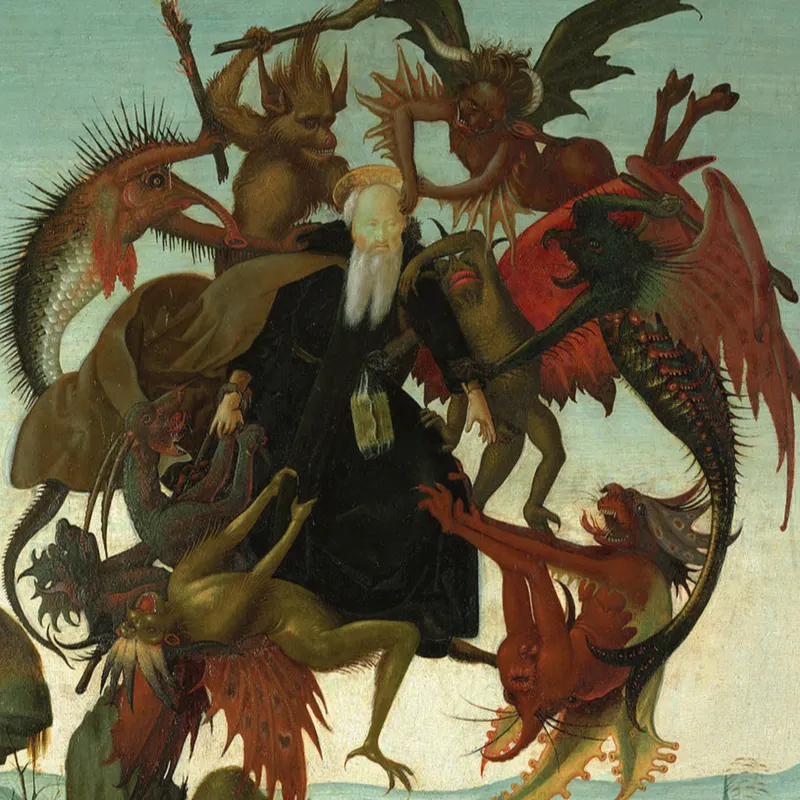
So at first the devil tried to tempt Anthony to return to an earthly life, but when this failed, he began to send demons to torment Anthony, something that he would face for the remainder of his life, really. But Anthony, he would not yield. He subjected himself to increasingly harrowing conditions to steel his resolve against the devil, spending many sleepless nights in prayer and going for days on end without eating. His devotion eventually brought him to a life of hermitude in a tomb, requesting that acquaintances only stop by occasionally to bring him a bit of bread. Satan only increased his torments, however, as Anthony withdrew into a spiritual life. He would send demons to beat Anthony until he was in too much pain to move.
Man.
Yeah, but Anthony took it all like a champ. When he spoke to the devil, Anthony said, quote, If you had any power in you, it would have been enough that just one of you should come, but the Lord has taken your strength away, and that is why you try to frighten me, if possible, by your numbers. It is a sign of your helplessness that you have taken the shapes of brutes. Again, he said cheerfully, if you can, and if you have received power over me, do not wait, but lay on. But if you cannot, why are you upsetting yourselves for nothing? For our trust in the Lord is like a seal to us and like a wall of safety.
Yeah, I just gotta add, hermitude, great word. We should use that more often.
Yeah, let's return.
Stop calling people NEETs.
Yeah.
So one day when Anthony was about 35, God finally intervened in this matter directly, the matter of the demons, you know, treating him like shit. He expelled them from the tomb and ridded Anthony of his pain. And then Anthony, seeing that this help had come from God, breathed more freely now that he was eased of his pains. He asked his vision, Where wert thou? Why didst thou not show thyself from the beginning to end my suffering? And a voice answered, I was here, Anthony, but I waited to see thy resistance. Therefore, since thou hast endured and not yielded, I will always be thy helper, and I will make thee renowned everywhere. And so, this miraculous vision from God inspired Anthony to go yet further in his lifestyle to remain pleasing God, the guy who just saved his life.
Into the desert
And so, just as Jesus had gone into the desert and been tempted by Satan in the famous Bible story, Saint Anthony also goes out into the desert, going into a dilapidated Roman fort on a place called Mount Colzem, where, guess what? Even more demons. He lived like this for 20 years until a crowd of people seeking to emulate his lifestyle tore down the door to the fort. They knew he was there because they would bring him food from time to time to make sure that he didn't starve over there. And when this finally happened, Anthony welcomed them and instructed them in the ascetic lifestyle, underlining that the glories of heaven will be greater than any possession on earth, which they would not be able to keep anyway, and that the devil is not to be feared, for God would protect them. Quote, the Lord has tethered the devil as a sparrow to be mocked by us.
He and his demons are like scorpions and snakes to be trodden underfoot by us Christians. Anthony lived the rest of his life without fear. And so when the persecutions of Emperor Maximinus began, he emerged from the monastery and headed to the city of Alexandria, where he ministered and presented himself to the Roman prefect in hopes of getting martyred. This is also a very common theme. Basically, this, you know, like suicidal martyrdom complex in these holy people. But according to Athanasius, God wasn't ready for him to get martyred yet. So he kept him alive so he could keep inspiring these persecuted Christians in Alexandria. By this point, Anthony was too much of a celebrity to really be living in isolation. He was being bothered by throngs of people who wanted to imbibe his wisdom. And seeing this as a distraction, he decided to take his asceticism still further by wandering once again into the desert until he came upon a tall hill with a spring and date palms in the vicinity.
The distance meant that far fewer people would actually be able to come visit him out here on this hill, even though he'd still received some visitors seeking help for sickness and demonic possession, despite that. He helped many people in this way, but his message remained that he was merely a conduit for God's power. And so any thanks for all these miracles that he was providing should be given to God, not to Anthony.
Hyenas and centaurs
And it was at this point that a few incidents happened, which would give Anthony the association of patron saint of animals, which is that some animals were rummaging through his garden. He admonished them and they never came back. And then Satan sent almost all the hyenas in the desert to plague him. Anthony looks at this big pack of hyenas coming up the hill and says, If you have received power over me, I am ready to be eaten by you. But if you are sent by devils, delay not, but go, for I am Christ's servant. And it worked. The hyenas freaked out. They turned tail. And Athanasius writes, His words chased them like a whip.
Right, and it's been kind of weird already, right?
Well, it's about the motivation in a manner.
Right.
There was also that one time when the devil sent a centaur to attack Anthony, but seeing Anthony's fearlessness, he turned, he ran away so quickly that he fell and died.
Like, hagiographies are all like this. It's like relatively normal stuff. Like, oh, this guy who lived in the wilderness and he did this and that. Oh, and then some didn't, and then one day a centaur came and tried to kill him.
Yeah. But yeah, this isn't even the only place where such a story appears featuring Saint Anthony. In the life of Saint Paul of Thebes, which I mentioned above, while journeying to meet the old man, Anthony actually encounters a benevolent satyr in the desert who points him to Paul and wishes him well.
I really gotta wonder whatever happened to those guys. You don't see many satyrs around these days.
No, it's tragic, yeah.
Anthony's death and relics
And then when Anthony was about 105, so again, a lot of longevity in these stories, he told the brethren that his death was near, and not wishing that his remains would be disturbed after his death, he went into the hills to die. He found a few trusted monks living in these hills, and he stayed with them for a few months until his passing, entrusting them to bury his body.
So it looks like his dying wish is fulfilled, right?
Not exactly. Only two decades after his death, his remains would be unearthed and translated. Translation being the word used for the transfer of relics to another location to Alexandria, from whence they would move to many places. As is often the case with relics, his remains are claimed to be housed in many different places. Saint Anthony's monastery in Mount Colzim claims that his bones were not unearthed at all, and that one of its churches is built atop the grave. But several churches all across Europe, claim to have the body of Saint Anthony as well. This is not entirely as absurd as it seems on its face, because bodily relics were often divided and sent to many different churches. But given the history of relic fraud, again, we're going to get into that in the main series. There's good reason to be skeptical of the legitimacy of at least some of these.
What hagiographies are for
Right, and that's the story of St. Anthony as brought to us by Athanasius. It's, you know, it really sets the standard for hagiography. And even though this is written in like the third century, a lot of these themes are going to be coming in these stories again and again and again, including a relatively regular life being punctuated by encounters with magical creatures, like, right? Like the Loch Dess Monster with Columba. So I would say, Sam, what do you think, like, what do these hagiographies do exactly? Because they're not just to entertain, right? They're like, they are really somber religious documents that were at one point a very important part of the intellectual worlds of medieval Christians.
Yeah, so I'd say that the main purpose of the hagiography was to memorialize the life of the saint, to inspire others to follow their example. In fact, Saint Augustine says he was inspired to become a Christian when he learned about Anthony after living a life full of sin as a young man. But also, it's to provide evidence of some of their miracles because this is really the key thing that saints do. But there was also the element of promoting the values which were allegedly espoused by the followers. In the Athanasius one, there's a strong emphasis on Anthony's battle against heresy, particularly the Arians who were very popular in Egypt at the time. But unfortunately, there have been cases where details have been meddled with to deal with contemporary exigencies. The most heinous example I could think of happened in the mid-16th century when the Franciscan Order, which was of course founded by Saint Francis of Assisi, destroyed pretty much almost all of the copies of a previous hagiography and had a new one written to skirt around the uncomfortable fact that the order had become very, very rich in the decades following the passing of their founder.
Yeah. It's got all these little kind of funny little uncomfortable questions arise in these cases.
Yeah, yeah, absolutely. In Athanasius' telling, there's a particular emphasis on Saint Anthony's healing miracles. Note once again that Anthony states several times that all things should be given to God alone, that he's just a conduit. And this kind of stuff was incredibly powerful for converting people to Christianity. And so hagiographies are full of stories of the saints overawing pagans by channeling miracles, thereby winning willing converts of the locals in the area. And I'd say that this was because these kinds of stories combine two very important elements. There's the general idea of magic and channeling the divine, which most pre-modern places had to one degree or another, as well as an emphasis of such power coming from God, which is kind of combining the familiar and the unfamiliar in a way that would make Christianity palatable to people who are unfamiliar with it.
And I just want to jump in here. I think it's something that the story of these saints' lives really, really makes clear: is that in the medieval worldview, particularly before the Counter-Reformation, a belief in the power of magic and miracles and witchcraft was completely compatible with the standard Catholic worldview. This was not seen as any kind of contradiction.
Right, yeah. So, syncretism was rife, and the church was very good at accommodating local particularities into this wider framework, right? Like, possibly Saint Brigid. But in Eastern Europe, for example, there's the old Slavic god Perun. He's the god of thunder. In some places in Eastern Europe, Perun was actually integrated into the prophet Elijah. So, sometimes you get like, I'm Elijah Perun.
That's crazy. That's awesome.
Yeah, it's really neat.
Yeah, yeah. You know, one last little note we should mention before we move on on Saint Anthony is that even though he spent his life in Egypt, he's really prominent in the Catholic Church, not just the Eastern churches, because his hagiography was very widely circulated in the Latin-speaking world. And that means he's actually probably held in a higher regard in the West, because that's where he's really, you know, a big deal, because that's where his books are read, you know.
And it's also interesting is that in general, it seems like saints are prominent in the Orthodox Church, but they generally seem to be a bigger deal in Catholicism, particularly the veneration of saints and their relics.
Yeah, specifically the relics part. But yeah, this shows that any particular cult might be very widespread and it might also be very unevenly distributed.
Saint Barlaam
Yeah, probably the single most widespread transit of any saint was that in medieval times, one of the saints who would be excised by the Counter-Reformation was Saint Barlaam. Does that name ring a bell, Sam?
Is that the Buddha from?
Yes. Barlaam is the Latinized name of the Buddha who was briefly revered as a Catholic saint. It's crazy.
Yeah, I know there's a hagiography of Saint Barlaam as well, if you want to. We might have to get into that one in a future episode.
Yeah, yeah, yeah. But yeah, but anything else you want to finish about Saint Anthony? Because I know there's a few other aspects of his worship before we move on to the next one.
Saint Anthony's fire
Just a few points. First of all, let's talk about St. Anthony's Fire. This is an old-timey name for what today is known as ergotism, which is an illness caused by a type of fungus which grows on grain.
Right. And there's probably one thing that you guys might know about ergotism, which is the fact that if you suffer from it, you have basically, it's psychoactive. You have psychedelic hallucinations. It's often compared to LSD, both chemically and in its experience.
Yeah, Hofmann, the guy who actually synthesized LSD first, derived it from ergot. He was doing all kinds of experiments with ergot and figured this thing out.
Yeah, but so why is it called St. Anthony's fire?
Well, I'd say because the kinds of hallucinations that it causes aren't nice ones. This is a really bad trip all around. One thing you guys might know about ergotism is that there's been a hypothesis that the Salem witch trials happened because of ergotism. So that gives you an idea of what kinds of hallucinations would be caused by this substance. So an afflicted person could behave in ways which the Christian mind would parse as demonic affliction or possession, which is of course similar to what Saint Anthony would have undergone throughout his life. But a name St. Anthony's Fire actually comes from the early 11th century because in southern France, after a nobleman's son recovered from ergotism after coming into contact with the purported relic of Saint Anthony, this nobleman funded the creation of a hospital specialized in the treatment of ergotism, which was really common in the Middle Ages.
The community around the hospital would receive sanction to become a hospital order a few centuries later, and they were very popular in their day. At their peak, they had over 350 hospitals all over Europe. But the order declined in popularity significantly once ergot was recognized as causing the sickness. And during the tumult of the French Revolution, it basically ceased to exist. Some of the hospitals that they built are still preserved. They're no longer owned by the order because there is no order, but you can still visit some of them in places like England and Central Europe.
Patron of swineherds
Yeah, we should also mention one last thing about St. Anthony is that possibly due to his association with animals, he is today known as the patron saint of swine herds.
Yeah, and if you have ever looked at an icon of this guy, he's often depicted with a little pig at his feet. It's not exactly clear why, but it might be a symbol of St. Anthony's good rapport with animals in general, or it might be that the pig is meant to depict the demonic and Saint Anthony stands triumphant over it as a symbol of his victory over Satan. But because of this association with pig, there's actually a really funny older English word that's not really in use anymore. The smallest pig in the litter is called a tantony, which is, of course, a contraction of Saint Anthony. Why, you might ask? Well, of course, it all goes back to medieval feudal weirdness. As part of the charter they received, the Order of St. Anthony had the special dispensation to raise pigs as a means of feeding the poor and raising revenue for their operations.
So in some places, it became customary to give the runt of the litter to the Antonine Order, who would fasten bells around their neck and let them roam freely. No one else was allowed to do this for the record because pigs can be very destructive, if you've ever seen the wild hog videos. But anyway, it was considered a good deed to feed one of these pigs and killing them was prohibited, of course. Well, that is until the little runt piggies got nice and fattened up, and the order would retrieve them and have them slaughtered. The fat from these pigs would have also been used to make the ointments which the order used to heal the sick. So lots of pig stuff going around.
Very nice.
Saint Isidore the Laborer
All right, well, on the topic of, you know, feudal agrarian labor, let's go to our next saint for this episode.
Right, and this guy is Saint Isidore the Laborer, who lived from around 1070 to 1130. He belongs to the category known as lay saints, who were ordinary people whose righteousness was nevertheless overwhelming. He is the patron saint of peasants and day laborers, and his cult is especially popular in Spain and some parts of Latin America. He was married to María Torribia, who has a folk cult around herself, but who has not yet been canonized. So, Saint Isidore, he was born in around 1070. He was named after the much more famous and much more wealthy Spanish saint named Isidore of Seville. When our Isidore was a teenager, he started to work as a day laborer for his local lord. And despite his meager wages, he gave as much money as he could to people with even less than him, keeping only enough to sustain himself. This, of course, is something that we saw in the life of Saint Anthony.
It comes from a verse that we find in Ephesians 4:28, where Paul wrote, Work with your hands so that you will be able to relieve the poverty of the hungry. And so, despite his low social standing, Isidore was so holy that he was performing miracles in his lifetime. And because remember, if you want to be a saint, you have to perform miracles when you're alive and then after you're dead. Probably the most interesting thing about Isidore is that he's one of the only saints that I've come across who's had a kerfuffle with God.
Yeah, this story actually felt kind of Jewish to me, actually.
Yeah, very Old Testament, absolutely. So Isidore was a very hard worker, and he would work even on Sundays so that he could feed the poor even more. One day, God admonished him for working on the Sabbath. When Isidore refused to stop working, God sent grasshoppers and flooded his field. Isidore would only stop working on Sundays when God threatened to send him bad neighbors. After Isidore agreed to observe the Sabbath, God sent an angel to plow his fields for him while he was away.
And in another story, one day Isidore's lord, you know, his boss essentially was told that Isidore spent too much time visiting churches and not enough time working. So he dispatched one of his knights to check up on Isidore. And then when this knight got there, he found Isidore in a field receiving the help of unknown men, who presumably are angels, but then they disappeared right before his eyes. At this point, the knight was astonished and he said, I beg you, dearest one, by God whom you serve so faithfully, not to hesitate to disclose to me who were your companions standing there and helping you as you farmed a short while ago. I saw certain ones assisting you and working while you worked, but suddenly, in the blink of an eye, they vanished from sight. Then the just man of God, well aware of what the knight meant, responded simply and in this matter: In the presence of God, whom I serve as fully as I am able, let me faithfully reveal to you that I have neither summoned nor seen any helpers in this field, other than God alone, whom I invoke and implore and whom I always have as a helper.
Then the knight, pierced in his heart and illuminated from on high by the things that he had seen, realized that divine grace adhered to the servant of God.
Yeah. And so you can see, Isidore's generosity was legendary. One Sunday, after he was giving food to the poor, he came upon a baker who asked him for something. So Isidore told his wife to check if there's anything left in the pot which they could give. Seeing they'd already fed the poor earlier that day, there wasn't much left. But then, when María opened the pot, it was miraculously full of food. And his charity, you know, it wasn't just limited to humans. One day he went to the mill with a sack of grain to grind it, and on the way there, he spotted a bunch of hungry pigeons. Feeling pity for the birds, Isidore poured out half of the contents of his sack to feed the birds to the entertainment of witnesses. But when Isidore reached the mill, he saw that his sack was once again totally full of grain.
Yeah, that's the point. God always provides. The point is to be as generous as possible and you'll always be okay.
Yeah, yeah.
And then so it's kind of a little bit like the binding of Isaac story. Kind of, it's like where like you do something, you do the sacrifice, but then you don't have to do it. Like you don't have to give away all our grain because then God will miraculously fill your grain again, you know.
One last one, a posthumous miracle, is that shortly after Isidore died, he appeared in a dream to his friend saying that God wished for his body to lay in a particular church. But this friend, or peasant, just like Isidore, didn't do this because he didn't want to cause a fuss. You know, he's just a peasant. How can he tell the priests what to do with the corpse? But then, because of that, he was struck sick until Isidore's remains were finally translated into this proper church. After another person had this vision of Isidore, his body was unearthed and found to be undecayed.
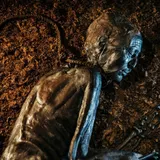
This is a really common aspect of saintly stories, which is still totally believed by the Catholic Church. It's called incorruptibility. The idea that the corpses of many saints do not rot. We briefly touched on this in our Bog Bodies episodes earlier this month.
And that they also smell of roses often.
Why Isidore matters
Yeah, so tell me, so we talked about why Anthony's important. Why is Saint Isidore important?
Well, as I mentioned previously, Isidore was a lay saint, but he wasn't any kind of lay saint. Like many lay saints are people like Thomas More, for example, who were pretty wealthy themselves. But Isidore, he was literally from the poorer strata of society, and he spent his entire life in that position. But despite his weak position in this life, Isidore is able to access God's grace for the betterment of his peers. And this demonstrates the ways in which the church was able to maintain its popular basis. Even if you're a nobody in this life, you could still become a model of emulation for your community and reap the rewards of heaven and the hereafter. And this also underlines the social function of the church as the helper of the poor. Even despite the corruption within the church, the function of helping the poor and encouraging others to do the same was pretty much always a very important component.
And quite a few people were helped by the church in such ways.
Saint Maximilian Kolbe
And finally, let's talk about the final saint for this episode. And this one is much more recent. This is a guy named Saint Maximilian Kolbe, who lived from 1894 to 1941. He's a martyr. He was a Polish Franciscan. And you've probably heard of this guy, even if you don't remember his name. He was the priest imprisoned in Auschwitz who offered himself to be killed in place of another man. The man in question was one Franciszek Gajowniczek, who passed away in 1995 at the age of 93. And I found this one very interesting because it gets us into a question of historical memory, which is very much part of our wheelhouse here at Gladio Free Europe. Because Kolbe lived so near to our time, we know much more about his life and the kind of person he actually was than about any of the aforementioned people. So let's have a look at him, words and all.
He was born in 1894 into a mixed German-Polish family, and he turned to the church while he was still a teenager after claiming that the Virgin Mary appeared to him in a vision. He said that, that night I asked the mother of God what was to become of me. Then she came to me holding two crowns, one white, the other red. She asked me if I was willing to accept either of these crowns. The white one said I should persevere in purity, and the red said I should become a martyr. I said I would accept them both.
So it's kind of like, you know, the Virgin Mary Morpheus.
Yes, exactly.
Mary Furious. Okay.
So yeah, then in 1907, when he was just barely a teenager, he became a Franciscan and moved to Lvov, Lemberg, I think at that time, to study at a seminary. And he said his final vows in 1914. His father was executed as a traitor during the war, because Central Poland was part of the Russian Empire. In 1919, he returned to Poland, which was now an independent country, and he got work publicly as a priest and a public intellectual, for lack of a better term. He founded the Catholic magazine Rycerz Niepokalanej in 1922, which is still being published. He was especially devoted to Mary. In fact, he took Maria as his middle name when he entered the priesthood. And he spent a lot of time promoting a Mariolatry in Poland, founding monasteries, things of that nature.
Kolbe and interwar Poland
But, you know, if you know anything about interwar Poland, there was something else that the church was promoting at this time, in addition to the message of God, and that was the message of anti-communism. You know, Poland was a pretty right-wing country, essentially. It was not democratic in the slightest. It was a battleground between different hardcore nationalist factions, and many of these tried to recruit the support of the clergy. But now we mentioned at the beginning that this guy died at Auschwitz. You know, obviously, Auschwitz is associated with the Holocaust, with the genocide of Jewish people by the Nazis. But it should be remembered that when it was founded, most of the people held in Auschwitz were not Jewish. They were dissident Poles, you know, mostly Catholics, people like Kolbe. And we should even mention that the person he saved wasn't Jewish either, which I think is somewhat important to the historical memory of Kolbe.
Yeah, well, here's where we get to the really unfortunate part. Kolbe was a pretty notorious anti-Semite. This was a period when the idea of the Żydokomuna, Judeo-Bolshevism, was in full swing in Poland. And Kolbe made his own contributions to the discourse in his magazine.
Yes, all of the far-right nationalists in Poland trying to rally the support of the clergy were incredibly anti-Semitic, and he went along with that easily. I think we talked in an earlier episode about how one big fight was basically whether or not the newly independent Poland could only be a place for Catholic ethnic Poles or if it could also tolerate any kind of ethnic and religious diversity. And Kolbe was on the side of no, it can't.
Yeah, so let's look at a Washington Post article published during the controversy surrounding his canonization.
The canonization controversy
Yeah, this is Mass is sent for the Saint of Auschwitz, December 5th, 1982. Saints do not seem like the stuff of the 20th century, being more often holy pictures in a children's book, suffused with a luminous glow. But they are real enough to Franciszek Gajowniczek. I'm sure I said that long. For in the unholy place called Auschwitz, a man whom the Catholic hierarchy declared a saint saved his life. He was a Polish soldier then, one of thousands in Auschwitz in 1941, and he was condemned to death. A man in his cell had escaped, and as retribution, the German command decided to kill 10 men by starvation. This selection was arbitrary. As he heard his name called, the 41-year-old soldier could not help but cry out for his wife and children. But seconds later, a Polish Franciscan monk stepped from the line, an action for which he might have been shot on the spot, and asked in perfect German for a favor.
I want to die in place of this prisoner, the man is believed to have said. I have no wife and no children. Besides, I'm old and not good for anything. The request was granted. The priest was taken away to be slowly starved to death, but he survived for days, leading the other condemned men in prayer. On the 15th day, the Nazis, needing the cell for other prisoners, killed him by injecting poison into his veins. Then, on October 10th, in 1982, the priest, Maximilian Kolbe, was canonized and proclaimed Saint Maximilian. Before his imprisonment, Maximilian Kolbe had founded a large Franciscan friary outside of Warsaw called Niepokalanów, Mary's City. Deeply committed to reaching people, he also founded a magazine called The Knight of the Immaculata, which at its peak reached more than 3,300,000 believers. The magazine, however, is the root of controversy that recently emerged regarding Kolbe. Accusations have come from some Jewish communities that the priest, like so many of his countrymen in the 30s, was an anti-Semite.
In the magazine's first issue in 1926, Kolbe described Freemasons as, quote, an organized clique of fanatical Jews who want to destroy the church. In 1934, he spoke out against the removal of Jews from economic life in Poland, an action, some felt, that made him, for his times, a political moderate. But five years later, arguing once more against the quote criminal mafia that calls itself Freemasonry as well as atheistic communism, Kolbe said that he did not mean to say that, quote, even among the Jews, one cannot find good people. Anti-Semitism, however, was not observed by Gajowniczek, who, accompanied by Reverend James McCurry, a Franciscan father, discussed Kolbe today in a Queen's Friary. When he was in Auschwitz in 1941, he did not know any Jews, Gajowniczek said, and never heard Kolbe speak of them. In the concentration camp where you might wake to find the man beside you murdered in the night, Kolbe stood out, Gajowniczek said.
When asked if he believes Kolbe would have made the sacrifice if he had not been Catholic but a Jew, Gajowniczek became irritated. How can I know this? He replied. McCurry addressed the question of whether Kolbe was anti-Semitic, a question that clearly concerns him. I am very distrustful of that, he said. I even went to Rome to see the archives and I've never seen any anti-Semitism with my own eyes. I would say, let the facts speak for themselves. In the late 1930s, Father Kolbe took a very strong pro-life stance against Nazi genocide in the magazine. He used the hospital at his community for Jewish families. Also, Mr. Gajowniczek is wrong about something. There were Jews at Auschwitz at the time Kolbe was there. One was a 14-year-old boy. He now lives in Wilmington, Delaware. He lost 58 members of his family, and Kolbe found him wandering around Auschwitz.
He said he owes his sanity to Kolbe. Quote, he has also said he has no doubt about whether it is a Gentile or a Jew. Kolbe would have saved his life.
A complicated saint
So, yeah, clearly a very complicated figure.
Yeah, like so many figures in the interwar period, you know, I would say.
For all his faults, Kolbe was, at the very least, anti-Nazi. He was first imprisoned in 1939 because he refused to sign documents which would acknowledge him as an ethnic German, something that would have given him protection. And as he had a German father, he could have easily applied for that. But after a while, they released him and he returned to the friary. But while he was there, he continued to run afoul of the Germans. Despite his own political anti-Semitism, Kolbe and the friars who remained with him cared for thousands of displaced persons, even though most of them were Jews. Eventually, the Germans got tired of his antics and he was finally imprisoned in Auschwitz in 1941.
Yeah, he was subjected to harassment and beatings by camp guards, as you might expect, but he continued to try to minister. At nights, he did rounds going around bunks, telling people that he was a priest and asking if there's anything that he could do for them. And famously at Auschwitz, like we mentioned earlier, he would take the place of Gajowniczek and in his place for this arbitrary execution for which he'd be martyred. And today, there is a shrine at Auschwitz dedicated to him in the cell he was held in. And interestingly and disturbingly and tragically, because of the incredibly efficient disposal of corpses at these Nazi camps, the only relic remaining of this priest is a lock of his hair, which has been preserved. So yeah, that's the story of a very recent martyr. And I think that's kind of interesting because, you know, when you claim that a modern person is saintly, especially a 20th century person, you basically are, you have to, that's a huge commitment to make, right?
You have to claim that despite whatever repugnant beliefs or attitudes they might have held, they still, you know, have this place among the saints. Personally, I think this reflects very poorly on the Catholic Church, that they would canonize somebody with just such a terrible history of anti-Semitism, even if they might have performed this one charitable act at their death. You know, I think it shows that the.
Well, I mean, he was also helping Jews. Like, we should be clear on that.
No, no, no, yeah, yeah, no, I know, but it's like, I feel like calling somebody a saint implies this, you know, this great holiness, which, you know, I don't want to get too like, you know, Reddit Fedora atheist right here, but I think it implies kind of a, basically, an infallibility essentially, that I don't think really exists in the modern world.
Saints and the medieval mind
I think that the idea of saintliness is kind of philosophically somewhat troubling, which is why I think it's going to be interesting in future episodes to kind of get into these philosophical critiques of sainthood that have been made, mostly as critiques of the cults of saints as superstitions. Because a lot of times, veneration of saints is really weird, and that's why it's so fun and interesting. It's an essential part of the traditional Catholic worldview, particularly in the Middle Ages, that I think is really necessary if we want to understand the lives and the minds of medieval and early modern people. I think that one place where some history books and a lot of fantasy books totally fall short is not recognizing the importance of saint cults and mystical experiences associated with them in the everyday lives of people in like the 13th century. I think that it's really essential to understand that aspect of the medieval experience if you want to understand the medieval world.
And that's why I'm really excited to go into this new series in the podcast, this saints series, because I think that it just really shows the ways that their lives were in some ways very recognizable to modern people. People in the Middle Ages had the same feelings, the same fears, the same concerns many times that we do, but they also incorporated into those lives mystical experiences that most of us today cannot comprehend due to secularism, the Reformation, so many other things.
A modern miracle
Although, with all of that being said, I just want to close this off by saying that although miracles and wonders might not be part of the everyday experiences of most Americans, for some hardcore Catholics, they still are.
Note 6: The possibility of an extremely rare miracle at a Thomaston church is getting the attention of Catholics near and far. Yeah, a lot of people talking about this one as Channel 3 eyewitness news reporter Mike Cerullo tells us now the Archdiocese of Hartford is looking into what happened. Father Crowley says earlier this month as a Eucharistic minister was handing out host, which is bread for communion, a miracle happened. The amount of hosts that minister had actually went up instead of down. When the minister suspected they were running out of hosts to pass out, Crowley says they glanced around to find more. But when that minister looked back down, more hosts had appeared. By the time communion was over, Crowley says there seemed to be either as many or possibly even more hosts in the ciborium than there were when he had first handed it to the minister.
What happened is our Lord multiplied himself. It's just so beautiful. God has been working so many miracles in our lives. It doesn't surprise me at all that God would come, like he did in the manger in Bethlehem so long ago, come to a small little tiny, humble town like this.
Yeah, and so according to the priest of that church, which is in Connecticut, Father Crowley said that earlier this month, a Eucharistic minister was handing out hosts, you know, the communion bread, and there, a miracle happened. The number of hosts that the minister had actually went up instead of down. When the minister suspected they were running out of hosts to pass out, Crowley said they glanced around to find more, but when they looked back down, there were even more hosts in his hand. And then by the time communion was over, had said, Crowley said it seems like there were actually more hosts than they started with. So there you have it. It's possibly a miracle. And you now, because of this, there's going to be a papal investigation where they're going to have to figure out whether or not a miracle actually happened. I would love to participate in the papal investigation.
Please, Pope Francis, if you're listening to this.
Wrapping up
All right. Well, thank you, Sam, for identifying this pretty cool topic for the podcast. Any of your listeners, if you have any particular saint stories you find interesting that you'd like us to share or any other topics about saintly worship, let us know. This is just a huge aspect of history that we can get into. The use of saints in history, the worship and veneration of saints. There's so much variety across the Catholic tradition. And I really like the weirder stuff, the stuff that's not entirely orthodox. Like, for instance, we talked about the medieval pagan holdovers. A much bigger issue right now are the fact that in many parts of the world, pre-Christian, more recent pre-Christian deities have sort of been lashed on to beliefs in saints. For instance, Santeria in Cuba is a very famous Afro-Syncretic religion in which saints are totally seamlessly integrated with West African Yoruba deities.
That's really damn cool. And I think that that kind of shows that these medieval mystical aspects of the saints still are part of the modern world. And I think we should have to go into that.
Yeah, but before we finish this episode for this week, just some late housekeeping news. Liam is actually flying on vacation tonight. And so he's going to be gone for a few weeks. And then right as he's coming back, I'm going to be going away myself. So you're going to hear a few episodes with just me and some guests without Liam. But rest assured, the ship is in steady hands, and you guys will be enjoying all the content.
Yeah, it's pretty break, I'm going to say. All right.
Well, yeah, we'll see you again. Thank you guys for listening. We'll see you all very soon.
The show is also on Apple Podcasts, Overcast, Pocket Casts, Podcast Addict, YouTube, RSS and Patreon.